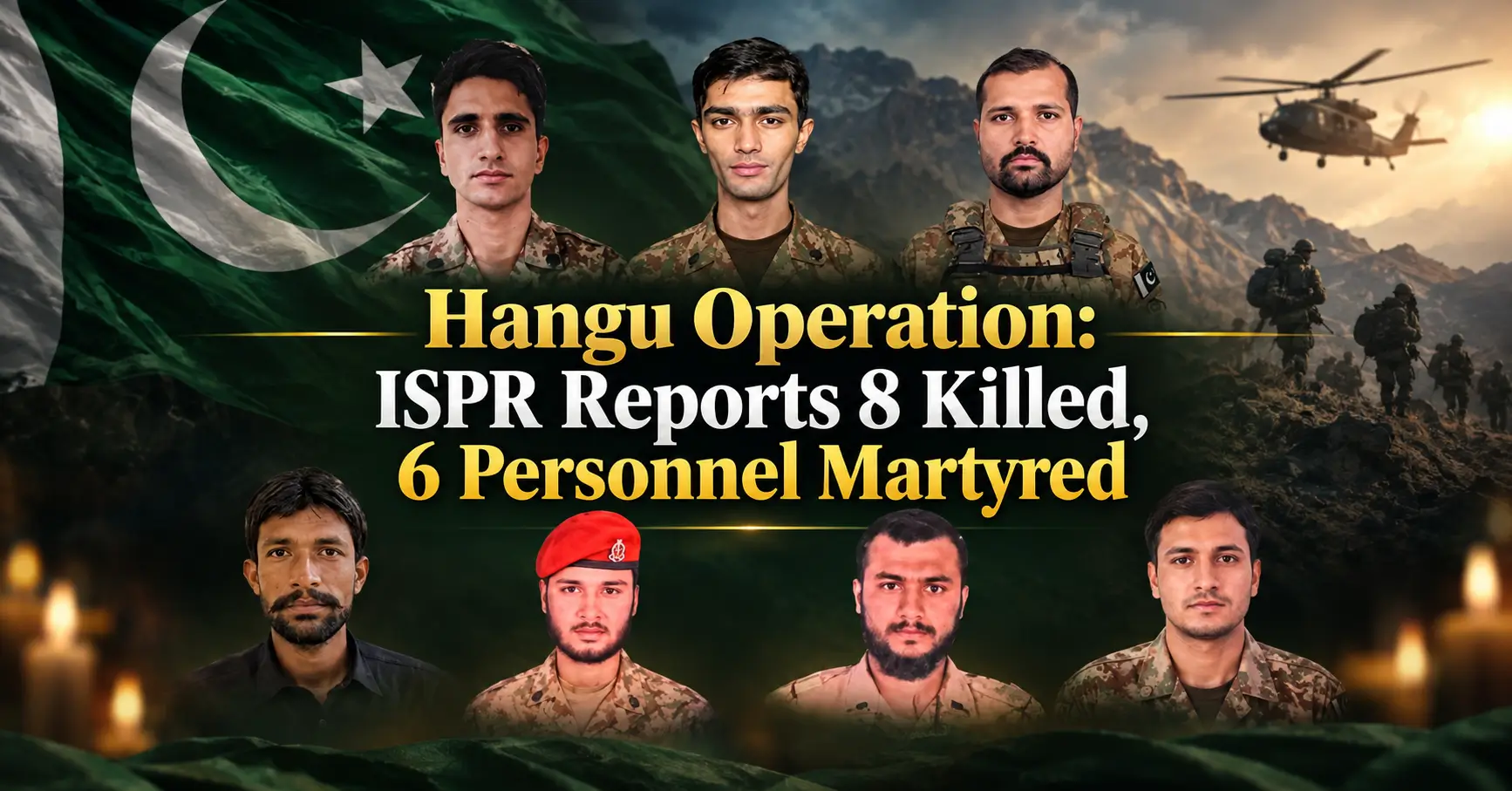

The Hangu operation ended in heavy loss on Sunday, 20 September 2026. Eight militants and six security personnel died when a security forces convoy and militants exchanged fire in Hangu district, Khyber Pakhtunkhwa, the ISPR said.
ISPR issued its statement on Sunday night. Independent confirmation of the militant toll has not appeared, so every figure for this clash traces to the military’s media wing, the sole source available at publication.
Who Died in the Hangu Operation
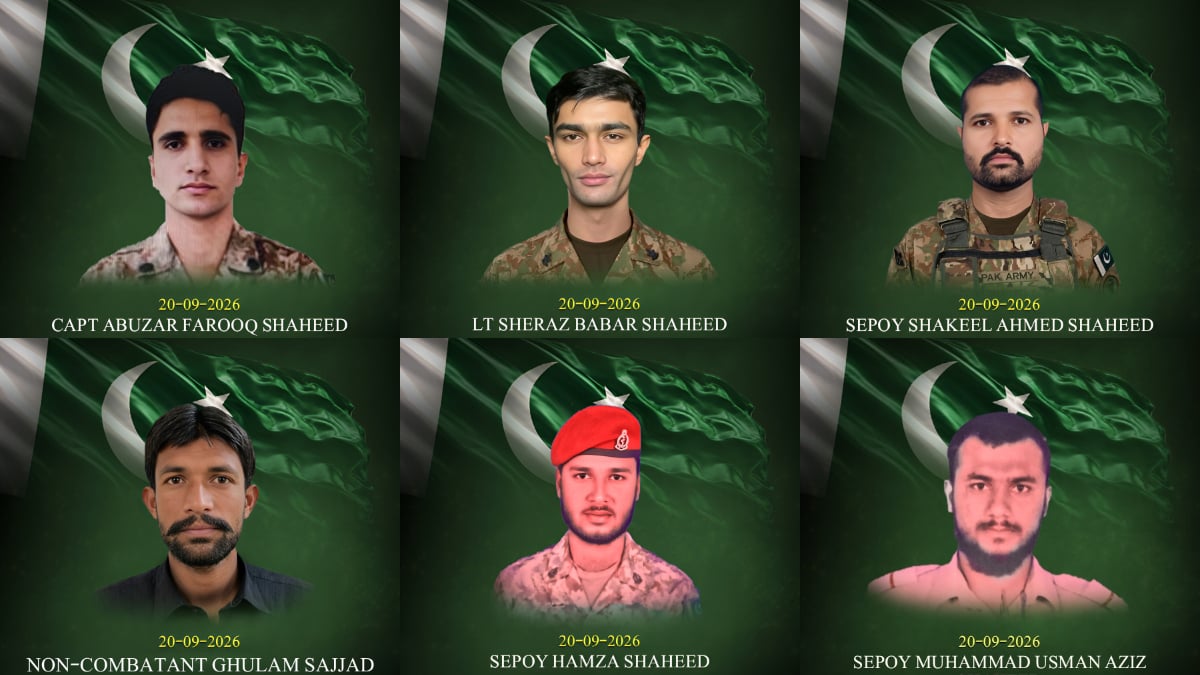
Captain Abuzar Farooq, 23, from Gujranwala, and Lieutenant Sheraz Babar, 22, from Chakwal were “leading their troops from the front,” ISPR said. Four other personnel also died beside them in the same exchange.
Images credited to ISPR name the other four as Sepoy Shakeel Ahmed, non-combatant Ghulam Sajjad, Sepoy Hamza and Sepoy Muhammad Usman Aziz. Six is therefore a tally of personnel rather than soldiers alone.
Key Facts From the ISPR Statement
The military’s media wing supplied every core detail of the Hangu operation. They are limited, and each item below comes from that single statement rather than from police, hospital or civilian witnesses speaking on record.
- Date and place: 20 September 2026, Hangu district, Khyber Pakhtunkhwa
- Militants killed: eight, called Fitna al-Khawarij by ISPR
- Personnel martyred: six, including Captain Abuzar Farooq (23) and Lieutenant Sheraz Babar (22)
- Status: a sanitisation operation is under way for any remaining militants
The statement gives no exact location, hour or recovered weapons, unlike earlier releases that listed seized arms. Readers should treat the eight-militant figure as an official claim, not an audited count.
Why Hangu Keeps Appearing in Security Briefings

Militant violence in Khyber Pakhtunkhwa and Balochistan has climbed since 2021, when the Afghan Taliban took power in Kabul, according to reporting on the security trend, with Hangu now a recurring site of ISPR-reported clashes.
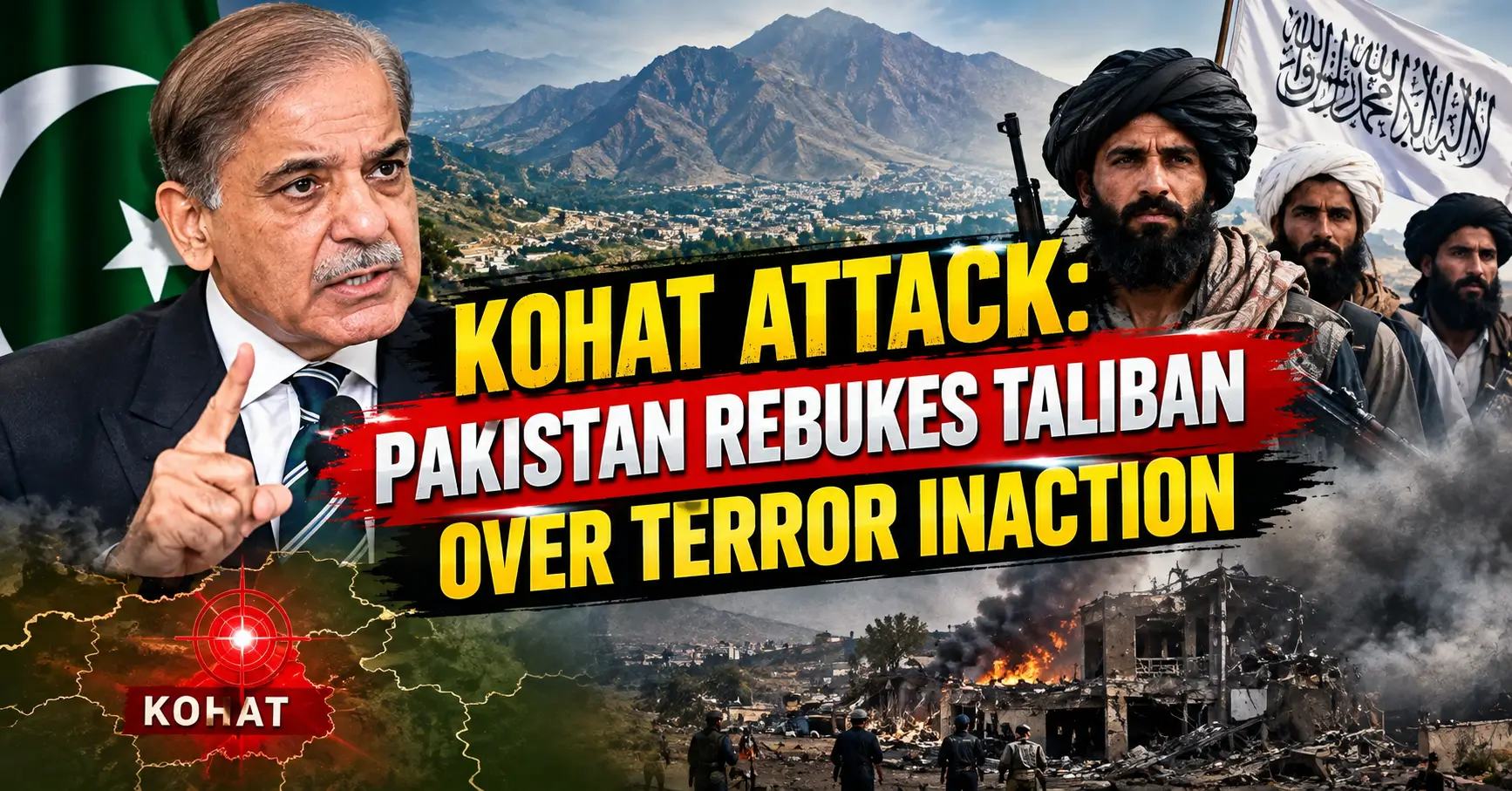
READ MORE: Kohat Attack: Pakistan Rebukes Taliban Over Terror Inaction
Hangu district also saw an intelligence-based operation on 7 August. Seven militants died there, and Captain Hamza Akram, 27, of Narowal was martyred while leading his troops, the military’s media wing said.
Timeline of Recent Hangu Engagements
Between 15 and 17 September, ISPR reported ten militants killed across Khyber Pakhtunkhwa, four of them in a separate Hangu encounter. Sunday’s Hangu operation adds eight more, making it the deadliest of the three engagements listed.
| Date | Militants killed | Personnel martyred | Note |
|---|---|---|---|
| 7 Aug 2026 | 7 | 1 (Captain Hamza Akram) | Intelligence-based operation |
| 15–17 Sep 2026 | 4 (Hangu) | Not specified | Part of 10 killed across the province |
| 20 Sep 2026 | 8 | 6 | Convoy exchange of fire |
Do not confuse two tallies of six. On 17 September, six soldiers died when an improvised explosive device struck a convoy, ISPR said; the Hangu deaths on 20 September are a separate loss of six personnel.
What Fitna al-Khawarij Means in ISPR Language
ISPR calls the militants Fitna al-Khawarij, a label the state applies to the banned Tehreek-e-Taliban Pakistan, or TTP. The statement also describes them as India-sponsored, a claim it does not support with evidence in the released text.
ISPR ties the Hangu operation to Azm-e-Istehkam, a counter-terrorism campaign approved by the Federal Apex Committee on the National Action Plan. It says the campaign will continue “at full pace,” according to its statement.
Expert Angle: What Security Data Shows

The Center for Research and Security Studies (CRSS) recorded 774 violence-linked deaths and 336 injuries across 267 incidents in Pakistan in the second quarter of 2026. Khyber Pakhtunkhwa accounted for 475 deaths, about 61 percent.
CRSS said national deaths fell from 813 to 774, yet Khyber Pakhtunkhwa fatalities jumped 53 percent, from 311 to 475. Hangu was not among the four districts CRSS named as holding 63 percent of the province’s incidents.
Officers Leading From the Front: A Pattern in ISPR Reports
ISPR used near-identical wording for both Hangu losses. Captain Hamza Akram, 27, died on 7 August leading his troops, and Captain Abuzar Farooq, 23, and Lieutenant Sheraz Babar, 22, died on 20 September doing likewise.
Three officers aged 22 to 27 fell within six weeks. Three cases prove no trend, yet they suggest junior commanders in Hangu carry the risk personally, a cost that headline militant counts never capture.
What Remains Unverified in the Hangu Operation
As of Sunday night, no police, hospital or local confirmation of the militant toll, location or identities had surfaced. ISPR’s India-sponsored description is likewise an official assertion, not an independently tested finding.
Small discrepancies also exist. One report renders the captain’s name as Abu Zar, another says the convoy “came under attack,” while ISPR’s text describes only a fire exchange. A sanitisation sweep is ongoing, so tolls may change.
Implications of the Hangu Operation for Local Security
At least three ISPR-reported Hangu engagements in six weeks point to sustained militant activity beyond the districts CRSS flagged. Convoys look exposed, and Sunday’s toll suggests militants can still inflict heavy losses on moving troops.
For policymakers, the pattern tests whether operations under Azm-e-Istehkam are keeping pace with the threat. CRSS’s second-quarter data showed Khyber Pakhtunkhwa worsening while national totals dipped; September’s clashes show the fighting continuing.
What to Watch Next After the Hangu Operation
Watch for an ISPR update on the sanitisation sweep that followed the Hangu operation, including further militant deaths, recovered weapons or a named location. Police or provincial government confirmation would also help test the figures.
Funeral details and official reactions may follow. Until then the verified picture stays narrow eight militants, six personnel, one district.