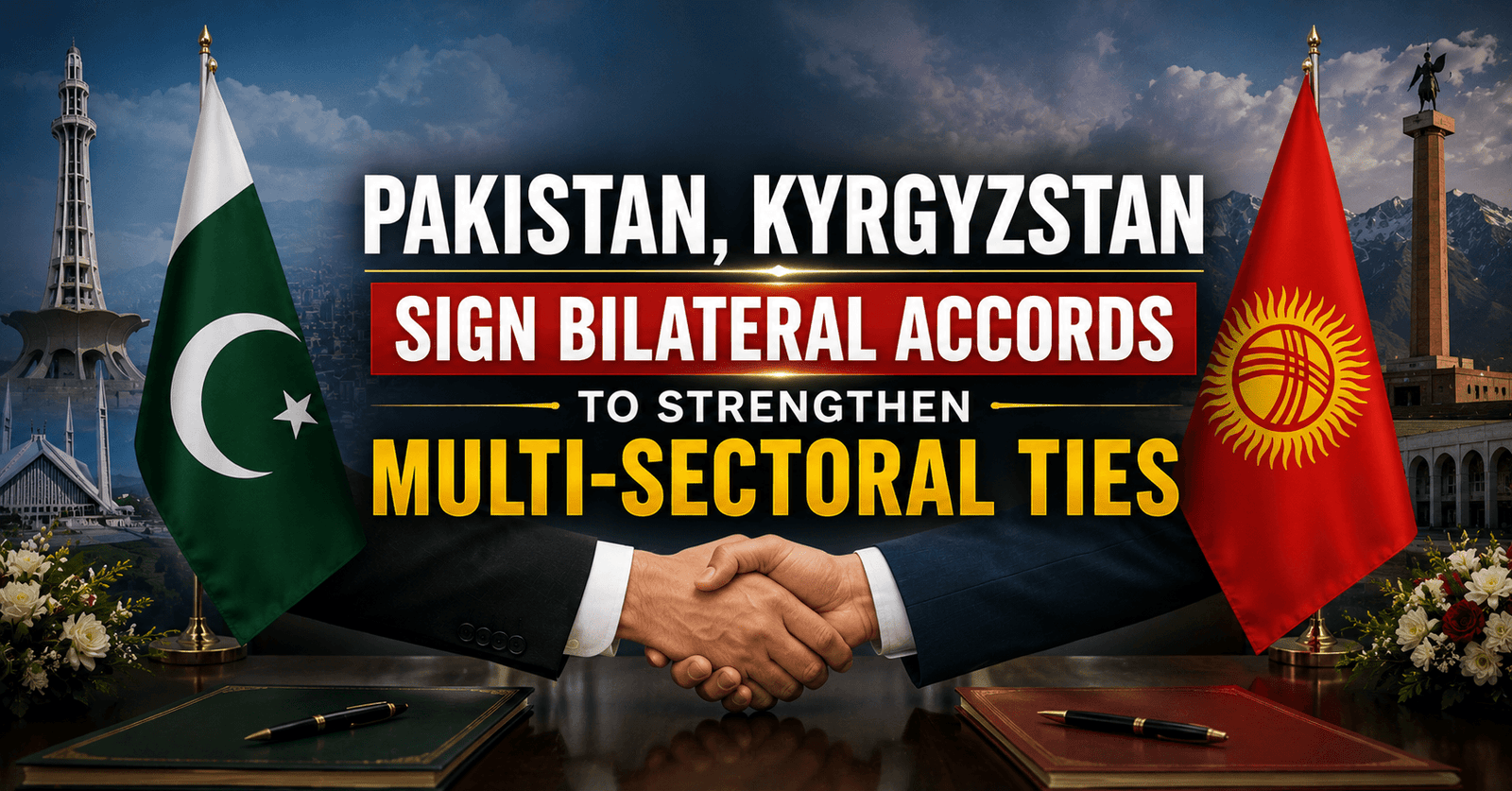

Sixteen agreements. One airport signing ceremony. And a trade target that would need to grow twelvefold in two years.
Pakistan Kyrgyzstan bilateral accords dominated diplomatic headlines this week, as Prime Minister Shehbaz Sharif and Kyrgyz President Sadyr Japarov oversaw a sweeping signing ceremony in Bishkek on September 2, 2026. The documents span trade, security, education, health, postal services and technology — but the real story is what happens after the ink dries.
Key Agreements at a Glance
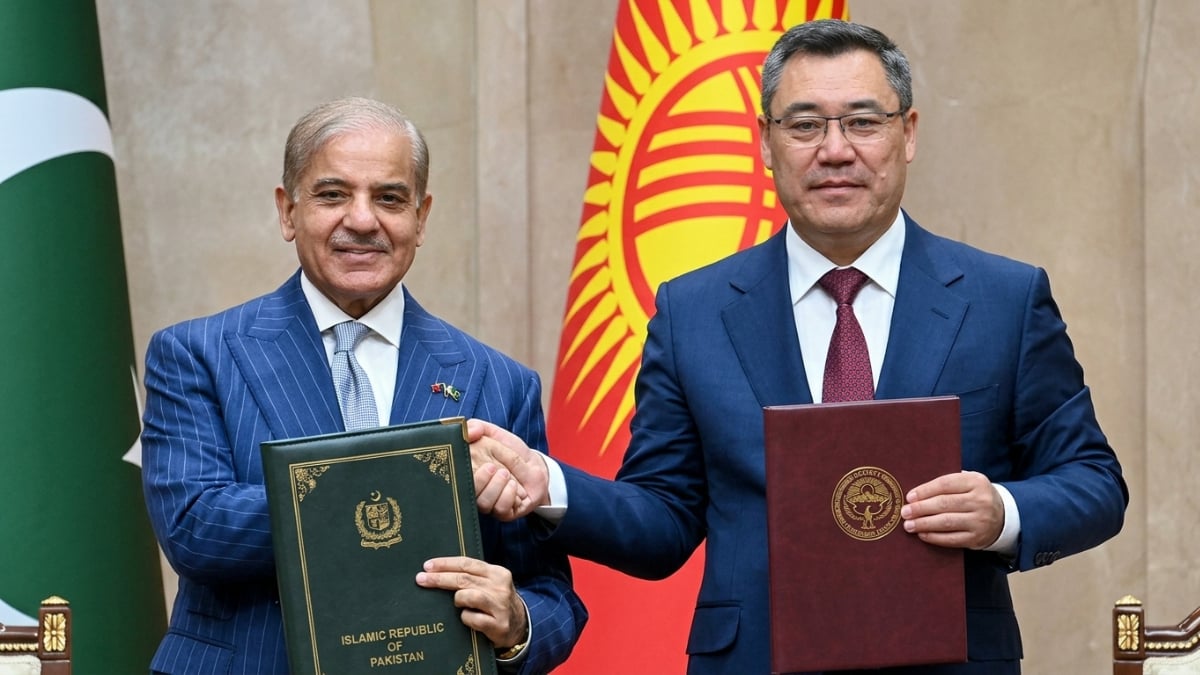
The signing ceremony took place at the Kyrgyz presidential palace, witnessed by both heads of government following a joint press conference. Deputy Prime Minister and Foreign Minister Ishaq Dar signed the centerpiece trade document alongside his Kyrgyz counterpart.
Here’s what was actually signed:
| Sector | Agreement |
|---|---|
| Trade | Formal trade agreement targeting $200M annual volume |
| Diplomacy | Foreign Ministry Programme of Cooperation, 2026–2027 |
| Research | ISSI–NISI strategic studies MoU |
| Legal | Extradition treaty + draft mutual legal assistance pact |
| Security | Interior ministry MoU on narcotics trafficking |
| Health | Medical education MoU (Kyrgyz health ministry–PMDC) |
| Postal | Kyrgyz Post–Pakistan Post e-commerce cooperation |
| Business | Chamber of Commerce cooperation pact |
| Cities | Lahore–Osh sister-city agreement |
- Total documents signed: 16, according to official Pakistani coverage of the visit
- Trade agreement was upgraded from a planned MoU to a binding document at Shehbaz’s request
- Sister-city pact links Lahore with Osh, Kyrgyzstan’s second-largest city
Trade Target — From $16 Million to $200 Million
This is where the story gets interesting. Current bilateral trade sits at roughly $16 million annually — a figure PM Shehbaz himself called “not a patch” on the two countries’ claimed friendship.
The new agreement sets a target of $200 million within two years. That’s a twelvefold increase, and Shehbaz pushed personally for a binding agreement rather than a softer memorandum of understanding.
- Current trade volume: ~$16 million/year
- Two-year target: $200 million/year
- Mechanism: transit trade agreement to ease customs, logistics and freight movement between South and Central Asia
Speaking at the joint press conference, Shehbaz Sharif said the two sides needed to move from goodwill to “concrete steps” — a phrase that signals Islamabad is aware past bilateral pledges with Central Asian states haven’t always translated into real trade flows.
Diplomatic Background — SCO Chairmanship Context

None of this happened in isolation. Shehbaz arrived in Bishkek on August 31 for a three-day visit built around the 26th SCO Council of Heads of State summit — the organisation’s 25th anniversary gathering.
READ MORE! PM Shehbaz meets Xi, Putin, Erdogan on SCO sidelines
Kyrgyzstan hosted the summit under its 2025–26 rotating chairmanship. At its close, that chairmanship passed formally to Pakistan for 2026–27, meaning Islamabad will host the 2027 SCO summit in the capital.
- Ten SCO member states attended, including China’s Xi Jinping, Russia’s Vladimir Putin and India’s Narendra Modi
- Pakistan’s delegation included Ishaq Dar, Commerce Minister Jam Kamal Khan, Communications Minister Abdul Aleem Khan and Information Minister Attaullah Tarar
- The bilateral accords were signed on the sidelines of this larger multilateral event, not as a separate state visit
That timing matters. Bilateral deals struck during multilateral summits often carry more symbolic weight than follow-through — a pattern worth watching as Pakistan assumes greater regional responsibility.
Security, Legal and Extradition Cooperation
Beyond trade, security cooperation formed a significant chunk of the package. An extradition treaty was formally signed, while a draft mutual legal assistance agreement in criminal matters was also finalized between the two governments.
A separate interior-ministry MoU targets illicit trafficking of narcotics, psychotropic substances and precursor chemicals — an area where both countries share regional exposure through Central Asian trafficking routes.
- Extradition treaty: signed and finalized
- Mutual legal assistance: draft agreement, not yet fully ratified
- Counter-narcotics MoU: interior ministries of both countries
Energy, Connectivity and CASA-1000

Energy cooperation received less headline attention but carries long-term weight. Both leaders reaffirmed commitment to the CASA-1000 project — the Central Asia-South Asia electricity transmission initiative — alongside a new joint working group covering hydropower, renewable energy and infrastructure.
This links Pakistan Kyrgyzstan bilateral accords to a much larger regional energy corridor connecting Kyrgyzstan and Tajikistan’s hydropower surplus to Afghanistan and Pakistan’s energy-hungry grid.
Analytical Angle — Can the Trade Target Be Met?
Here’s the honest question competitors have largely avoided: is a twelvefold trade increase in two years realistic?
Pakistan has signed similarly ambitious trade targets with other Central Asian states before, with mixed follow-through. Logistics remain a genuine constraint — Pakistan and Kyrgyzstan share no direct land or sea corridor, meaning goods typically transit through third countries.
The new transit trade agreement is designed to address exactly this bottleneck by simplifying customs and transport procedures. Whether that translates into actual container movement — rather than paperwork — will be the real test over the next 24 months.
What This Means for Pakistan-Central Asia Ties
Taken together, these accords fit a broader pattern: Pakistan using its incoming SCO chairmanship to deepen bilateral ties across Central Asia, not just with Kyrgyzstan. The Lahore-Osh sister-city link, medical education cooperation and postal-sector deal all point toward longer-term institutional relationships rather than one-off trade numbers.
For Factfile readers tracking regional diplomacy, the real indicator of success won’t be the signing ceremony — it’ll be customs data eighteen months from now.
Do you think Pakistan can realistically hit its $200 million trade target with Kyrgyzstan within two years, or is this another ambitious pledge that will quietly fade?