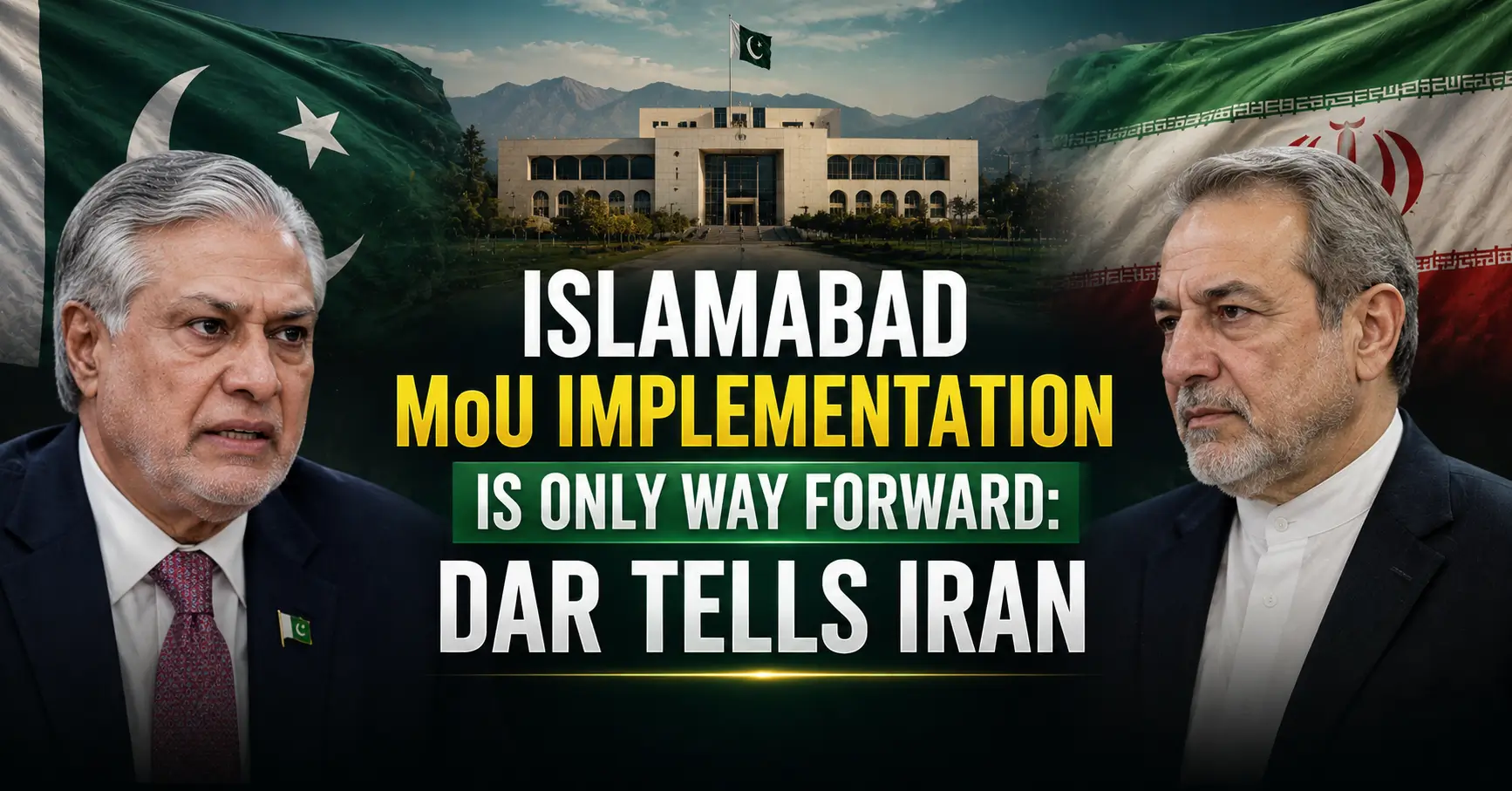

Islamabad MoU implementation remains the only viable route to ending the US-Iran standoff, Deputy Prime Minister and Foreign Minister Ishaq Dar told his Iranian counterpart on Tuesday, as renewed hostilities threaten to unravel a fragile diplomatic framework built with Pakistan’s help.
What Dar Told Araghchi in Bishkek

Dar’s message to Iran was direct: sincere Islamabad MoU implementation by both parties is the only way out of a conflict that has dragged on since February. He delivered the point on the sidelines of the SCO summit.
READ MORE: Aleem Khan announces intensified campaign for new provinces
The meeting with Iranian Foreign Minister Abbas Araghchi took place in Bishkek, Kyrgyzstan, where Dar arrived a day earlier to join Prime Minister Shehbaz Sharif. The Foreign Office described the exchange as “warm,” with both sides reaffirming continued engagement.
- Meeting held on sidelines of SCO Council of Heads of State summit
- Location: Bishkek, Kyrgyzstan, September 1
- Dar also held separate talks with China’s Foreign Minister Wang Yi
- FO statement: dialogue and diplomacy “remain essential” to regional stability
Inside the Islamabad MoU: What It Actually Commits Both Sides To

Understanding Islamabad MoU implementation requires knowing what the document actually says. Signed on June 18 after 21 hours of Pakistan-mediated talks, it’s a 14-point interim framework aimed at ending the wider Middle East conflict.
The agreement was negotiated by a 300-member US team led by Vice President JD Vance, alongside envoys Steve Witkoff and Jared Kushner, and a 70-member Iranian delegation headed by parliamentary speaker Mohammad Bagher Ghalibaf and Araghchi himself.
| MoU Provision | Status as of September 2026 |
|---|---|
| Reopening Strait of Hormuz | Contested; Iran imposed tolls and controls |
| Halt to military operations | Repeatedly violated by both sides |
| Nuclear program constraints | Unresolved, still on negotiating table |
| Sanctions relief | Conditional, largely stalled |
| Frozen asset release | Partial, tied to broader compliance |
Pakistan’s mediating team — Prime Minister Shehbaz Sharif, Field Marshal Asim Munir, and Dar himself — brokered the framework after direct US-Iran engagement, the first of its kind since the 1979 revolution.
Why Implementation Has Stalled Since June
The push for Islamabad MoU implementation comes only weeks after the agreement effectively broke down. Iran struck multiple commercial vessels in the Strait of Hormuz on July 6–7, prompting a sharp US military response.
President Trump declared the truce “over” following those strikes, though negotiators were told talks could continue. Iran’s Deputy Foreign Minister Kazem Gharibabadi announced on July 18 that Tehran was suspending its MoU-related commitments, citing what it called bad faith by Washington.
Timeline of the Collapse
- February 28, 2026: US and Israeli strikes on Iran kill Supreme Leader Ali Khamenei, igniting the war
- April 8, 2026: Pakistan brokers a two-week ceasefire
- June 18, 2026: Islamabad MoU signed, a 14-point interim framework
- July 6–7, 2026: Iran strikes commercial ships in the Strait of Hormuz
- July 18, 2026: Iran suspends MoU commitments
- September 1, 2026: Dar renews call for implementation at SCO summit
Pakistan’s Mediator Role Explained

Islamabad has staked real diplomatic capital on this file. Pakistan emerged as the principal go-between after Washington and Tehran failed to reach terms directly, relaying messages and hosting negotiators even as fighting resumed intermittently.
Dar’s meeting with US Chargé d’Affaires Natalie Baker in August underscored the same message he gave Araghchi: implementation “in letter and spirit” is the only durable path. Islamabad has repeatedly positioned itself as the channel keeping both sides talking.
- Pakistan hosted April 11–12 Islamabad Talks between Vance and Ghalibaf
- Brokered the original April 8 ceasefire before June’s MoU
- Continues to relay messages between Washington and Tehran
- Maintains parallel bilateral channels with both US and Iranian officials
What Comes Next for the Region
Whether Islamabad MoU implementation actually happens now depends on whether Washington and Tehran can move past the Strait of Hormuz dispute, still the single biggest sticking point. Gulf states and shipping interests remain exposed to further disruption.
Iran has signalled it would return to the framework if the US honours its side of the bargain, according to regional reporting. For now, Pakistan’s diplomatic messaging continues, even as military exchanges periodically undercut the very deal it helped negotiate.