
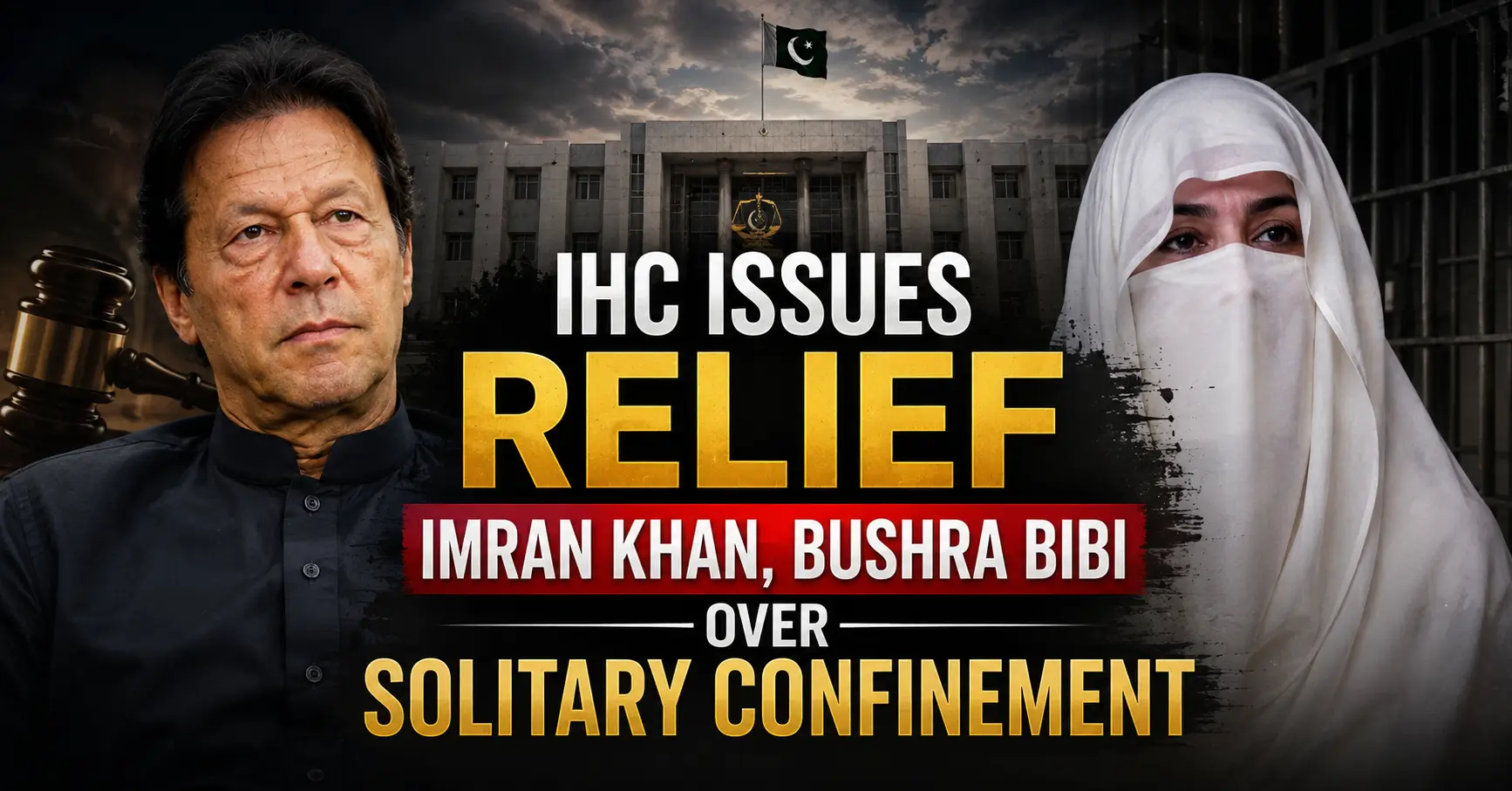

Imran Khan Bushra Bibi solitary confinement has ended by court order. The Islamabad High Court ruled on Tuesday that Adiala Jail authorities cannot keep the PTI founder and his wife in isolation any longer.
What the IHC Ruled on Imran Khan and Bushra Bibi’s Confinement

The order came from Justice Khadim Hussain Soomro, who declared petitions challenging the alleged solitary confinement of Imran Khan and Bushra Bibi maintainable and directed jail authorities to ensure neither prisoner was held in isolation.
The ruling closes weeks of legal wrangling. Jail authorities were also ordered to submit an implementation report to the court within 15 days confirming compliance.
Key Directives Issued by Justice Khadim Hussain Soomro
Beyond ending isolation, the bench issued a detailed set of instructions. The Adiala Jail superintendent was directed to ensure both prisoners are not confined separately and to facilitate meetings between Imran Khan and Bushra Bibi.
- Imran must be allowed family meetings under jail rules
- Phone contact with his sons must be arranged
- Daily newspapers and books must be provided
- Medical facilities must follow jail regulations
- Phone recordings withdrawn if used politically
Who Filed the Petitions Against Adiala Jail Authorities
Imran Khan’s sister Aleema Khan approached the court over his alleged solitary confinement, while Mubashara Khawar Maneka filed a separate petition concerning Bushra Bibi. Both petitions were heard jointly by the bench.
READ MORE: Imran Khan’s Sister Moves SC for Urgent Contempt Hearing
Islamabad’s Advocate General had pushed back earlier in proceedings. During hearings, Advocate General Naveed Malik denied that either Imran or Bushra Bibi was being held in solitary confinement at all.
Legal Precedents Behind the Solitary Confinement Verdict

Justice Soomro grounded maintainability in established case law rather than fresh doctrine. The court held the petitions maintainable in light of principles laid down in the Begum Nusrat Bhutto and Begum Shamim Afridi cases.
Earlier in the hearings, the judge had flagged a gap in the record. He noted that accountability court judgments in the £190 million and Toshakhana-I cases carried no punishment of solitary confinement for the accused.
Imran Khan’s Prison Timeline Since August 2023
| Event | Date |
|---|---|
| Imran Khan imprisoned | August 2023 |
| Removed as PM via no-confidence vote | April 2022 |
| SC orders medical transfer to Shifa Hospital | August 18, 2026 |
| IHC reserves verdict on confinement pleas | August 6, 2026 |
| IHC bars solitary confinement | September 1, 2026 |
The IHC’s latest order comes weeks after the Supreme Court, in an August 18 order, directed authorities to transfer Imran Khan from Adiala jail to Shifa International Hospital for a medical examination, underlining ongoing concern over his conditions.
Family Access and Communication Rights Restored

The court’s language went beyond simply banning isolation. It ordered that Imran’s family members be allowed to meet him as permitted under jail rules, and directed authorities to arrange telephone conversations between him and his sons.
That access carries a condition attached to it. The telephone facility can be withdrawn if recordings of Imran’s conversations with his sons are used for political purposes, the court specified in its order.
Compliance Deadline for Adiala Jail Superintendent
Enforcement now rests with jail administration rather than the court alone. The court directed the superintendent of Adiala Jail to submit an implementation report confirming compliance within 15 days of the ruling.
This timeline gives both sides a concrete checkpoint. Petitioners’ lawyers can return to court if the superintendent’s report shows the directives were not followed in practice.
What This Ruling Means for PTI’s Legal Battles
PTI has framed the case within a broader grievance. Imran Khan has remained imprisoned since August 2023 after convictions his party has repeatedly described as politically motivated, following his removal as prime minister.
The order doesn’t resolve those underlying cases. It does, however, set a documented legal standard on prison conditions that PTI’s counsel could invoke in future related proceedings.