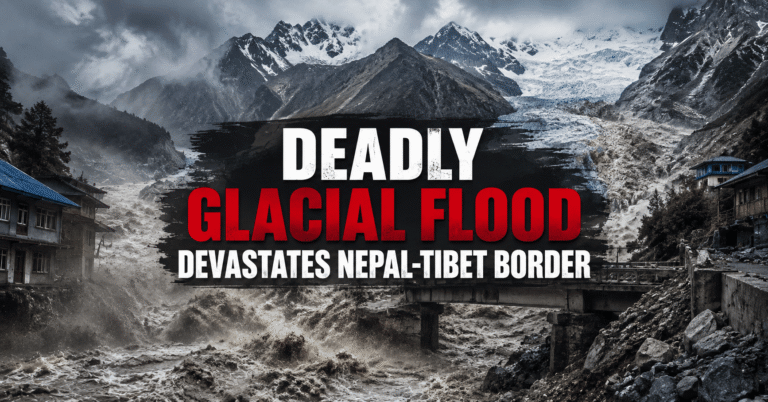

A wave of destruction swept through the Nepal-Tibet border region on Wednesday morning. A massive glacial flood tore down the Bhote Koshi and Trishuli river valleys. Entire villages were buried under thick layers of mud and debris within minutes.
The disaster struck Nepal’s Rasuwa district hardest which is close to the border with Tibet. Floodwaters then surged downstream into the Nuwakot and Dhading districts.
Water levels in the Trishuli River reportedly rose by nine meters in just thirty minutes. Officials described the speed and force of the flood as almost unimaginable. Many residents had little to no warning before the water reached them. Homes, bridges, roads, and hydropower stations were destroyed by this strong forceful water.
What Triggered this Disaster

Experts believe an ice and rock landslide struck the Lhende River on the Tibetan side. The falling debris slided roughly 1,200 meters before smashing into the valley floor. This impact most likely blocked the river and formed a temporary glacial lake.
That lake is believed to have burst suddenly, releasing a massive amount and pressure of water. Nepal’s National Disaster Risk Reduction and Management Authority described it as a “glacier-inclusive flood.”
A magnitude 4.4 earthquake was also recorded near the border around the same time. Some officials initially suspected the tremor triggered the avalanche and subsequent flood. Nepal’s foreign minister Shisir Khanal said early assessments pointed toward this earthquake link.
Scientists note that such glacial lake outburst floods are becoming more frequent across the Himalayas regions. Rising temperatures continue to melt the snow and ice formations at high altitude.
Rising Death Toll and Widespread Destruction

The human cost of this disaster has grown sharply since Wednesday morning. Nepal’s death toll has climbed more than 350 people, according to the latest reports. Chinese authorities confirmed at least three additional deaths in Tibet region.
More than 1,300 people remain missing across both Nepal and Tibet combined. Officials say around 700 of the missing are believed to be foreign nationals. Many were tourists travelling through the region during the ongoing trekking season. Rescue teams continue searching through mud and collapsed infrastructure.
The flood also damaged hydropower projects supplying nearly 430 megawatts of electricity nationwide. That figure represents roughly one-eighth of Nepal’s total installed power capacity. Key roads, bridges, and the border crossing at Gyirong were left in ruins.
Rescue Operations Push Forward
Nepal’s Army helicopters have played a central role in the rescue effort so far. More than 250 people were airlifted to safety in the first hours alone. Priority has been given to the injured and those trapped in remote areas.
Authorities reserved 100 hospital beds at the Hospital and the National Trauma Center in Kathmandu. All available helicopters, including private aircraft, are ready to help out. Rescue teams face major challenges due to damaged roads and cut communication lines. Officials say the search will continue as long as survivors might still be found.
What is the Government’s Response

Nepal’s Prime Minister Balendra Shah addressed the nation soon after the disaster struck. He promised the government would stand fully behind affected communities and families. “You are not alone, the state is with you,” he said in his message.
He also said, “The government takes full responsibility for your rescue, treatment, food and shelter.” He urged citizens to remain patient as rescue operations continued across the region.
Authorities were told to send SMS alerts and phone calls warning people of ongoing danger. Government spokesperson Sasmit Pokharel confirmed that Nepal had formally requested outside assistance. “We have asked both India and China to help us with the rescue efforts,” he said.
International Support Steps in
Neighboring countries responded quickly with offers of help and solidarity. Indian Prime Minister Narendra Modi spoke directly with his Nepali counterpart following the disaster. “The people of India stand in solidarity with their sisters and brothers in Nepal,” he said.
China’s government also acknowledged the disaster and asked for continued search efforts on its side. Chinese President Xi Jinping called for stronger disaster monitoring and early-warning systems going forward. He urged continued cooperation to locate missing individuals on both sides of the border.
What to Expect in Future
As the search operations continue, more dead and injured people are likely to be rescued as the mud and debris are still holding bodies. The whole world condolences for the loss of the ones who died and got misplaced during this disaster.
Back in 2024 and 2025 we have seen that similar floods struck the same river systems, but it was on a smaller scale. Researchers say warming temperatures continue to weaken glaciers and destabilize mountain slopes and this is an alarming situation for the whole world. For now, rescue teams remain focused on finding survivors before recovery efforts fully begin.