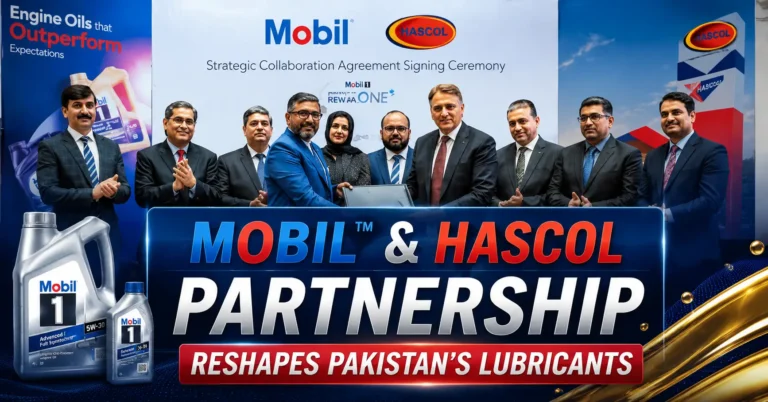

The Mobil HASCOL partnership has quietly become one of the most consequential retail-energy tie-ups in Pakistan this year.
MAL Pakistan Limited, the exclusive marketing alliance of ExxonMobil Lubricants and Specialties, has signed a Strategic Collaboration Agreement with Hascol Petroleum Limited, putting Mobil’s global lubricant range inside Hascol’s nationwide fuel station network.
Mobil HASCOL Strategic Collaboration Agreement Explained

The agreement was announced roughly two weeks ago through simultaneous statements from both companies. Hascol CEO Javed Ahmedjee called it “an important milestone,” while MAL Pakistan described the tie-up as a partnership “built on trust, reach, and customer value.”
Under the deal, Mobil-branded engine oils and lubricants will be sold through Hascol’s retail outlets, which number in the hundreds across all four provinces and Azad Kashmir. Neither company has disclosed financial terms or an exact rollout timeline publicly.
Why MAL Pakistan and Hascol Are Joining Forces

For MAL Pakistan, the Mobil HASCOL partnership extends a retail footprint it has been aggressively building. The company already distributes Mobil through Taj Gasoline stations, and this new agreement adds Hascol’s network to that expanding reach.
READ MORE: Sunrate Launches in Pakistan to Boost Digital Exports
For Hascol — Pakistan’s fourth-largest oil marketing company by share, majority-owned by global trader Vitol — the deal offers a premium, globally recognized brand to pair alongside its existing lubricant business, strengthening non-fuel retail revenue at forecourts nationwide.
Pakistan’s Lubricant Market at a Glance
Pakistan’s lubricant sector is valued at roughly PKR 230 billion, with annual consumption exceeding 370 million litres, according to industry rating data. Growth is being driven by rising vehicle ownership and a steady shift toward synthetic oils suited to extreme summer heat.
| Metric | Figure |
|---|---|
| Market size | ~PKR 230 billion |
| Annual consumption | 370+ million litres |
| Hascol retail outlets | 600+ nationwide |
| MAL Pakistan blending capacity | ~75,000 MT (Hub, Balochistan) |
| Mobil entry into Pakistan | September 1997 |
Hascol’s Retail Network Meets Mobil’s Distribution Push
Hascol’s forecourt footprint gives Mobil instant visibility across markets it hasn’t fully penetrated through Taj Gasoline alone. This kind of retail-stacking strategy has become MAL Pakistan’s signature approach over the past year.
Key elements of the arrangement, based on company statements, include:
- Mobil lubricants stocked across Hascol’s company-owned and dealer-operated stations
- Continued operation of Hascol’s existing FUCHS lubricant lines alongside Mobil
- No confirmed exclusivity clause disclosed by either party so far
- Joint marketing expected at Hascol forecourts nationwide
MAL Pakistan’s Growing Web of Alliances

The Hascol deal is not an isolated move. MAL Pakistan has signed a string of partnerships in 2025 and 2026 alone, positioning Mobil across multiple consumer touchpoints rather than relying on traditional retail alone.
Recent alliances include:
- Taj Gasoline (fuel and lubricant retail distribution)
- Mari Energies (industrial lubrication supply, signed September 2025)
- Mine Lubes & Chemicals with AUTOCOM (mining sector, Reko Diq)
- inDrive and JazzCash (driver discounts and cashless payments, signed June 17, 2026)
What Happens to Hascol’s FUCHS Lubricants Business

Hascol has held exclusive Pakistani distribution rights for Germany’s FUCHS lubricants since the mid-2010s, a relationship that remains active. The Mobil HASCOL partnership does not appear to replace this arrangement, based on available statements.
Instead, industry watchers expect Hascol to run both brands in parallel — FUCHS for its established industrial and commercial customer base, and Mobil to capture retail and passenger-vehicle demand where global brand recognition carries more weight with everyday consumers.
Industry Outlook: What Comes Next
Analysts tracking Pakistan’s fuel retail sector note that lubricant margins are less regulated than fuel pricing, making such tie-ups commercially attractive for OMCs facing thin, government-capped fuel margins. Neither company has confirmed a rollout schedule or sales targets publicly.
What remains to be seen is how quickly Mobil products reach Hascol’s smaller-city outlets, and the Mobil HASCOL partnership eventually expands into co-branded service centres, similar to the AutoSpa model MAL Pakistan has already piloted with inDrive in Islamabad.