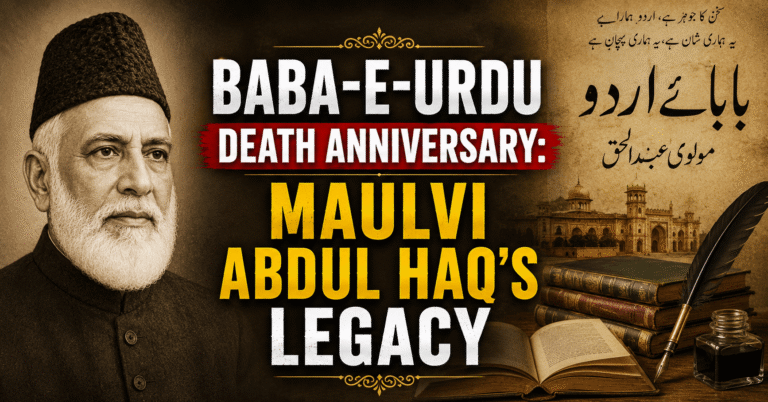

Every August 16, Pakistan pauses to remember the man who spent a lifetime fighting for a language. The Baba-e-Urdu death anniversary falls today, marking 65 years since Maulvi Abdul Haq — scholar, reformer and lifelong Urdu campaigner — died in Karachi in 1961.
He isn’t a household name outside literary circles, and that’s part of the problem this anniversary tries to correct. Without Abdul Haq’s decades of organizing, dictionary-building and political lobbying, Urdu’s status as Pakistan’s national language would look very different today.
Who Was Maulvi Abdul Haq, the Man Behind “Baba-e-Urdu”?

The Baba-e-Urdu death anniversary honors a scholar whose title literally means “Father of Urdu” — a name earned, not given. Abdul Haq was born on April 20, 1870, in Hapur, in what was then British India’s North-Western Provinces.
He built his reputation not through poetry or fiction, but through decades of institution-building: dictionaries, journals, colleges and a movement. That distinction matters, because most Urdu icons are remembered as writers. Abdul Haq is remembered as an organizer.
Baba-e-Urdu Death Anniversary: Key Facts at a Glance
| Detail | Information |
|---|---|
| Full name | Maulvi Abdul Haq |
| Title | Baba-e-Urdu (Father of Urdu) |
| Born | April 20, 1870, Hapur |
| Died | August 16, 1961, Karachi (aged 91) |
| Cause of death | Prolonged illness, reportedly cancer |
| Key role | Secretary, Anjuman Taraqqi-e-Urdu (from 1912) |
| Resting place | Federal Urdu University, Abdul Haq Campus, Karachi |
| Notable honor | Commemorative postage stamp, 2004 |
- The organization he led published dozens of journals and books during his tenure.
- His dictionary work remains a reference point for Urdu-English lexicography.
- His grave sits on the campus of the university his movement effectively created.
Early Life and Education Before the Urdu Movement
Long before the Baba-e-Urdu death anniversary became an annual fixture, Abdul Haq was simply a student moving between institutions. He studied first in Punjab before enrolling at M.A.O. College, Aligarh — a hub of Muslim intellectual life in colonial India.
READ MORE: Dr. Shahid Mahmud Recommended for Hilal-i-Imtiaz for Contributions to Pakistan’s Digital Future
In 1895, he moved to Hyderabad Deccan and took charge of Dar-ut-Tarjuma, a translation bureau. He later served as Principal of Osmania College, Aurangabad, retiring from that post in 1930 to focus fully on the Urdu cause.
Anjuman Taraqqi-e-Urdu and the Fight for Urdu’s Status

In 1912, Abdul Haq became General Secretary of the Anjuman Taraqqi-e-Urdu, an organization Sir Syed Ahmad Khan had founded decades earlier in Aligarh. This appointment defined the rest of his working life.
After Partition, he migrated to Pakistan and rebuilt the Anjuman from scratch in Karachi. He used the platform for direct political activism, pushing for Urdu to become the country’s sole official language rather than one among several.
- He launched journals including Urdu, Science and Hamari Zaban.
- He championed Urdu College Karachi in 1949, which later became Federal Urdu University in 2002.
- He worked to preserve “Hyderabadi Urdu,” a distinct regional literary tradition now largely absorbed into mainstream usage.
Literary Legacy: Dictionaries, Books and Language Reform
Abdul Haq’s written output backs up the institutional work. His Standard English-Urdu Dictionary remains his best-known contribution, still cited by students and translators decades later.
Beyond the dictionary, he authored Qawaid-e-Urdu (Urdu grammar), Maktoobat (letters), Muqaddimat, Tauqeedat, Chand Ham Asar and Afkar-e-Haali, a study of the poet Altaf Hussain Hali. Each title reflects the same goal: standardizing Urdu as a serious academic and administrative language.
Illness, Final Years and Death in Karachi

The years around Partition took a visible toll. Migration disrupted his health, and he later developed cancer, which left him incapacitated for an extended period before his death.
Maulvi Abdul Haq died on August 16, 1961, in Karachi, at the age of 91. He was buried on the campus that now houses Federal Urdu University — a fitting resting place for someone who spent half a century building it.
How Pakistan Marks the Baba-e-Urdu Death Anniversary Today
Each year’s Baba-e-Urdu death anniversary brings ceremonies at Federal Urdu University and events organized by the Anjuman Taraqqi-e-Urdu, still active in Karachi more than a century after its founding.
Past commemorations have included tributes from university vice-chancellors, poets and civic officials, along with book launches and academic sessions. In one past ceremony, a city deputy mayor pledged municipal support for maintaining Urdu Bagh, a green space at the university’s Abdul Haq campus dedicated to his memory.
- The Anjuman continues publishing new Urdu-language books regularly.
- University events typically combine speeches, poetry readings and academic panels.
- Pakistan Post issued a commemorative stamp in his honor in 2004, part of its “Men of Letters” series.
Why Baba-e-Urdu’s Work Still Shapes Urdu Language Policy
The debate Abdul Haq pushed Urdu as Pakistan’s unifying national language never fully settled. Questions about medium of instruction, provincial languages and English’s dominance in official and academic life remain active today.
That’s really what the annual observance is about. It’s less a memorial and more a checkpoint a reminder that language policy in Pakistan has a documented history, built by specific people who made specific, sometimes contested, choices.