
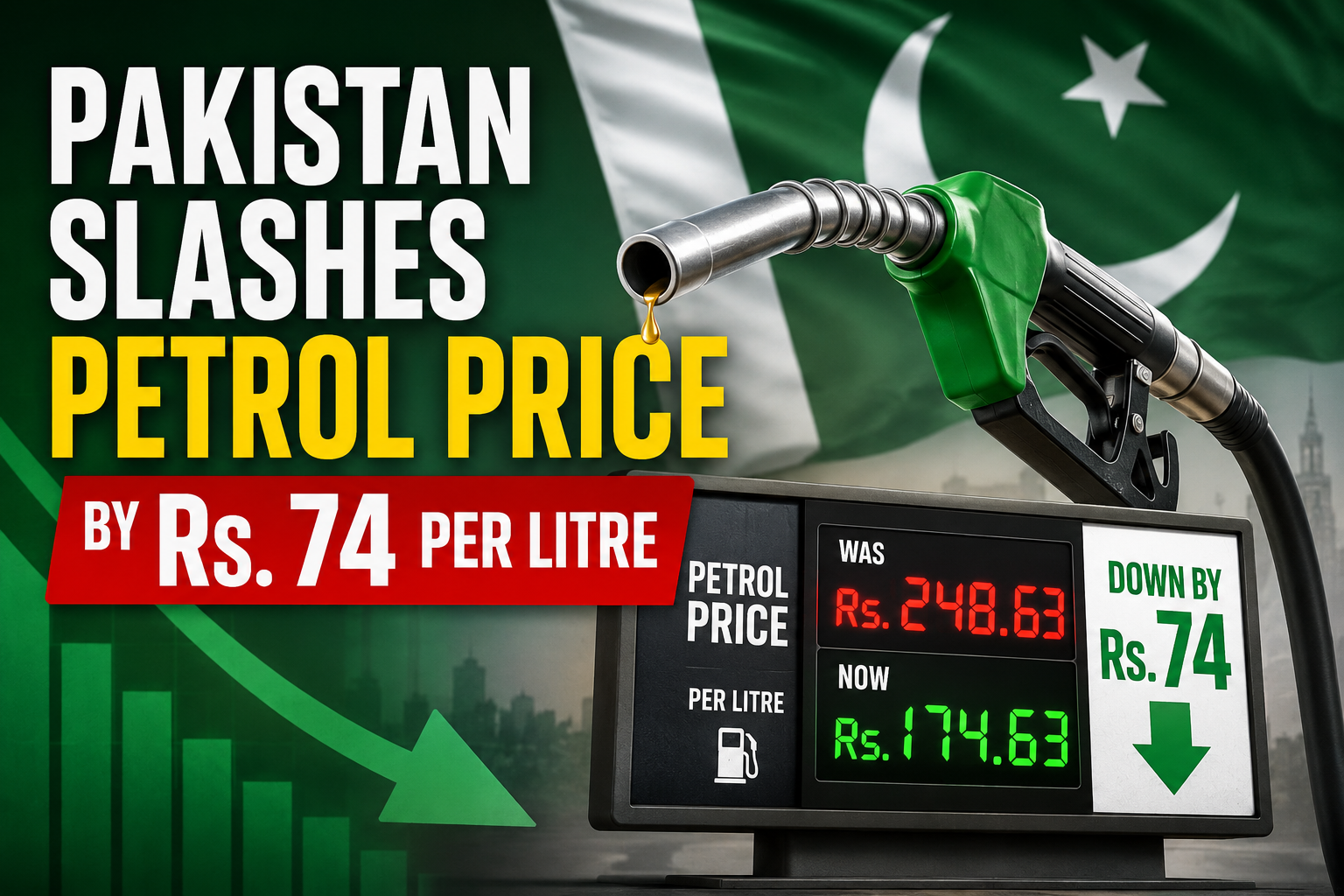

Pakistan Slashes Petrol Price by Rs. 74 Per Litre — Biggest Relief in Years
In what is being called one of the sharpest single-notification fuel price reductions in recent memory, the Pakistani government has announced a massive decrease of Rs. 74 per litre in the petrol price in Pakistan. The decision, which took effect immediately following the announcement, is expected to bring widespread financial relief to millions of ordinary citizens, commuters, and businesses across the country who have been struggling under the weight of high fuel costs.

The announcement was made by the federal government after a formal recommendation from the Oil and Gas Regulatory Authority (OGRA), which had reviewed the latest international crude oil benchmarks, the rupee-dollar exchange rate, and domestic levy structures. The cut applies primarily to petrol (Motor Spirit/MS), with adjustments to High Speed Diesel (HSD) and other petroleum products also under review.
This is one of the largest single-period reductions in the petrol price in Pakistan in recent years, and comes at a time when global oil markets have shifted significantly in consumers’ favour.
Why Did the Government Cut Petrol Prices?
The primary driver behind this decision is the sustained decline in global crude oil prices. International benchmarks, including Brent crude, have fallen considerably over the past several weeks, reducing the per-litre import cost for Pakistan significantly. Since Pakistan imports a substantial portion of its refined petroleum, movements in global oil markets directly affect what consumers pay at the pump.
Additionally, a relative stabilisation in the Pakistani rupee against the US dollar has helped reduce the import cost in local currency terms. This combination of a weaker dollar price for crude and a steadier exchange rate created the fiscal space for OGRA to recommend — and the government to approve — a reduction of this scale.
The government has also been under considerable public and political pressure to pass on savings to consumers rather than absorb them into the federal petroleum levy or other fiscal adjustments. With inflation still a sensitive topic across Pakistan, this price cut is widely seen as both an economic and political decision.
How Much Will Petrol Cost Now?
The revised petrol price in Pakistan reflects a full Rs. 74 per litre reduction from the previous fortnightly rate. For a typical motorcycle owner filling up a 10-litre tank, this translates to Rs. 740 in direct savings per fill. For car users, the savings are even more significant, particularly for those who commute daily or run small delivery businesses.
High Speed Diesel, which is the fuel of choice for heavy transport, agricultural machinery, and long-haul trucking, is also expected to see an adjustment — a move that carries major downstream implications for food and goods transportation costs across the country.
Approximate savings at a glance:
- Motorcycle (5–10 litres): Rs. 370–740 saved per fill-up
- Car (40–50 litres): Rs. 2,960–3,700 saved per full tank
- Rickshaw operators: Estimated Rs. 500–800 per day in reduced costs
- Truck / freight operators: Rs. 5,000–10,000+ per fill, depending on tank capacity
- Small businesses (generators): Meaningful reduction in operating costs
Impact on Inflation and the Cost of Living
Pakistan’s inflation figures have been persistently high over the past two years, largely driven by energy costs, import-side pressures, and currency depreciation. A meaningful reduction in the petrol price in Pakistan is expected to feed through into a broader softening of consumer prices — though economists caution that the transmission is rarely immediate.
Transport costs are one of the most direct channels. When fuel prices fall, the cost of moving goods — from raw materials to finished products to fresh produce — typically declines as well. Transporters and logistics companies, if they pass on savings, could contribute to a noticeable reduction in the price of everyday goods within a few weeks.
Electricity costs, which in Pakistan are partly determined by the fuel mix used in thermal power generation, could also see indirect relief — though this depends on how quickly the cost pass-through occurs through the grid’s pricing mechanism.
What Experts and Citizens Are Saying
Economic commentators have broadly welcomed the move, though several have noted that the benefit could be partially absorbed by Pakistan’s existing petroleum levy structure. The government typically maintains a floor levy regardless of international price levels, which means not every paisa of global savings necessarily reaches consumers.
On social media and in street-level conversations across Lahore, Karachi, and Islamabad, the reaction has been cautiously positive. Rickshaw drivers, small shopkeepers, and daily commuters have expressed relief, though many remain sceptical about whether the cut will remain in place at the next fortnightly review, or whether prices will bounce back if global crude recovers.
“We’ve seen this before — they cut prices for two weeks and then raise them again,” said one Lahore-based motorcycle user, reflecting a sentiment shared by many. “We hope this time it sticks a bit longer.”
International Oil Markets: What’s Driving the Drop?
The global oil market has been on a softening trend, largely attributed to a combination of factors: demand concerns in major consuming economies, a rise in non-OPEC production (particularly from the United States), and ongoing negotiations within the OPEC+ alliance over output strategy.
Brent crude, the international benchmark most relevant to Pakistan’s import basket, has declined noticeably from its peaks, giving oil-importing nations like Pakistan a meaningful window to reduce domestic fuel prices without adding to fiscal pressures.
If this trend holds through the next review cycle — typically every two weeks in Pakistan — further reductions or at minimum stable prices remain possible. However, geopolitical developments in the Middle East or a sharp demand recovery could reverse some of these gains quickly.
How Does Pakistan Set Petrol Prices?
Pakistan operates a fortnightly petroleum pricing system, where OGRA calculates an ex-refinery price based on the import parity price, adjusts for freight and handling costs, and then applies government-mandated levies and taxes. The final retail price at the pump includes the petroleum levy, general sales tax, and dealer margins.
The process means that domestic fuel prices in Pakistan move in near-lockstep with international oil prices — but with a lag, and filtered through the levy structure. When global prices fall sharply, as they have recently, OGRA’s formula generates a significant recommended reduction, which the federal government can either implement in full or partially.
In this case, the government has implemented the full Rs. 74 per litre reduction — a signal that it is prioritising relief over revenue collection from the petroleum levy at this particular moment.
People Also Ask
What is the new petrol price in Pakistan after the Rs. 74 cut?
The petrol price in Pakistan has been reduced by Rs. 74 per litre in the latest fortnightly revision. The new price reflects the updated international crude oil rates and OGRA’s recommendation, effective immediately upon announcement.
Why did Pakistan reduce petrol prices so sharply?
The reduction is driven by a significant fall in global crude oil benchmarks combined with a relatively stable Pakistan rupee. These factors reduced the import cost of petroleum substantially, allowing OGRA to recommend a major downward revision.
Will diesel prices also be reduced?
High Speed Diesel (HSD) prices are expected to be revised alongside petrol. Any adjustment in diesel costs would particularly benefit the transport, agriculture, and heavy industry sectors.
How often does Pakistan review petrol prices?
Pakistan reviews and revises petroleum product prices every two weeks (fortnightly), based on OGRA’s assessment of international oil prices, exchange rates, and applicable government levies.
Will this reduce inflation in Pakistan?
Lower fuel costs are expected to ease transport and logistics costs, which can contribute to reduced consumer prices over the following weeks. However, the full inflationary impact depends on how quickly the savings are passed on through the supply chain.
The Bigger Picture: Relief, But for How Long?
Pakistan has faced a difficult economic period, with high inflation, a challenging IMF programme, and energy costs that squeezed household budgets and business margins. This Rs. 74 per litre cut in the petrol price in Pakistan is a genuinely significant piece of good news for ordinary people — and the government will undoubtedly seek political credit for it.
Yet the structural challenges have not disappeared. Pakistan remains heavily dependent on imported energy. Any reversal in global oil prices, or a renewed weakening of the rupee, could quickly erode these savings. Long-term energy security for Pakistan will require investment in domestic energy production, refinery capacity, and eventually renewable energy sources — none of which are solved by a single fortnightly price notification.
For now, though, for the commuter filling up a motorbike in Rawalpindi, or the truck driver hauling goods from Karachi to Peshawar, this is real, tangible relief — and that matters.
The Rs. 74 per litre reduction in the petrol price in Pakistan marks one of the most significant fuel price cuts in recent times, offering genuine relief to millions of consumers, businesses, and workers across the country. Driven by falling global oil prices and a steadier exchange rate, the cut is both welcome and overdue.
Whether it holds into the next review cycle will depend on how international markets behave — but for now, Pakistanis have reason to welcome the break at the pump. Have thoughts on how this will affect your daily life? Let us know in the comments below.