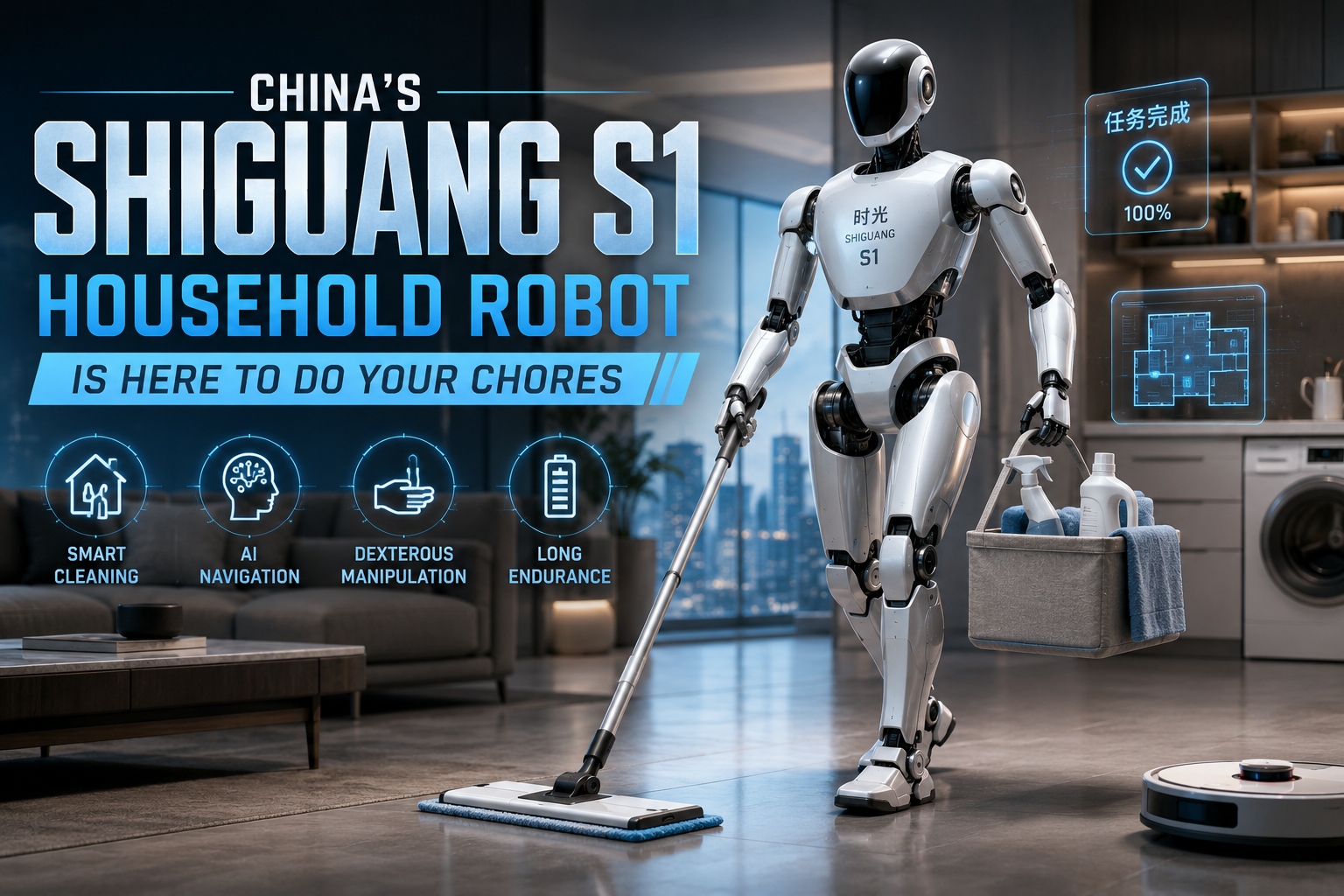

A Chinese robotics startup just did something nobody in the industry has managed to pull off at scale — it launched a robot built not for a factory floor, but for your living room.
On May 20, 2026, GigaBrain unveiled the Shiguang S1 household robot at a ceremony in Wuhan’s Optics Valley, marking what the company calls China’s first general-purpose robot designed specifically for everyday home use.
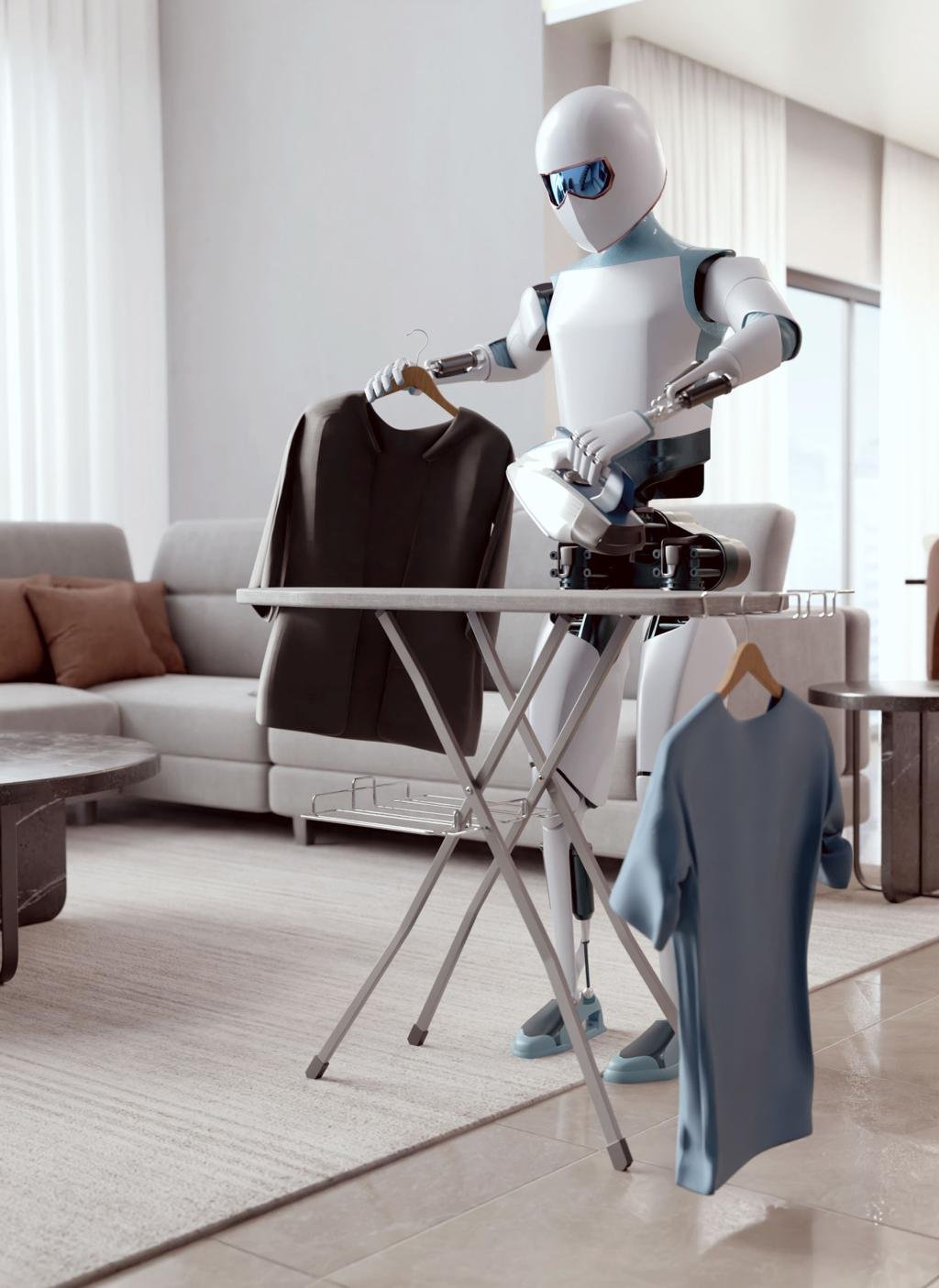
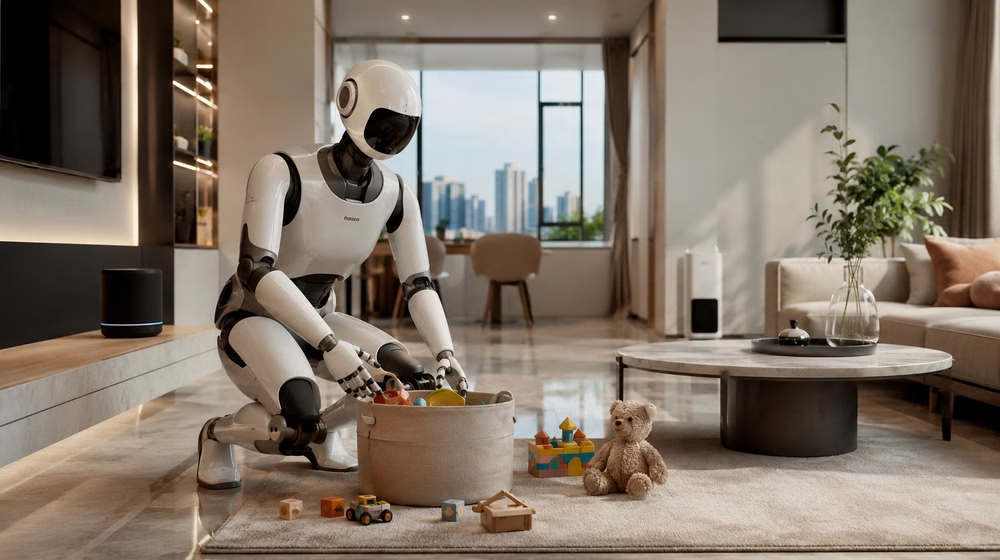
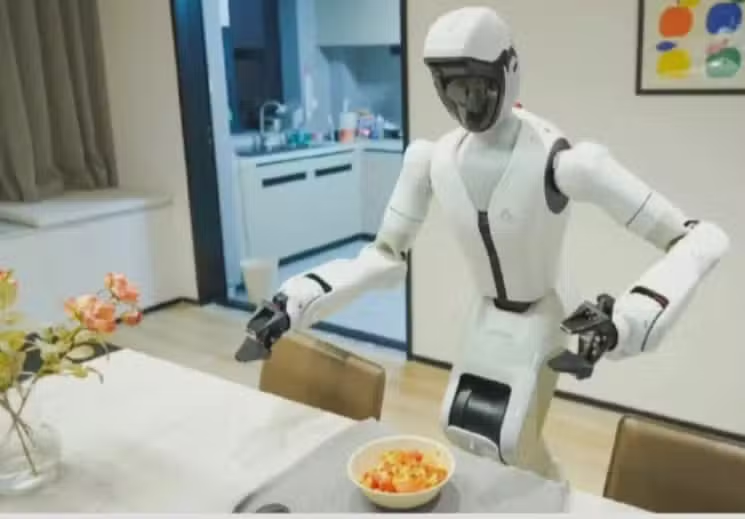
The robot can fold laundry, cook a meal, clear the dining table, and even strike up a conversation with an elderly family member — all powered by a proprietary embodied AI model that GigaBrain developed in-house.
What Exactly Is the Shiguang S1?
Most people who follow robotics news have seen demos of humanoid robots doing backflips or sorting car parts in factory halls. The Shiguang S1 is a different animal entirely.
GigaBrain designed it from the ground up for the messier, less predictable world of the home, where tasks change from moment to moment and humans — including children, pets, and elderly people — move unpredictably around the space.
The robot has a wheeled base paired with dual arms, giving it the mobility to navigate a typical apartment without needing to balance on two legs. This design choice reflects a deliberate trade-off: wheeled movement is more reliable and energy-efficient indoors, even if it lacks the dramatic visual appeal of a fully bipedal machine.
The Shiguang S1 is not trying to look like a science-fiction robot. It is trying to be useful in the actual place where most people spend most of their lives — at home.
What Can It Actually Do?
GigaBrain has been specific about the capabilities the Shiguang S1 brings to the table at launch. According to the company, the robot can perform the following tasks without needing to be reprogrammed for each one:
- Fold clothes and sort laundry
- Prepare and cook meals
- Clear and wipe down the dining table
- Have natural conversations with elderly residents
- Assist with general household tasks and routine chores
What stands out here is not any single capability but the combination. Earlier domestic robots could vacuum a floor or play music on command. The Shiguang S1 is positioned to handle a chain of tasks that require understanding context, adapting to interruptions, and keeping learning over time.
The company says the robot’s ability to continually acquire new skills makes it fundamentally more flexible than machines built around fixed routines.
The Brain Behind the Robot: Embodied AI
The technology powering all of this is what GigaBrain calls its self-developed embodied intelligent model. This is not a pre-programmed instruction set — it is an AI system that allows the robot to understand what it is being asked to do, figure out how to do it within its current environment, and adapt when things do not go according to plan.
Ye Yun, Vice President of Research and Development at GigaBrain, explained the difference clearly during the launch event. Traditional factory robots, he said, operate on fixed instructions: if the environment changes in a way the robot was not programmed for, it stops working properly. The Shiguang S1 is built differently. It can plan its own actions and respond intelligently when conditions shift — a critical requirement for any machine working inside a real home.
This approach to machine intelligence — embedding AI directly into the robot’s perception, planning, and motor control — is increasingly seen as the key breakthrough separating next-generation home robots from everything that came before them.
Safety Is Built In, Not Bolted On
GigaBrain has also paid serious attention to one of the biggest concerns around robots sharing space with people: what happens if it bumps into someone? The company has integrated a compliant control mechanism into the Shiguang S1’s movement system. If the robot accidentally makes contact with a person or a pet while moving through a room, it stops immediately to prevent injury.
This is not a trivial feature. For a robot operating near children and older adults — exactly the demographic GigaBrain is targeting — the ability to react instantly to unexpected physical contact could be the difference between the technology being trusted or rejected by families.
Where and Who: The Wuhan Pilot Program
The launch took place in Wuhan’s Optics Valley, a technology hub in Hubei province that has become a focal point for China’s growing robotics industry. But the bigger story is what comes next.
GigaBrain has opened applications for families in Wuhan to become early “seed users” of the Shiguang S1. Interested households can apply through the company’s official Shiguang Vision WeChat account or its application portal.
A fleet of one hundred S1 units will first enter housing reserved for employees in high-tech industries in Wuhan, before a broader pilot targeting families with elderly members, children, or pets rolls out in 2027. The company is offering these trials free of charge to gather real-world data and refine the robot’s performance in a wide variety of home environments.
This kind of structured pilot approach — start small, gather feedback, iterate fast — mirrors how the most successful consumer technology rollouts have worked, from early smartphone ecosystem tests to smart speaker deployments.
What Comes Next: The GigaBrain 1 Model
GigaBrain is not stopping with the Shiguang S1. The company has already announced plans to officially launch its next-generation AI model, called GigaBrain 1, in the third quarter of 2026. While full specifications for this model have not yet been disclosed, the implication is that it will power more sophisticated versions of the robot’s decision-making and expand its range of capabilities.
The target price point is also on the radar. GigaBrain’s CEO has indicated that the company wants to bring hardware costs below 100,000 yuan — roughly $14,700 USD — by mid-2027. That would represent a significant drop from current costs and could open the door to broader consumer adoption in China’s rapidly aging society.
Why This Matters: China’s Household Robot Race
China is pushing hard into humanoid and general-purpose robotics, and the Shiguang S1 is one of the clearest signals yet that the race has moved from industrial floors into family homes.
Other Chinese companies, including Unitree and AgiBot, have been building robots for factory deployment and making moves toward household use. But GigaBrain appears to be among the first to build specifically for home environments from day one, rather than adapting an industrial product for domestic use.
The timing is not accidental. China is facing a rapidly aging population, a shortage of professional caregivers, and rising household labor costs. A robot that can reliably help an elderly person at home, take over daily chores, and adapt over time to a family’s specific routines addresses a real and growing social need — not just a technical curiosity.
At the same time, this launch comes as global competition in home robotics is intensifying. Tesla’s Optimus project, several US-based startups, and South Korean manufacturers are all working toward similar goals.
The Shiguang S1 arriving first in the home — even in a limited pilot — gives GigaBrain a meaningful head start in terms of real-world learning data, which is arguably the most valuable asset in embodied AI development right now.
What Families Should Know
If you are following this space with an eye toward when a home robot might realistically show up in your own household, a few things are worth keeping in mind:
- The technology is real but still early. The Shiguang S1 is a genuine product with genuine capabilities, not a concept demo. But it is entering homes as part of a controlled pilot, not a mass-market rollout.
- Pricing remains high for most consumers. Current costs put this firmly in early-adopter territory. Meaningful price drops are expected by 2027.
- Continuous learning is the key differentiator. Unlike robots tied to fixed routines, the Shiguang S1 is designed to get better the longer it is in your home.
- Safety mechanisms are standard, not optional. The compliant control system that stops the robot on contact is built into the hardware, not a software patch.
The launch of the Shiguang S1 household robot by GigaBrain is a genuine milestone in Chinese robotics — and arguably in consumer robotics globally.
READ MORE! ChatGPT Went Full Goblin Mode — And OpenAI Finally Explained Why 2026
It represents the clearest attempt yet to bring a fully capable, learning-capable, AI-powered machine into the domestic spaces where people actually live. Whether it delivers on that promise at scale will depend on the coming months of real-world pilot data.
But the direction is set, the technology is deployed, and the race to put a robot in every home just got a lot more serious. What do you think — would you trust a robot with your household chores? Let us know in the comments below.