
The Makkah defence pact is facing its first real-world stress test — just a month after ink dried on the signatures in Mecca.
Houthi Attacks Push the Makkah Defence Pact Into the Spotlight

Yemen’s Houthi movement launched a wave of missile and drone strikes on Saudi Arabia this week, hitting cities and energy infrastructure. At least 73 people were injured, according to multiple reports citing Saudi officials.
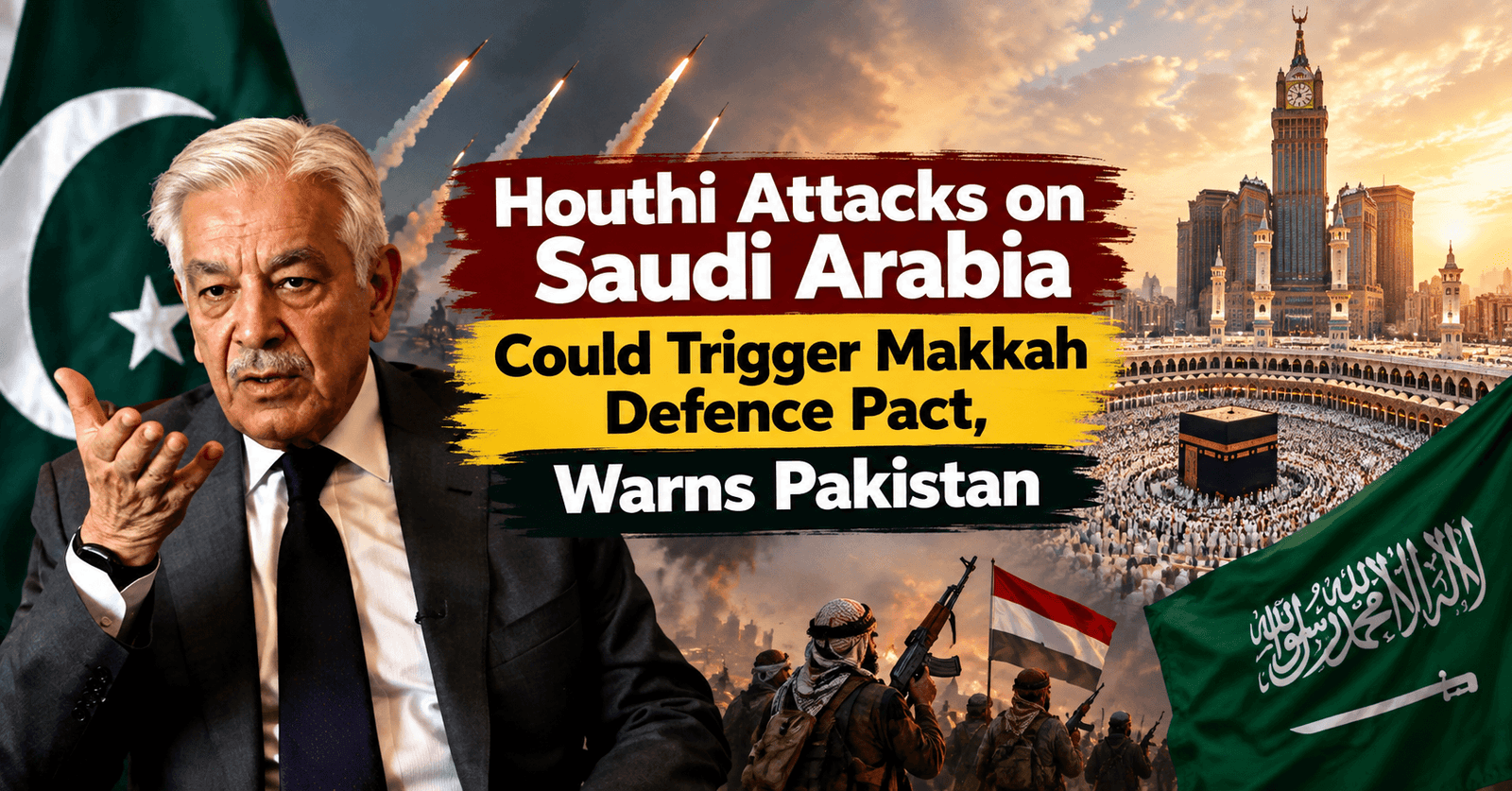
Within hours, Pakistan’s Defence Minister Khawaja Asif was on national television warning that the Makkah defence pact — signed by Pakistan, Saudi Arabia and Turkiye barely a month ago — could be formally invoked if the violence spills further into Saudi territory.
What Pakistan’s Defence Minister Actually Said
Speaking on News’ Aaj Shahzeb Khanzada Kay Sath, Asif didn’t hedge. He said there was “no ambiguity” that aggression against any one signatory of the pact amounts to aggression against all three nations.
- “There should be no ambiguity; there is no need for any clarity that this is a joint defence agreement,” Asif said.
- He added Islamabad would respond even without the pact: “This is a trilateral pact… but even if it were bilateral, we would have responded.”
- He also downplayed talk of an immediate military response, noting: “We don’t need to respond to a brick with a stone.”
Asif said he wasn’t aware of direct contact between Islamabad and Riyadh since the strikes, but stressed Pakistan’s obligation stands regardless. Prime Minister Shehbaz Sharif separately condemned the Houthi attacks as “cowardly,” reaffirming support for Saudi sovereignty.
Inside the Makkah Defence Pact: Signatories and Structure

The Makkah defence pact, formally called the Mecca Joint Defence Agreement, was signed on August 7, 2026, at Al-Safa Palace in Mecca by Saudi Crown Prince Mohammed bin Salman, Turkish President Recep Tayyip Erdogan, and Pakistani Prime Minister Shehbaz Sharif.
Its core clause is simple: an armed attack on one member is treated as an attack on all three. Here’s a quick breakdown:
| Detail | Information |
|---|---|
| Signed | August 7, 2026, Mecca |
| Members | Pakistan, Saudi Arabia, Turkiye |
| Secretariat location | Riyadh |
| First Secretary-General | Pakistani national |
| Core clause | Collective defence — attack on one is attack on all |
| Stated nature | “Purely defensive,” open to other states |
From Bilateral Deal to Trilateral Alliance: A Quick Background
This wasn’t built overnight. Pakistan and Saudi Arabia had already signed a bilateral Strategic Mutual Defence Agreement in Riyadh back in September 2025, establishing the same collective-security principle between the two countries alone.
READ MORE: Massive blaze continues to rage at Karachi Landhi factory, section collapses
That earlier pact was effectively folded into the broader Makkah defence pact once Turkiye joined the following August. A formal defence-industrial forum between the three nations had quietly existed since 2022, so the trilateral structure built on groundwork laid years in advance rather than emerging suddenly.
Why Analysts Are Split on the Pact’s Real Weight
Not everyone treats the pact as a fully armed alliance ready to fire on command. Kamran Bokhari of the Middle East Policy Council has described it as more of “a strategic signal” than “an operational alliance,” arguing any integrated military capacity remains years away.
Other analysts note real substance behind the symbolism too. Pakistan’s nuclear-armed status, Saudi Arabia’s financial and regional clout, and Turkiye’s NATO-linked defence industry give the bloc genuine — if untested — combined leverage should the Makkah defence pact actually be triggered.
What a Houthi-Triggered Response Could Mean Regionally

Asif was careful to frame the Houthis as “non-state actors,” a distinction that matters legally and diplomatically. Triggering a state-to-state mutual defence clause against a non-state militia raises complicated questions about proportional response.
- It could mean intelligence-sharing or coordinated diplomatic pressure rather than troop deployment
- It could accelerate the pact’s promised “capacity building,” including Saudi efforts to reduce reliance on Western arms imports
- It risks widening a Yemen-based conflict into a broader Gulf security crisis if strikes continue
Asif also linked the tension to the wider US-Israel-Iran conflict, saying sympathy for Iran exists across the Muslim world, including in Yemen — but warned against letting that sentiment justify further escalation against Saudi Arabia.
What Comes Next
For now, Pakistan’s position is a warning, not a declaration. Asif said he hopes “the situation will come under control and die down,” leaving the door open for de-escalation before the Makkah defence pact faces its first genuine activation.
This remains rhetoric or turns into coordinated trilateral action will likely depend on whether the Houthis heed the warning — or whether further strikes force Islamabad, Riyadh and Ankara to decide, together, what “attack on one is attack on all” actually looks like in practice.