
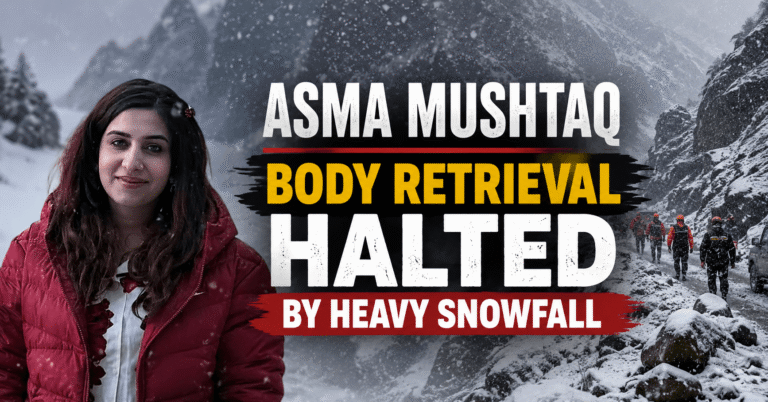

Body Retrieval Mission Halted as Snowfall Grips Spantik
The Asma Mushtaq body retrieval mission has been suspended once again, this time by a wall of snow and wind that rescuers simply couldn’t push through. What was meant to be a straightforward recovery has turned into a waiting game at 6,400 metres.
Federal Information Minister Attaullah Tarar confirmed the setback on Sunday, saying high-altitude porters had come agonisingly close to Camp 3 before conditions turned. They were forced back to Camp 2, leaving Asma Mushtaq body stranded on the mountain for now.
What the Minister Said: Tarar’s Statement on the Delay

Tarar’s update, posted on X, laid out the plan porters had been expected to reach Camp 3, retrieve the body, and bring it to base camp by Monday. Heavy snowfall and strong winds broke that timeline apart.
- Helicopter support has been formally authorised
- Coordination is underway between the Gilgit-Baltistan government and Force Command Northern Areas (FCNA)
- Alternative arrangements are reportedly being kept ready
- Prime Minister Shehbaz Sharif is being briefed regularly
“Whatever can be done in these circumstances, will be done,” Tarar said, adding that authorities remain committed despite the delay.
Timeline: From Summit Success to Stranded Recovery Team
| Date | Event |
|---|---|
| Aug 20 (Thu) | Asma Mushtaq summits Spantik (7,027m) in good health; falls ill during descent at ~6,400m |
| Aug 21 (Fri) | ACP confirms her death; family arrives in Skardu |
| Aug 22 (Sat) | Six-member recovery team departs; reaches Camp 2 |
| Aug 23 (Sun) | Team nears Camp 3; snowfall forces retreat back to Camp 2 |
The table shows how quickly a routine descent turned fatal, and how weather has repeatedly outpaced the recovery effort since. Each stalled attempt pushes the operation further into uncertainty.
Why Helicopters Can’t Reach Above 6,000 Metres

This is the detail most reports skip past: helicopters generally cannot safely operate above 6,000 metres due to thin air reducing rotor lift and engine performance. That’s precisely where Asma Mushtaq body remains.
- Air density drops sharply above 6,000m, cutting helicopter lift capacity
- Most rescue choppers in the region are rated for lower-altitude operations
- Bodies above this line must first be moved down by ground teams
- A helicopter can only take over once the body reaches base camp or a lower staging point
That’s why porters, not aircraft, are doing the heaviest work right now — manually lowering the body through some of Pakistan’s most unforgiving terrain.
Alpine Club of Pakistan’s Role and the Accountability Question
The Alpine Club of Pakistan (ACP) says the recovery is being coordinated by Mushtaq’s own expedition company, alongside the Tourism Department, local government and the ACP itself. Climbers from multiple teams have joined the mission voluntarily.
READ MORE: Polish cyclist completes 1,390-km tour from Islamabad to Khunjerab Pass
But questions are already surfacing. Baltistan Division Commissioner Kamal Khan reportedly said the tour operator failed to arrange a proper recovery team and helicopter backup, a violation of mountaineering regulations.
- ACP has pledged a full investigation once the body is recovered and teams are safely down
- The probe will examine the expedition company’s conduct and emergency response
- “Any necessary action will follow” the findings, ACP stated
The scrutiny reflects a wider concern: whether Pakistan’s expedition operators are adequately equipped for emergencies at extreme altitude.
Who Was Asma Mushtaq? A Doctor, Vlogger and Climber

Born on February 7, 1992, in Lahore, Asma Mushtaq built two very different careers side by side. She worked in Britain as a doctor specialising in obstetrics and gynaecology, while pursuing mountaineering as her passion.
She had previously completed a winter ascent of the 4,076-metre Musa ka Musallah and joined expeditions to Rupal and Arandu. Online, she documented her travels as a vlogger, drawing a devoted following who admired her love for mountains and natural landscapes.
Her guides, Akbar Ali and Muhammad Amin, stayed by her side as her condition worsened. ACP Senior Vice President Karrar Haidri praised their “immediate and dedicated efforts,” noting they could not save her despite trying everything possible.
The Risks Behind Pakistan’s High-Altitude Recovery Missions
Asma Mushtaq case isn’t isolated. Just days earlier, the body of American climber Sarah Mallory Geis was recovered from Broad Peak, following an avalanche that also killed Pakistan’s Sohail Sakhi and left others missing for weeks.
- High-altitude sickness (HACE/HAPE) remains a leading cause of climbing deaths in the Karakoram
- Rapid ascent without proper acclimatisation sharply raises fatality risk
- Weather windows at 6,000m+ can close within hours, trapping both climbers and rescuers
- Ground recovery teams face the same dangers that claimed the original climber
These recurring incidents raise a pressing question for Pakistan’s mountaineering authorities: is current expedition oversight strong enough for the risks these peaks present?
What Happens Next
For now, the recovery team waits at base camp for a safer weather window, while officials keep the helicopter option on standby. Authorities insist the mission isn’t abandoned, only paused.
Mushtaq’s family, already in Skardu, continues to wait alongside them. The coming days will determine whether Monday’s missed deadline becomes days — or longer — before she can finally be brought home.