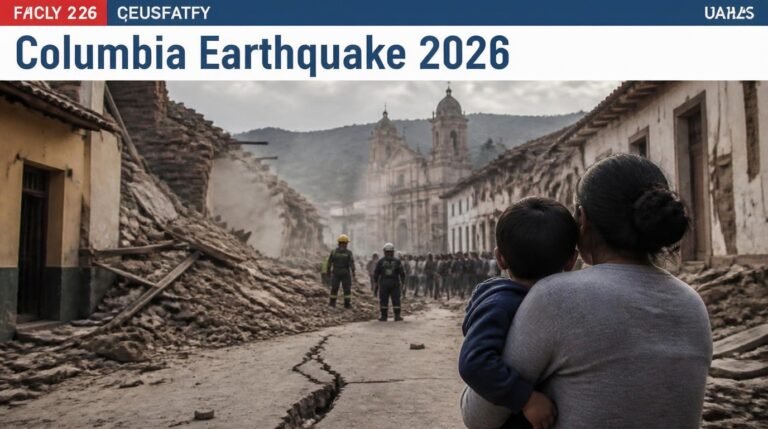

On the morning of August 10, 2026, a magnitude 7.4 earthquake tore through western Colombia.
Search and Rescue Continues after Colombia Earthquake. As it is now being called the strongest earthquake the country has ever recorded in this century, and by any measure it is a disaster still unfolding. Rescue teams are still digging through rubble, the death toll keeps rising every moment, and whole communities remain cut off. This is not a settled story yet, so all the numbers and facts below are of where things stand right now rather than a final count.
What Exactly Happened?
The quake struck at around 7:30 in the morning local time, centered near San José del Palmar in the Chocó region which is a remote, largely rural stretch of the country’s Pacific coast that is mostly reachable only by boat or small plane. Colombia’s geological service put the depth at just over 100 kilometers, deep enough that the shaking spread across a huge area rather than staying localized. People felt it as far away as Bogotá, and even across the border in Ecuador and Panama. Dozens of aftershocks followed in the hours after, some strong enough to bring down buildings already weakened by the initial shock.
Where the Damage Is Worst
Cali, which is the country’s third-largest city, took a heavy hit as dozens of buildings collapsed, including part of a hospital where patients had to be evacuated mid-treatment. Pereira, Manizales, Quibdó, and Armenia were also hit hard enough that all five cities remain under the government’s highest disaster alert. In Manizales, one of the towers on the city’s well-known cathedral came down. Several airports in the region suspended flights entirely, and basic services like power, water, phone networks all have been knocked out in a lot of the hardest-hit areas, which is slowing down both rescue work and any real accounting of the damage.
The Human Toll
- More than 200 people are confirmed dead, and that number has been climbing steadily as search teams reach more affected areas.
- Over a thousand people have been injured.
- Thousands more are still listed as missing, particularly in Chocó, where communication outages have made it hard to even get a clear picture of who’s unaccounted for.
- Well over a thousand homes have been damaged or destroyed outright, along with schools and health centers across the region.
Behind those numbers are individual stories that are hard to read past among them, the young son of a small coastal town’s mayor died when his family’s house came down. It is the kind of detail that makes clear this is a human tragedy first, not just a statistics update.
The Response by the Government and World So Far
Colombia’s government declared a national disaster within hours, and the country’s new president who sworn in just days before the quake hit has been leading the emergency response directly rather than delegating it, which says something about how seriously the government is treating this. Troops and emergency crews have been deployed to the hardest-hit areas, with more reinforcements arriving as the response scales up, and a curfew was put in place in some cities to keep people safe while search operations continue through the night. Aid offers have come in from across Latin America and beyond, and international relief groups are already on the ground assessing what is needed the most medical supplies, shelter, and clean water are the priorities right now.
Why This Region Is So Earthquake-Prone
Colombia’s Pacific coast sits along the Ring of Fire, the horseshoe-shaped chain of fault lines circling the Pacific Ocean where most of the world’s earthquakes happen. It is the same tectonic activity that caused two devastating quakes in neighboring Venezuela earlier this year, which together killed thousands. Chocó, where this quake was centered, is one of the poorest and least developed parts of Colombia, which makes the recovery even harder as the infrastructure that was already limited is now stretched even further, and reaching some communities is only possible by boat or air.
What Comes Next
Search and rescue is still the immediate focus especially in Chocó, where teams have not fully reached the epicenter yet. Once that phase winds down, the harder, slower work begins rebuilding homes, schools, and hospitals in a region that did not have much to spare before the ground started shaking. Given how much is still changing day to day, we all should pray and fund for those who lost their families and towns in this tragic quake. The whole human community felt a deep shock when they heard this news and all our hopes are with the people of Colombia.