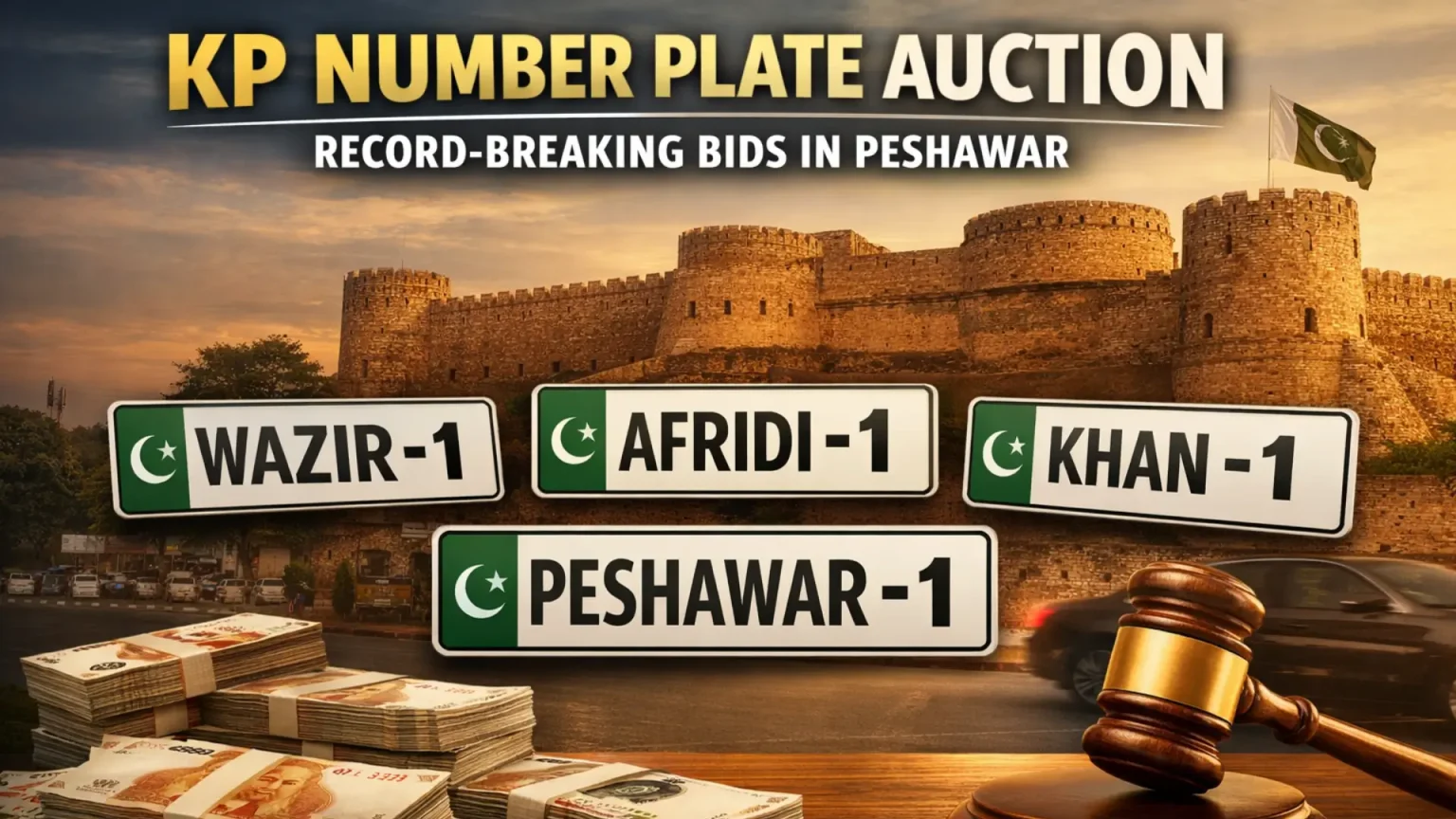
The Khyber Pakhtunkhwa (KP) government has generated more than Rs. 47 crore through its latest premium vehicle registration number auction, officials confirmed this week. The KP Premium Number Plate Auction was conducted by the Khyber Pakhtunkhwa Excise, Taxation and Narcotics Control Department in Peshawar, drawing strong participation from business leaders, car enthusiasts, and investors. The event aimed to increase non-tax revenue while promoting transparency through a competitive bidding process.
The auction, held in Peshawar earlier this week, attracted hundreds of bidders both in person and online. Officials said the strong response highlights growing public interest in personalized and premium vehicle registration numbers across the province.
Strong Response to KP Premium Number Plate Auction
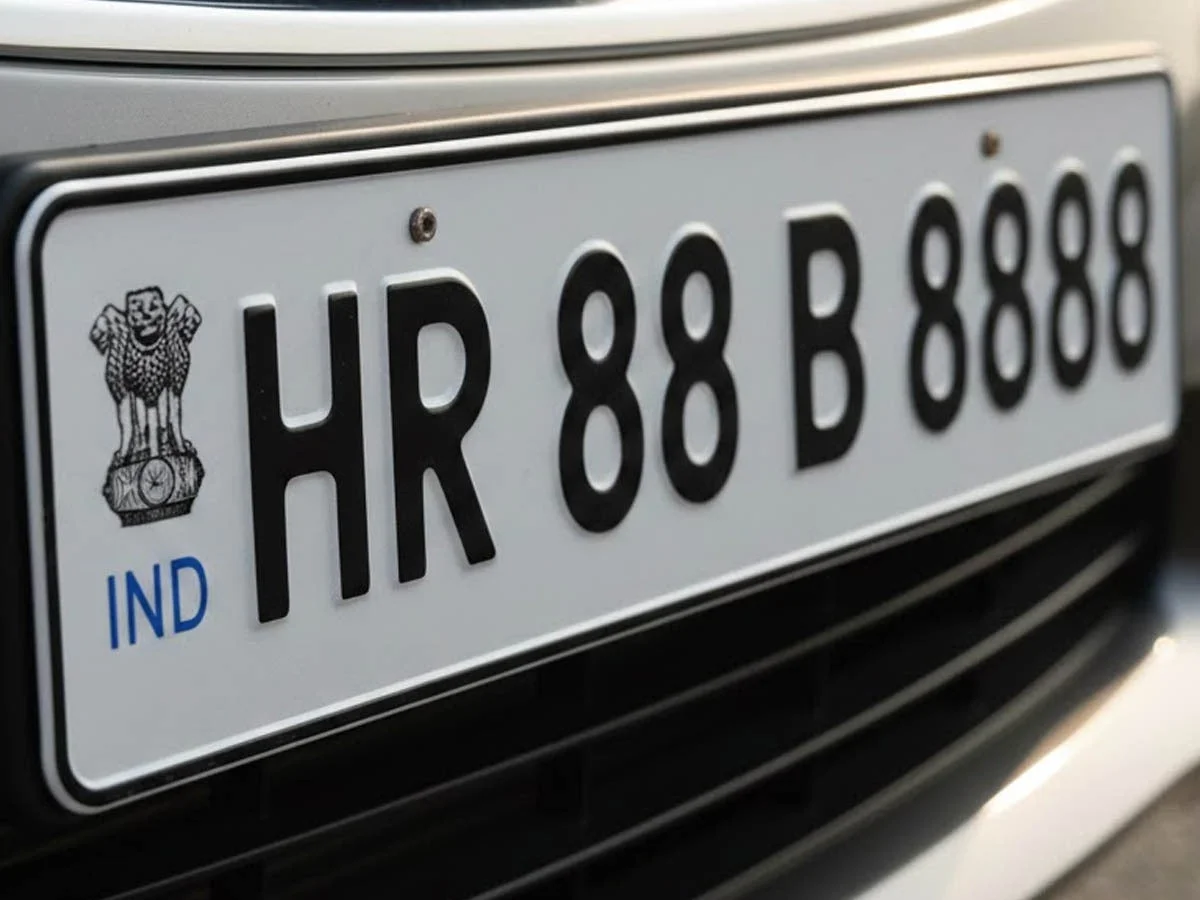
Numerous valuable number plates classified as VIP, golden, and unique registration numbers were up for auction at the KP Premium Number Plate Auction. Bidders fought for unusual combinations that are frequently seen as prestigious in Pakistan, such as repeating sequences and single-digit digits.
Some number plates sold for millions of rupees at the auction, exceeding officials’ expectations. The money raised will support public services and provincial development initiatives.
According to a senior excise department official, the auction procedure was open and closely monitored to guarantee equity. In order to facilitate wider involvement, digital bidding methods were also developed.
KP Excise Department Earns Rs. 47.03 Crore from Premium Number Plate Auction
The Khyber Pakhtunkhwa Excise, Taxation and Narcotics Control Department generated Rs. 47.03 crore by auctioning 30 premium “choice” number plates during a competitive bidding event held in Peshawar. The auction attracted business leaders, car enthusiasts, and investors from across the province.
Top Bids for High-Value Plates
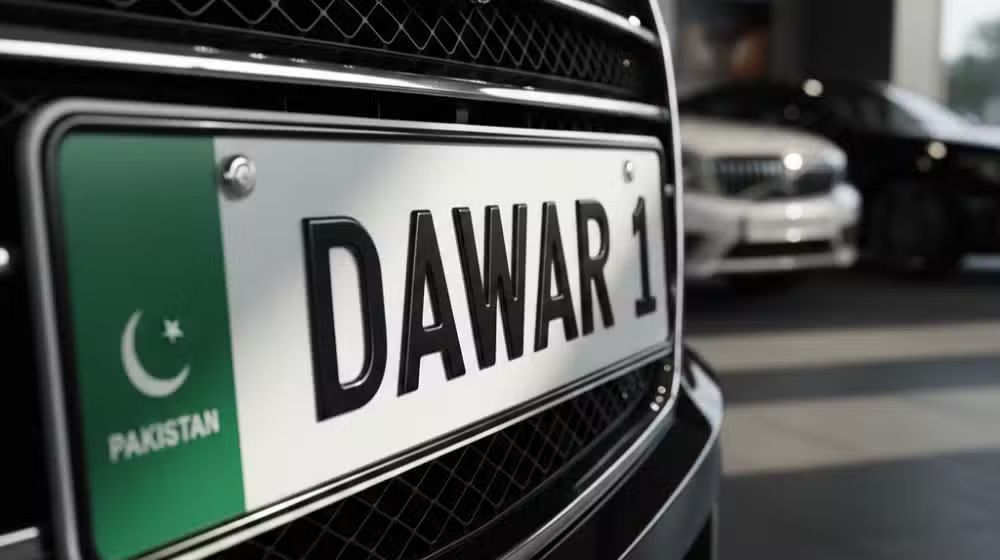
The highest bid went to the number plate “Dawar 1,” which was sold for an impressive Rs. 17.50 crore. Following it, “Orakzai 1” fetched Rs. 4.10 crore, and “Waziristan 1” was sold for Rs. 4.06 crore.
Other high-value plates included:
- “Bajaur 1” – Rs. 3.35 crore
- “Mohmand 1” – Rs. 3.21 crore
- “Mehsud 1” – Rs. 2.20 crore
- “Khyber 1” – Rs. 2.01 crore
Mid-Range Premium Plates
Among other notable sales, “Gujar 1” was auctioned for Rs. 1.63 crore, while “Pashtun 1” sold for Rs. 1.32 crore.
Several plates sold for below one crore also attracted strong participation:
- “Buner 1” – Rs. 9.5 million
- “Jadoon 1” – Rs. 7.1 million
- “Mardan 1” – Rs. 6.8 million
- “Dir 1” – Rs. 6.7 million
- “Khalil 1” – Rs. 6.5 million
- “Khattak 1” – Rs. 6.1 million
Affordable Premium Plates
Smaller bids still reflected high demand for prestigious numbers:
- “Taj 1” – Rs. 4.2 million
- “Kohat 1” – Rs. 4.3 million
- “Syed 1” – Rs. 3.3 million
- “Swat 1” – Rs. 3.0 million
- “Sheikh 1” – Rs. 2.7 million
- “Marwat 1” – Rs. 2.6 million
- “Kulachi 1” – Rs. 2.5 million
- “Abbottabad 1” – Rs. 1.7 million
Why Premium Number Plates Are in Demand
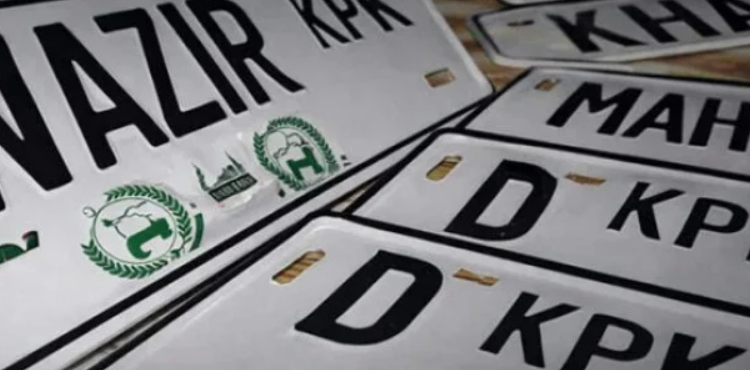
In Pakistan, premium vehicle number plates are often seen as status symbols. Business owners, politicians, and celebrities frequently compete for distinctive numbers that reflect personal branding or social standing.
Some of the most sought-after categories included:
- Single-digit numbers (e.g., 1, 7, 9)
- Repeated numbers (e.g., 111, 786, 999)
- Special cultural or religious combinations
- Customized series numbers
Experts say the demand has increased in recent years as car ownership rises across KP and other provinces.
In cities like Peshawar, Mardan, and Abbottabad, premium plates are commonly displayed on luxury vehicles, adding to their appeal. The auction model allows the government to tap into this demand and convert it into public revenue.
Revenue to Support Public Development
The Rs. 47 crore that was raised at the sale would go into the provincial treasury, officials revealed. It is anticipated that the money will help with administrative reforms, road upgrades, and infrastructure projects.
A provincial government spokeswoman underlined that non-tax revenue streams like auctions increase provincial revenue while relieving citizens of financial strain.
The spokeswoman stated, “This initiative reflects our commitment to innovative revenue generation without imposing additional taxes.”
Although the excise department has held similar auctions in the past, the amount raised at this year’s event was among the largest in recent memory.
Digital Transparency and Fair Bidding
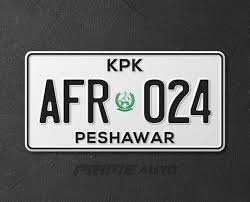
The KP Premium Number Plate Auction was conducted using a hybrid model, combining physical and online bidding. Officials believe this approach increased participation and reduced the risk of manipulation.
Key measures included:
- Public display of bidding results
- Real-time monitoring
- Official documentation of successful bids
- Secure payment mechanisms
The department also encouraged citizens to verify auction details through its official website and social media platforms.
Experts say that digitization has strengthened public trust in such revenue initiatives.
Comparison with Other Provinces
In the past, Sindh and Punjab have also held premium number plate auctions. Similar amounts of money have been made in Punjab through auctions run by the Punjab Excise and Taxation Department.
KP’s recent performance, according to analysts, indicates that the province’s economy is expanding. KP is one of the provinces that has effectively used novel revenue streams, as seen by the Rs. 47 crore collection.
According to observers, Pakistan’s competitive bidding culture is growing as administrations look for new revenue streams in the face of financial difficulties.
Public Reaction and Market Trends
The auction generated considerable discussion on social media platforms, with users praising the government’s strategy. Many citizens appreciated the idea of voluntary participation instead of mandatory taxes.
Automobile market experts say premium number plates have become an investment trend. Some buyers later resell rare numbers at even higher prices, especially in major cities.
Car dealerships in Peshawar reported increased inquiries about vehicle registration procedures following the auction announcement. This suggests a positive ripple effect on the automotive market.
Economic Implications for Khyber Pakhtunkhwa
The successful KP Premium Number Plate Auction reflects broader economic resilience in the province. Despite fiscal pressures at the national level, provincial authorities are exploring innovative revenue solutions.
Key economic impacts include:
- Increased non-tax revenue
- Improved budget flexibility
- Enhanced transparency in public auctions
- Boost to local automotive culture
Financial analysts say such initiatives demonstrate how provinces can diversify income without overburdening taxpayers.
Moreover, the revenue collected may help bridge budget deficits and support welfare programs.
Future Auctions Expected
Following the success of this event, officials hinted at organizing additional auctions later this year. There are also plans to introduce new registration series to meet growing demand.
The excise department is reportedly working on further digital upgrades to streamline bidding and registration processes.
Citizens interested in participating are advised to monitor official announcements and prepare necessary documentation in advance.
How the Auction Process Works?
For those unfamiliar, the premium number plate auction process typically includes:
- Announcement of available numbers
- Registration of bidders
- Open competitive bidding
- Immediate declaration of highest bid
- Payment and official allotment
This structured system ensures clarity and fairness for all participants. Experts suggest that regular auctions could create a steady revenue stream for the provincial government.
Implications for KP’s Revenue Plan
The KP Premium Number Plate Auction performance indicates that Khyber Pakhtunkhwa is increasingly turning to creative, non-tax revenue sources. The provincial administration has proven that it is possible to successfully transform public interest into long-term revenue by generating over Rs. 47 crore through volunteer involvement.
Such measures, according to officials, promote budgetary stability while reducing reliance on traditional revenue. Similar auctions might be incorporated into the province’s budget planning on a regular basis if there is high demand and clear digital procedures.
In addition to reflecting an increase in car ownership, the most recent sale also demonstrates public trust in open government. Premium number plate auction may continue to be a significant source of provincial development cash as KP looks into other revenue streams.