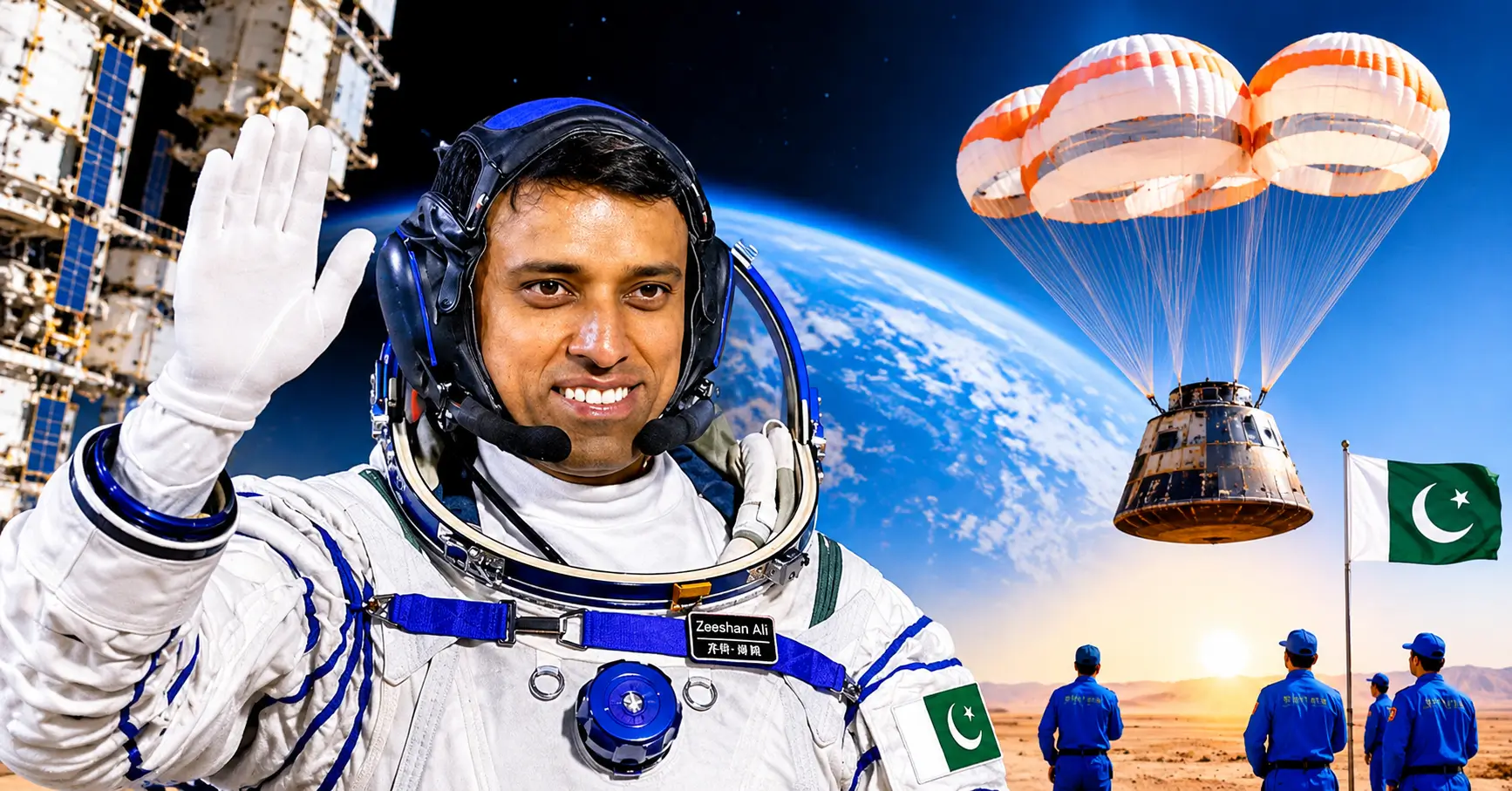

The Pakistani astronaut return is scheduled for 2:00 AM on Monday, November 30, as Wing Commander Muhammad Zeeshan Ali prepares to conclude his historic mission aboard China’s Tiangong space station. The return will mark another milestone in Pakistan’s space programme.
According to the official SUPARCO Mission Hub, Ali is expected to begin his return journey at approximately 9:00 PM on Sunday, November 29. He will travel aboard China’s Shenzhou-23 spacecraft, with the landing scheduled in Inner Mongolia, China.
Pakistani Astronaut Return Date and Time Confirmed

Pakistan’s first orbital astronaut will return to Earth early Monday after completing his short-duration mission in space. The scheduled landing time is 2:00 AM Pakistan Standard Time, November 30, according to the official mission dashboard.
The return operation is expected to begin several hours earlier, at approximately 9:00 PM on Sunday. These timings refer to different stages of the journey, with Monday’s early-morning landing marking the mission’s expected conclusion.
| Mission detail | Confirmed information |
|---|---|
Astronaut | Muhammad Zeeshan Ali |
Return date | November 30, 2026 |
| Expected landing | 2:00 AM PKT |
Return journey begins | 9:00 PM, November 29 |
| Return spacecraft | Shenzhou-23 |
Landing site | Dongfeng, Inner Mongolia |
| Mission destination | Tiangong space station |
When Will Muhammad Zeeshan Ali Land in Pakistan Time?
People following Pakistan’s first human orbital mission can expect the landing during the early hours of Monday. The 2:00 AM schedule is particularly important because it provides a specific reference for tracking the spacecraft’s return.
However, the published schedule represents an expected landing rather than a guarantee of an exact touchdown minute. Spacecraft operations, atmospheric conditions and recovery procedures can affect the final timing of a crewed landing.
Where Will Pakistan’s First Astronaut Land?

Ali is expected to land at the Dongfeng landing site in Inner Mongolia, China. The location is part of China’s established recovery arrangements for crewed space missions and will host the returning Shenzhou-23 spacecraft.
Recovery teams will be responsible for locating the capsule, assisting the astronauts after landing and conducting the necessary post-flight procedures. The operation will conclude Ali’s journey from China’s orbital space station back to Earth.
Why Is Ali Returning Aboard Shenzhou-23?
Although Ali travelled into orbit aboard Shenzhou-24, his return journey will take place aboard Shenzhou-23. This arrangement is connected to the crew rotation process at China’s Tiangong space station, where incoming and outgoing astronauts exchange responsibilities.
READ MORE: Islamabad Convention Centre Gets July 2027 Deadline
The Shenzhou-24 crew arrived at the station on November 25, joining the astronauts already living aboard the orbital facility. Following the handover, Ali is scheduled to depart with members of the outgoing Shenzhou-23 crew.
Who Will Accompany the Pakistani Astronaut?
Two Chinese astronauts, Zhang Zhiyuan and Li Jiaying, are expected to accompany Ali aboard Shenzhou-23. Zhang will command the return mission, while the three-person crew will travel together towards the designated recovery location in Inner Mongolia.
Meanwhile, Chinese astronaut Zhu Yangzhu is expected to remain aboard Tiangong alongside the incoming crew. His extended assignment involves research into how the human body responds to prolonged exposure to the space environment.
How Pakistan’s First Human Spaceflight Mission Unfolded
The mission began on November 25, when Shenzhou-24 launched from China’s Jiuquan Satellite Launch Centre aboard a Long March-2F rocket. Ali travelled alongside Chinese commander Tang Hongbo and flight engineer Wu Yi.
The spacecraft subsequently docked with Tiangong, making Ali the first Pakistani to enter Earth’s orbit and the first foreign astronaut to visit China’s space station. His participation also represented China’s first crewed mission involving an international astronaut.
Scientific Experiments Conducted Aboard Tiangong

Ali’s assignment involved scientific research under the China-Pakistan space cooperation programme. His work included experiments involving biotechnology, agricultural research and advanced materials, demonstrating that the mission extended beyond symbolic diplomatic and national achievements.
One notable experiment involved photosynthetic cyanobacteria, with Ali documenting their growth and collecting biological samples for further examination on Earth. Researchers are studying their potential for producing oxygen and protein in closed-loop life-support systems.
The reported Pakistani research activities covered several areas:
Photosynthetic microorganisms and biological sample collection.
Graphene-based hybrid composite materials.
Self-healing carbon-fibre composite materials.
Effects of microgravity on quinoa seeds.
What Happens During the Astronaut’s Return to Earth?
The return journey involves more than simply leaving the space station. The crew must complete departure procedures, separate from Tiangong, prepare the spacecraft for atmospheric re-entry and follow the planned landing sequence.
During re-entry, the return capsule encounters intense atmospheric heating before deploying its parachute system for a controlled descent. Recovery personnel then assist the astronauts and arrange initial medical assessments following their return.
How Long Was the Pakistani Astronaut’s Space Mission?
Ali’s orbital assignment was designed as a short-duration mission rather than a conventional six-month space station rotation. Before the flight, the expected stay was reported at approximately five to ten days, reflecting the mission’s specialised scientific objectives.
His preparation included seven months of training in Beijing, covering spacecraft operations, physical conditioning and intensive Chinese-language instruction. The training was essential for working alongside Chinese astronauts and carrying out assigned responsibilities aboard Tiangong.
Pakistan-China Space Cooperation and Future Missions
Pakistan’s participation in the mission follows a cooperation agreement signed by SUPARCO and China’s Manned Space Agency in February 2025. The arrangement established a training programme through which Pakistani candidates could prepare for China’s crewed spaceflight activities.
Muhammad Zeeshan Ali and Khurram Daud were selected for training, with Ali ultimately chosen as the mission’s payload specialist. The programme reflects a broader partnership involving satellite technology, scientific research and opportunities for future cooperation.
Why This Mission Matters for Pakistan’s Space Programme
The Pakistani astronaut return will close an important chapter in the country’s entry into human spaceflight. Beyond the national recognition, the mission has provided Pakistani researchers with an opportunity to conduct experiments in microgravity and gain practical experience.
Space policy expert Blaine Curcio described the mission’s potential benefits as bringing Pakistan prestige, scientific and technological knowledge, and deeper collaboration with China. These benefits could support future research partnerships and strengthen Pakistan’s participation in international space activities.
For Pakistan, the next challenge will be translating this achievement into sustained scientific progress, stronger research capabilities and further participation in international missions. The experience gained through Ali’s flight could provide a foundation for developing more ambitious space exploration projects.