
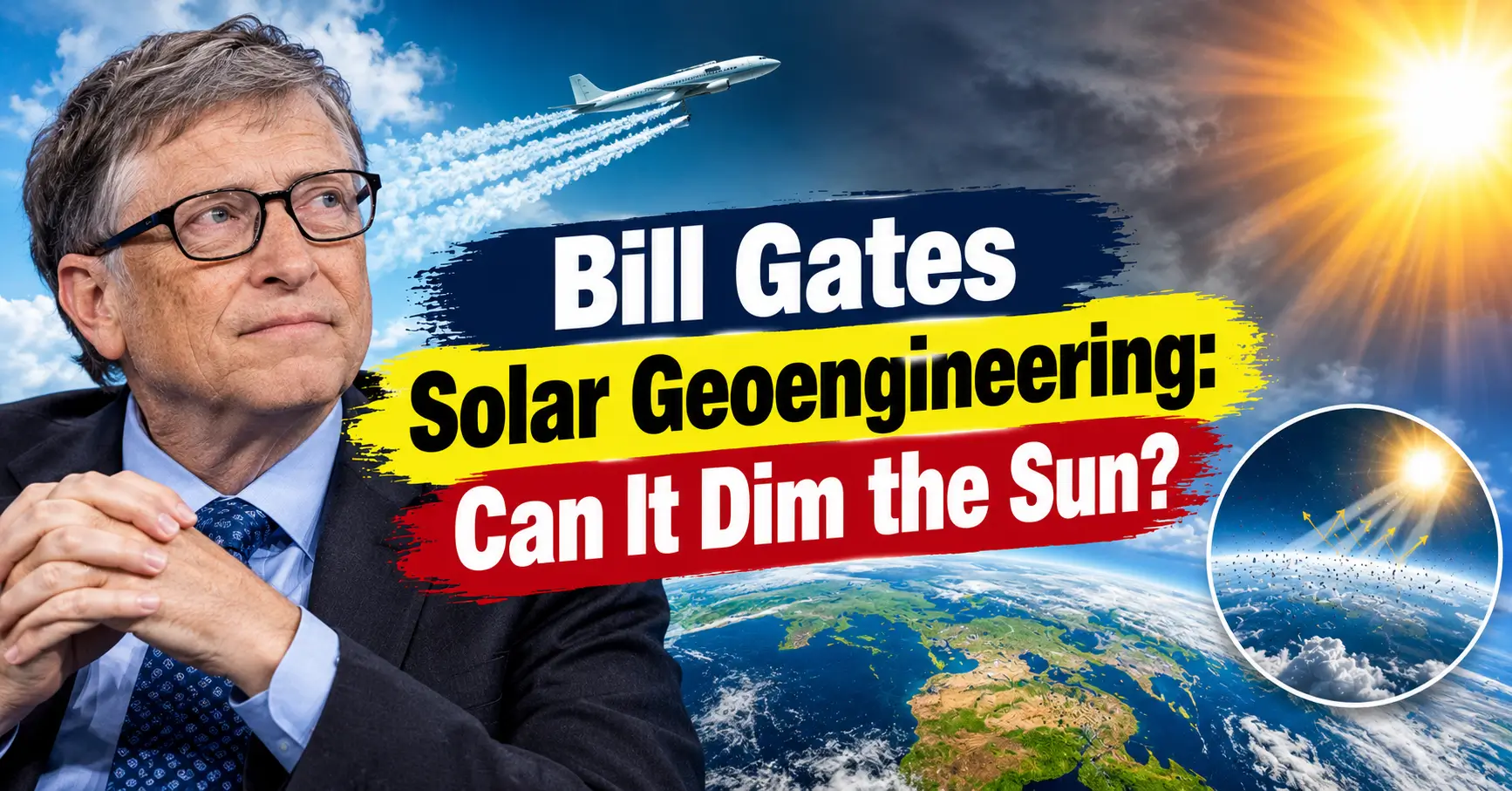

Bill Gates solar geoengineering research is drawing renewed attention as scientists examine whether reflecting sunlight away from Earth could temporarily slow global warming. The controversial concept raises questions about climate intervention, environmental safety and international control.
The Microsoft co-founder has funded research into technologies that could influence Earth’s temperature. However, supporting scientific investigation is not the same as launching a programme to block sunlight or changing the planet’s climate without international approval.
What Is Solar Geoengineering and How Does It Work?

Solar geoengineering, formally called solar radiation modification (SRM), describes proposed techniques that would reflect a portion of incoming sunlight back into space. The objective is to reduce the amount of solar energy warming Earth’s surface.
One prominent proposal involves releasing reflective aerosols into the stratosphere, the atmospheric layer above most weather systems. These particles could scatter sunlight, creating a temporary cooling effect similar to certain large volcanic eruptions.
Why Bill Gates Has Funded Sun-Dimming Research
Gates has supported research into geoengineering because scientists may need a better understanding of potential emergency climate interventions. His involvement includes funding research associated with Harvard’s Solar Geoengineering Research Program, established in 2017.
READ MORE: Green Card Rules Are Changing This September, Applicants Need to Pay Attention
In an earlier interview, Gates described geoengineering as an insurance policy rather than a preferred climate solution. He explained that he was not pushing for its use, while arguing that understanding the technology could become valuable if conventional climate action proved insufficient.
How Stratospheric Aerosol Injection Could Cool Earth
Stratospheric aerosol injection (SAI) is among the most discussed solar geoengineering proposals. It would involve releasing substances such as sulphur dioxide high above Earth, where they could form reflective particles and scatter incoming sunlight.
The scientific principle has a natural comparison: volcanic eruptions. The 1991 Mount Pinatubo eruption injected approximately 20 million tonnes of sulphur dioxide into the atmosphere, producing an estimated temporary global cooling of around 0.3 degrees Celsius.
What Happened to Harvard’s SCoPEx Experiment?

Harvard’s Solar Geoengineering Research Program supported the proposed Stratospheric Controlled Perturbation Experiment, commonly known as SCoPEx. Researchers planned to use a high-altitude balloon to investigate how small quantities of particles behaved in atmospheric conditions.
However, the experiment faced delays, public criticism and concerns about scientific oversight. Harvard ended the project in March 2024. Its cancellation did not terminate the wider scientific investigation into solar geoengineering or establish that large-scale deployment had occurred.
What Bill Gates Says About Deploying the Technology
Gates has distinguished between studying solar geoengineering and actually implementing it. During his November 2025 discussion at the California Institute of Technology, he addressed the possibility of emergency intervention if climate conditions became significantly more dangerous.
He emphasised extreme caution, explaining that researchers should understand potential consequences before considering deployment. His position reflects a debate about whether investigating a controversial technology could provide useful knowledge without creating pressure to use it.
Environmental Risks of Reflecting Sunlight
Despite its theoretical cooling potential, solar geoengineering could introduce environmental consequences that scientists cannot fully predict. Changes in atmospheric conditions might affect rainfall, regional temperatures, agricultural production and ecosystems across different parts of the world.
The US Government Accountability Office identified several concerns in its March 24, 2026 assessment, including possible ozone damage, increased air pollution, altered precipitation and geopolitical tensions. These uncertainties make environmental monitoring and independent scientific oversight essential.
Possible Effects on Rainfall and Monsoon Patterns

One major concern involves the uneven distribution of cooling. Different regions could experience different atmospheric responses, potentially changing rainfall patterns and affecting communities dependent on predictable seasonal weather.
For countries relying heavily on monsoon rainfall, including Pakistan, changes in precipitation could have serious agricultural and economic implications. However, these outcomes remain potential risks rather than established consequences of an operating global programme.
Ozone Depletion and Atmospheric Pollution
Researchers have also raised concerns about how injected particles might interact with atmospheric chemistry. Depending on the substances used and the scale of intervention, solar geoengineering could contribute to ozone depletion and other unwanted environmental effects.
These risks cannot be dismissed simply because the intended objective is cooling. The US assessment highlights uncertainties surrounding human health and environmental impacts, reinforcing the need for further research before any deployment decision.
Why Solar Geoengineering Raises Global Governance Concerns
Solar geoengineering presents a difficult international policy question because atmospheric interventions could affect countries far beyond the territory where an experiment or deployment begins. Governments may disagree over acceptable risks, responsibility and the distribution of potential benefits.
The United Nations has highlighted the absence of comprehensive international governance for solar radiation modification. Its scientific advisory body has called for inclusive international discussion, precautionary measures and stronger assessment of possible consequences.
What the Latest Scientific Assessments Reveal
A major development came in May 2026, when the United Nations Environment Programme published an updated working paper examining solar radiation modification. It concluded that existing scientific evidence does not establish SRM as a viable climate response.
The March 2026 US Government Accountability Office review also identified significant knowledge gaps, limited oversight and geopolitical challenges. Together, these assessments show that solar geoengineering remains an uncertain research area rather than an established solution to global warming.
The latest findings can be summarised below:
| Assessment | Date | Main finding |
|---|---|---|
US GAO review | March 24, 2026 | Environmental and governance uncertainties |
UNEP working paper | May 2026 | Evidence does not support SRM as a viable climate solution |
| UK Government position | September 29, 2026 | No support for deployment; responsible research supported |
Could Solar Geoengineering Become a Climate Emergency Option?
Solar geoengineering could attract greater attention if global warming accelerates and conventional mitigation measures fail to prevent severe climate impacts. Supporters argue that understanding possible interventions beforehand could help policymakers evaluate emergency scenarios more responsibly.
However, reflecting sunlight would not remove greenhouse gases or address the underlying causes of climate change. Reducing emissions, adapting infrastructure and protecting vulnerable communities remain essential priorities, regardless of future developments in atmospheric intervention research.
The central question is therefore not simply whether humanity can dim sunlight, but whether governments and scientists could ever justify an intervention with consequences extending across national borders. What do you think: should solar geoengineering research continue, or is interfering with Earth’s atmosphere too risky?