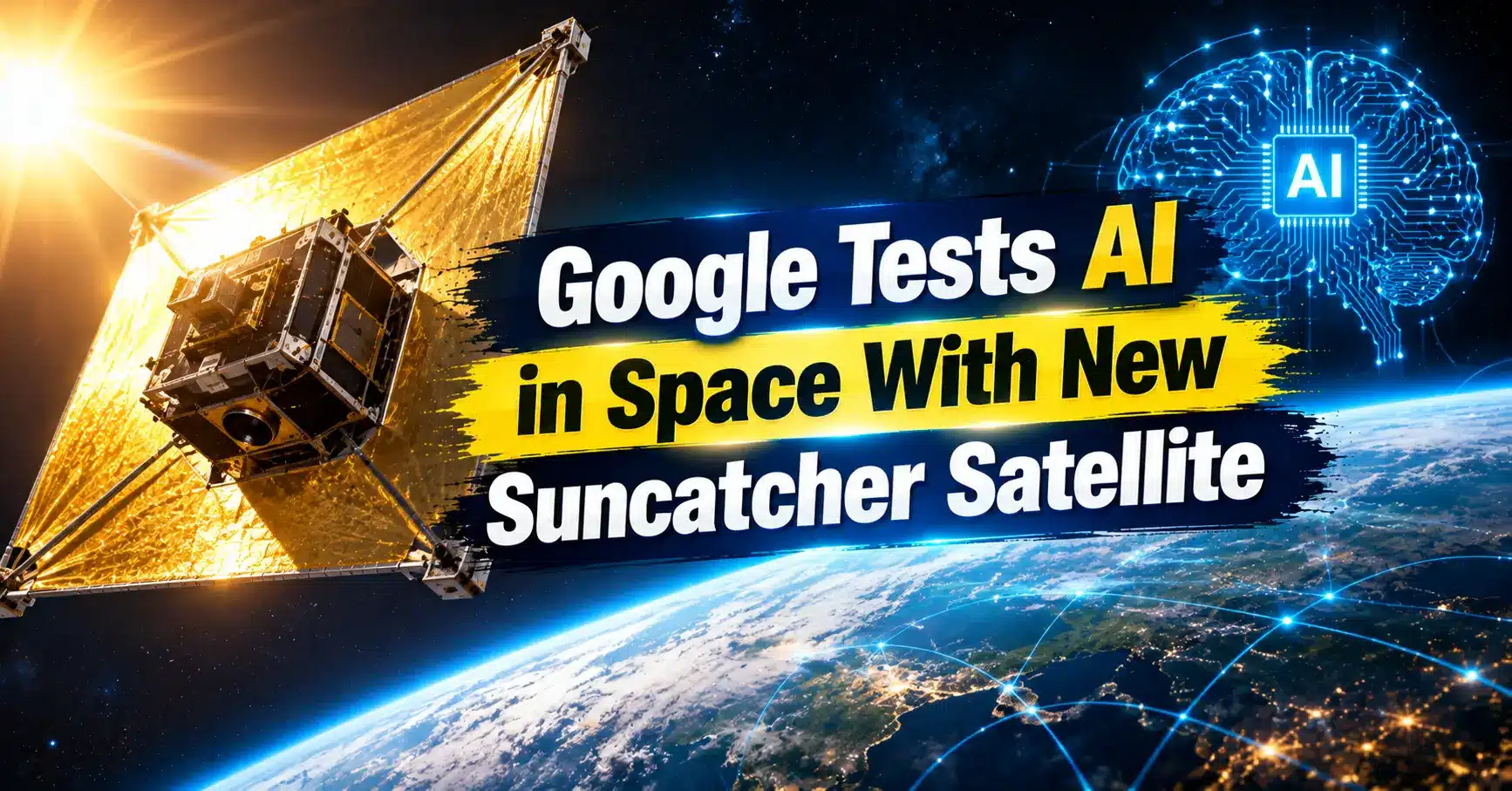

AI chips are now circling Earth. On October 1, 2026, Google’s first Project Suncatcher prototype reached orbit, carrying processors built to run machine learning where sunlight is nearly constant and no power grid is needed.
The experiment is small: four chips, one satellite, one rideshare slot. But it is the first real-world test of whether Google’s processors can survive and compute in orbit, rather than in simulation.
What Google Launched on October 1

Google’s prototype rode SpaceX’s Transporter-18 rideshare mission into low Earth orbit on October 1, 2026. Travis Beals, Google’s senior director for Paradigms of Intelligence, said engineers confirmed contact and the satellite was “operating as expected.”
Planet, the Earth-observation company, is Google’s partner on the spacecraft. Google will spend the coming weeks collecting data on how its chips cope with spaceflight stress, radiation and temperature extremes, then feed the findings into later designs.
Inside the Suncatcher Prototype Satellite
Reports on the mission describe a refrigerator-sized craft carrying four Trillium-generation Tensor Processing Units, Google’s custom chips, powered by roughly one kilowatt of solar generation. Google’s own posts do not publish those payload figures.
Those chips are reported to run Gemini models in bursts of about 15 minutes. That puts the payload closer to a single server than a data centre, which is exactly the point of a first test.
| Detail | Status |
|---|---|
| Launch date | October 1, 2026 (confirmed by Google) |
| Mission | SpaceX Transporter-18 rideshare (confirmed by Google) |
| Partner | Planet (confirmed by Google) |
| Chips | Four Trillium-generation TPUs (reported) |
| Power | About 1 kW solar (reported) |
| Compute window | About 15 minutes, then cooldown (reported) |
| Next milestone | Two satellites in 2027 (confirmed by Google) |
Why Orbit Appeals to AI Infrastructure Planners
In low Earth orbit, satellites get near-constant sunlight. Google says panels there can generate up to eight times more power than on the ground, which matters as AI workloads put growing strain on terrestrial grids.
Google first outlined Project Suncatcher in November 2025, citing surging data-centre energy demand. The long-range concept envisions clusters of orbiting satellites linked by lasers, handling larger machine learning jobs together.
Surviving Launch Vibration and Radiation

A launch to orbit lasts about 10 minutes, with sustained loads up to 10 times gravity. Individual components, including the chips, can feel 50 to 100 g. Engineers shook the satellite on three axes to mimic launch.
Radiation is the second threat. Google tested its Trillium chips in a proton beam at UC Davis’s Crocker Nuclear Laboratory while they ran AI workloads, and says they can absorb more total ionizing dose than a five-year mission delivers.
The Cooling Problem Behind the 15-Minute Limit
Space is cold, yet a vacuum is a poor place to shed heat. With no airflow, chips can only lose heat through radiators, so the prototype’s processors reportedly power down after about 15 minutes.
READ MORE: Meta Just Reimagined What Smart Glasses Can Do
Google is pairing heat pipes with radiators and has tested the design in a thermal vacuum chamber. Orbit will show whether that cooling system holds up, which makes thermal performance arguably the most revealing measurement of the mission.
What Google Says About the Mission
Beals frames the flight as a learning exercise, not a product demo. He wrote that the launch is about “seeing what works, identifying points of failure, and applying those findings to future missions.”
Google calls Suncatcher a long-term research moonshot. Its peer-reviewed paper in the journal Joule, available since launch day, details the research behind the mission, giving outside engineers material to scrutinise closely.
What the Test Cannot Prove Yet

Four chips on one satellite say little about economics or scale. Google’s full concept involves an 81-satellite constellation near 650 kilometres altitude, a design that remains a proposal, not a build.
No result from this launch will show whether orbital AI computing can compete on cost or latency. It will show whether the hardware survives and how well it cools. Everything else remains projection.
Cost, Debris and the Mid-2030s Question
When Google unveiled the concept in 2025, it projected that falling launch costs could make space-based data centres economically feasible by the mid-2030s. That is a forecast, and the in-orbit data cannot confirm it.
One independent analysis warns that the sun-synchronous orbit the concept targets is among the most congested in low Earth orbit. Collision avoidance and a US five-year disposal rule would shape any scaled-up AI system.
The 2027 Laser-Link Test and What to Watch
The next milestone arrives in 2027, when Google plans to put two satellites in orbit and test laser links between them. Holding those links steady at high bandwidth over short distances demands extraordinary precision.
Those links matter because each future satellite is meant to carry dozens of chips and work as part of a cluster. Without reliable laser connections, orbital computing cannot scale beyond isolated machines.
- Thermal results: whether the radiators sustain the reported 15-minute compute cycles.
- Radiation effects: bit flips or faults while AI workloads run in orbit.
- The 2027 launch: two satellites and the first inter-satellite laser test.
What It Means for AI Data Centres
If the hardware performs, Google gains evidence that orbit is worth another test, nothing more. The company is checking whether an alternative to power-hungry ground facilities is physically possible before asking whether it is affordable.
If the cooling or radiation results disappoint, the lessons still count. Google describes the mission as a way to find points of failure, and a failed component now is cheaper than one discovered in an 81-satellite constellation.