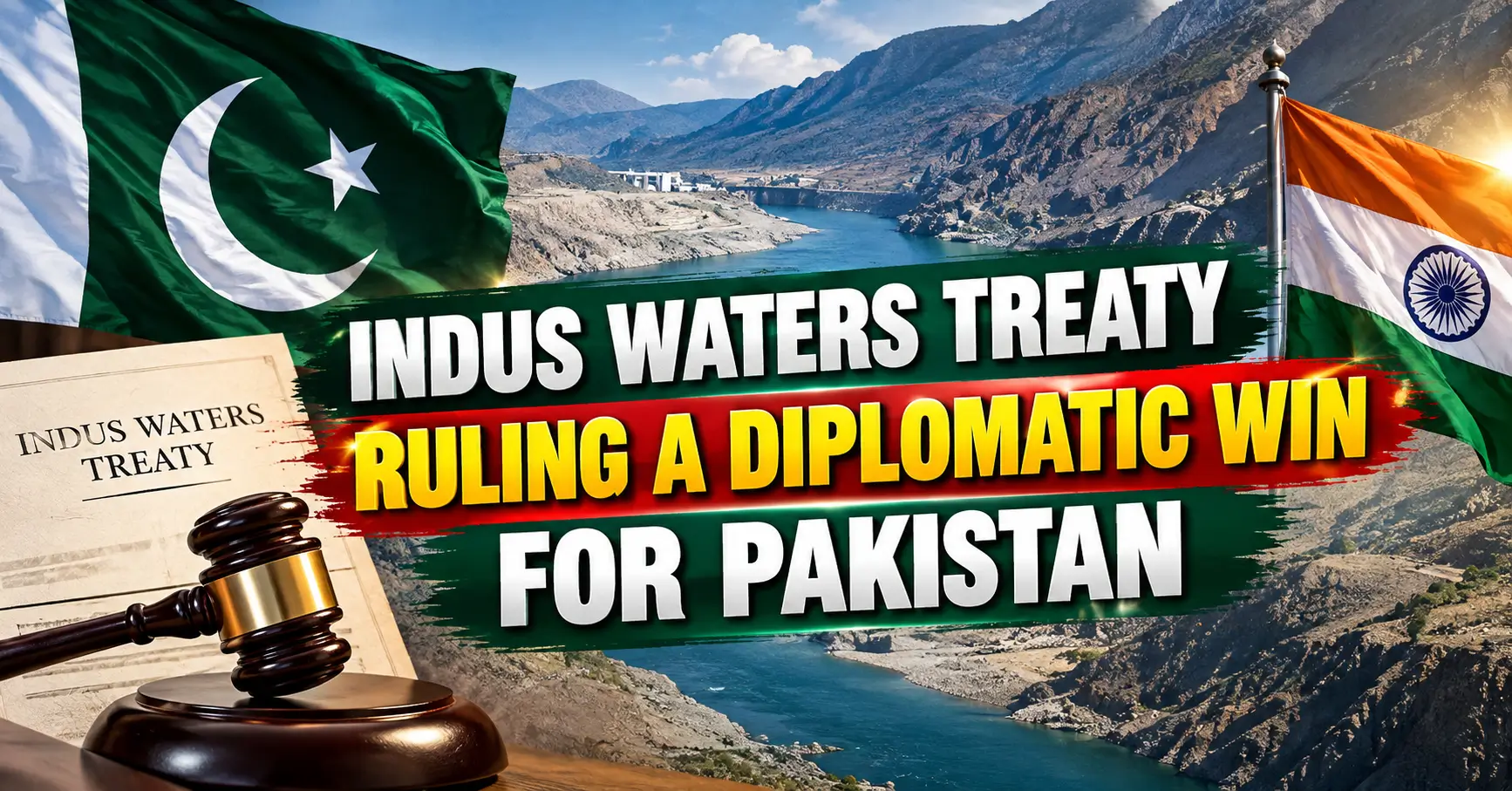

The Indus Waters Treaty ruling delivered at The Hague on August 31 has handed Pakistan its clearest legal victory yet in a decades-old water dispute with India.
A five-member tribunal unanimously found that the treaty “remains fully in force” and that India “must observe its obligations” under it. India rejected the decision within hours. But the symbolism, and the substance, both favour Islamabad.
What the Indus Waters Treaty Ruling Actually Says

The Indus Waters Treaty ruling settles a question that had hung over South Asia for more than a year: can one country simply walk away from a binding water-sharing pact? The Permanent Court of Arbitration said no. The tribunal stated that none of India’s cited grounds could justify suspension or termination of the treaty.
The panel went further than a symbolic statement. It also placed restrictions on construction at India’s Ratle hydroelectric project in Kashmir, tying its future to a separate technical process. This gives Pakistan a concrete, enforceable outcome — not just a favourable opinion on paper.
How the Dispute Reached The Hague
The roots of this fight trace back to April 2025. Following the Pahalgam terrorist attack, India announced it would hold the treaty in abeyance until Pakistan “credibly and irrevocably” ended its alleged support for cross-border terrorism. Pakistan denied any involvement.
ALSO READ: Referendum on new provinces subject to parliament’s nod: Rana Sanaullah
That move broke a six-decade streak. The 1960 treaty had survived three wars and repeated diplomatic freezes without ever being suspended outright. Pakistan applied to the PCA in March 2026 asking the court to rule on the treaty’s status, and hearings went ahead in April with only Pakistan present, since India refused to participate.
India’s Rejection of the Ruling

New Delhi didn’t soften its position. India’s Ministry of External Affairs said the panel “has no jurisdiction whatsoever to pronounce on India’s sovereign decisions.” The ministry called the body illegally constituted and said its rulings carry no weight over Indian projects.
That stance leaves an awkward gap between law and practice. Key points from India’s position:
- India maintains the treaty remains suspended domestically, regardless of the ruling.
- New Delhi has never formally recognised the arbitration mechanism’s legitimacy.
- Officials argue the dispute is a sovereignty matter, not a legal one.
- No timeline has been given for resuming the Permanent Indus Commission’s work.
Ratle Hydroelectric Project Restrictions Explained
Beyond the headline finding on treaty status, the tribunal imposed specific limits on India’s Ratle plant in Indian-administered Kashmir. The panel restricted construction at the site pending a World Bank-appointed neutral expert’s decision, expected in July 2027.
Practically, this blocks work above certain levels on the dam wall and intake structure until that process concludes. It’s a narrow technical ruling, but it carries real weight — it stops facts on the ground from being set before the legal questions are resolved.
Timeline of the Indus Waters Dispute
| Date | Event |
|---|---|
| 1960 | Indus Waters Treaty signed, brokered by the World Bank |
| April 2025 | India places treaty “in abeyance” after Pahalgam attack |
| June 2026 | PCA issues supplemental award reaffirming its jurisdiction |
| March–April 2026 | Pakistan files case; hearings held without India |
| August 31, 2026 | PCA rules treaty remains fully binding |
| July 2027 (expected) | Neutral Expert ruling on Ratle and Kishenganga |
Pakistan’s Diplomatic Response

Islamabad moved quickly to project the ruling as validation of its long-standing position. Pakistan’s government said in a statement that India must fully comply with its obligations under the treaty and with the binding decisions of its dispute settlement mechanisms.
Prime Minister Shehbaz Sharif took the message to Bishkek days later, telling the Shanghai Cooperation Organisation summit that water is “the foundation of life” in the region and must never be used as a weapon or a political pressure tool. Balochistan’s Chief Minister, Mir Sarfraz Bugti, separately called the ruling a major legal and diplomatic victory for the country.
International and Expert Reaction
Reaction outside South Asia has largely reinforced Pakistan’s framing. China’s South China Morning Post described the decision as an unexpected setback for India, noting that the ruling strengthened Pakistan’s position after decades of tension over the water-sharing agreement.
Legal analysts have been more cautious. Commentary from Legal Service India notes that the ruling gives Pakistan an important diplomatic and legal advantage, but doesn’t by itself resolve the practical dispute over future water flows or hydroelectric development. In short: a win on paper, not yet a win on the ground.
What the Ruling Means for the Region
The stakes go well beyond legal bragging rights. The Indus river system irrigates roughly 80 percent of Pakistan’s farmland, according to reporting on the case, making any disruption a direct threat to food security, not just diplomacy.
Key implications worth watching:
- Farmers downstream remain exposed until India resumes data-sharing on river flows.
- The Permanent Indus Commission has not met since May 2022, stalling routine cooperation.
- Site inspections required under the treaty have reportedly been blocked since 2023.
- Trust between the two governments remains at its lowest point in the treaty’s history.
The Road Ahead: The 2027 Neutral Expert Process
The Indus Waters Treaty ruling doesn’t end the story it shifts it to a new stage. The Neutral Expert process on Ratle and Kishenganga, expected to conclude around mid-2027, will decide technical questions the arbitration court didn’t touch.
Deputy Prime Minister Ishaq Dar has called for both sides to resume and strengthen technical dialogue, transparency, and data sharing under the treaty. India engages with that call, or continues to reject the entire framework, will determine if this diplomatic win translates into water security on the ground.