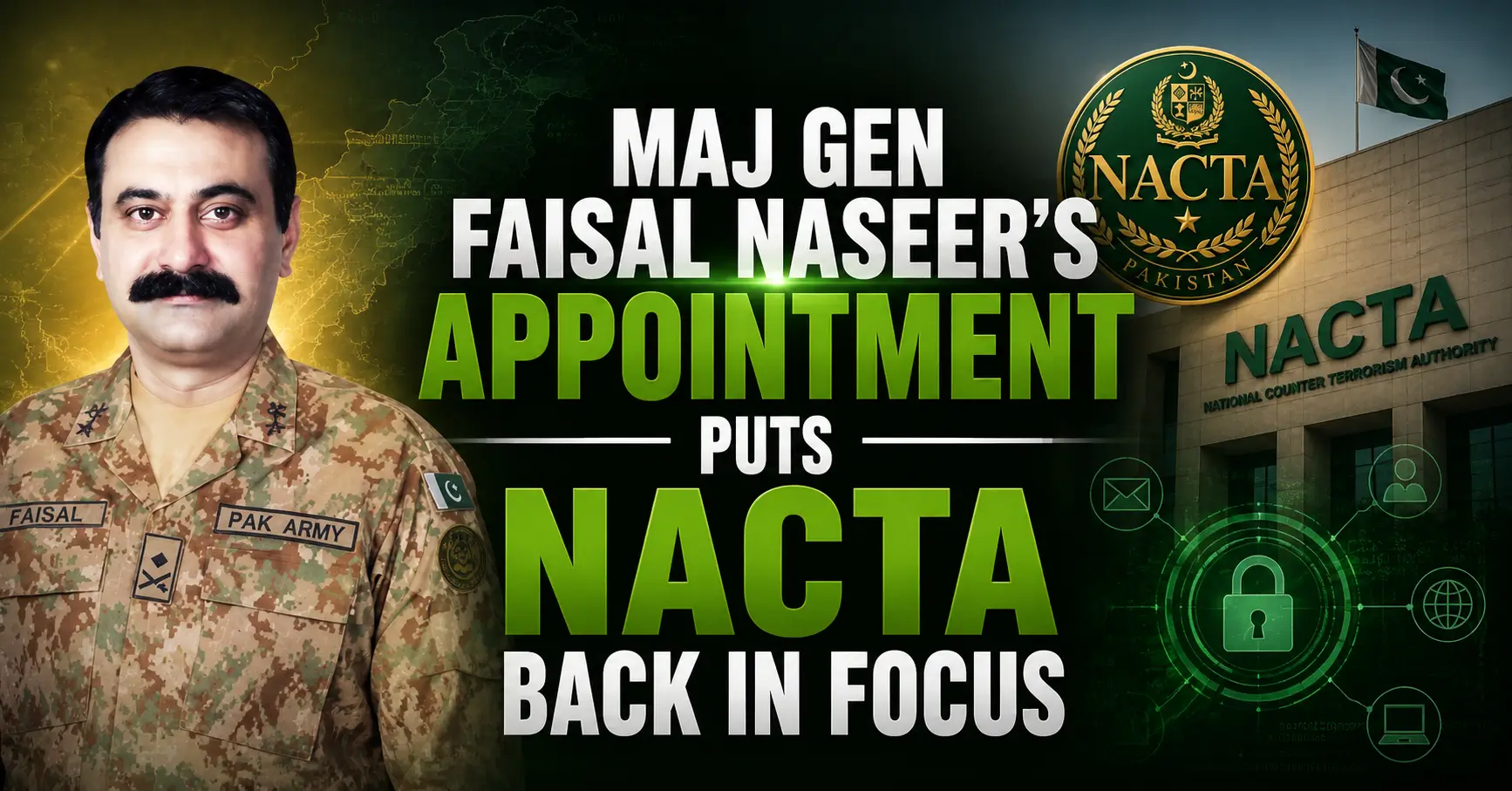

The Faisal Naseer NACTA appointment has landed at a tense moment for Pakistan’s security establishment. A notification issued by the Establishment Division on Friday, September 4, 2026, confirmed that Major General Faisal Naseer would take charge as National Coordinator of the National Counter Terrorism Authority for a three-year term.
The move places a serving ISI officer at the helm of a body that has, for most of its history, been run by police officers. That alone has turned heads in Islamabad’s policy circles.
Who Is Maj Gen Faisal Naseer?

Faisal Naseer NACTA appointment follows a career built almost entirely inside intelligence and counter-terrorism circles. He was serving as Director General Counter-Intelligence at the Inter-Services Intelligence headquarters, a post often mistaken for heading ISI’s counter-intelligence wing.
In reality, that role oversees the agency’s Internal Wing, which handles domestic security matters. He holds the HI(M), T. Bt & Bar honours and was promoted to major general in 2022, shortly before assuming the DG(C) post.
Inside the NACTA Appointment Notification
According to the Establishment Division notification, Faisal Naseer’s NACTA posting was made under Section 9(1) of the NACTA Act, 2013, on a secondment basis. Civilian officers move through deputation; army officers move on secondment — a technical but meaningful distinction.
- Effective immediately, “until further orders”
- Three-year tenure, standard terms and conditions
- Notification circulated to the President’s Secretariat, PM Office, Cabinet Division and all four provincial chief secretaries
- Officer required to submit a charge assumption report
What NACTA Does — And Why This Appointment Matters
NACTA was established in 2008 under the Ministry of Interior before gaining legal and financial autonomy through the NACTA Act, 2013. Its mandate covers national counter-terrorism strategy, threat assessments, research and coordination between federal and provincial agencies.
READ MORE: 25 Pakistani nationals return home after release from Indian jails
The authority gained real prominence after the December 2014 Army Public School attack, when it was tasked with monitoring the 20-point National Action Plan. Even so, NACTA has long struggled to build independent institutional capacity of its own.
A History of Leadership Turnover and Institutional Gaps
NACTA’s National Coordinator office has seen more than a dozen appointees since inception, the overwhelming majority drawn from the police service rather than the military. Naseer appointment therefore marks a genuine departure from that pattern.
The authority’s institutional rhythm has also slipped. Its seventh Executive Committee meeting was held in April 2024, and no eighth meeting appears on NACTA’s public records as of early September 2026 — a gap analysts say reflects deeper coordination problems.
Security Backdrop: Balochistan, KP and the Afghan Border

The timing of the NACTA appointment is not incidental. Pakistan continues to confront a heightened militant threat concentrated in Balochistan and Khyber Pakhtunkhwa, where security forces are conducting sustained counter-terrorism operations.
Officials and commentators have framed the appointment as part of a broader push to bring rising terrorism attributed to cross-border militancy from Afghanistan under a more coordinated national response, rather than a routine bureaucratic reshuffle.
Analyst View: A Departure From Precedent
Coverage of the appointment has repeatedly noted that NACTA “remains largely dependent on officers posted to it from other government institutions,” according to reporting cited by Geo News, rather than building a permanent, dedicated cadre of its own.
That dependency is precisely why Faisal Naseer NACTA appointment carries symbolic weight. Placing a senior ISI officer with deep intelligence and counter-terrorism experience atop the authority signals an attempt to tighten the link between military intelligence and civilian-facing counter-terrorism policy.
What Comes Next for NACTA
NACTA appointment translates into lasting institutional reform remains the open question. NACTA continues implementing the National Prevention of Violent Extremism Policy 2024 alongside its counter-financing and research functions.
The real test, analysts suggest, will be whether Faisal Naseer tenure is paired with stronger coordination among intelligence and law-enforcement agencies, and whether NACTA’s dormant executive and governing forums are revived to match the urgency of the current threat environment.