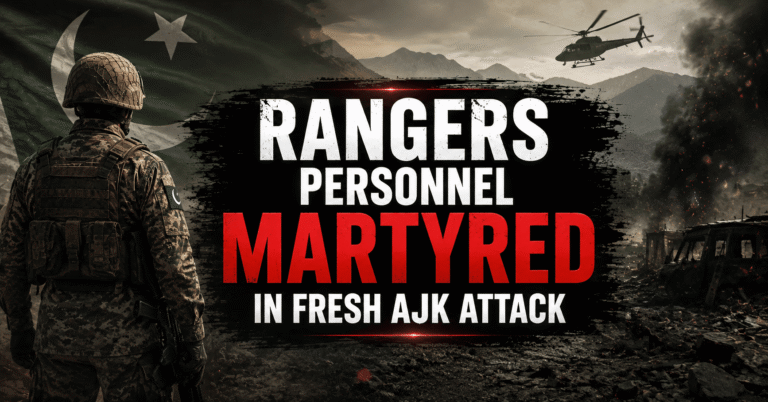

Rangers personnel martyred in Azad Jammu and Kashmir once again this week, as gunmen linked to a banned protest group opened fire on a security convoy trying to reopen a blocked mountain road. The attack, confirmed by security sources on Wednesday, has pushed the death toll among law enforcement officers in the restive region into double digits since June.
A soldier bled out from a chest wound within minutes. Another was carried away with a shattered shoulder. For residents of Rawalakot and the surrounding hill districts, it was the latest jolt in a summer that has refused to calm down.
How the Sarsawa-Tarar Khel Attack Unfolded

The Rangers personnel martyred this week were part of a unit escorting a road-clearance operation on the Sarsawa-Tarar Khel route, a corridor that had stayed blocked for weeks. Suspected snipers, security sources said, targeted the convoy from elevated positions as officers worked to restore access.
- Rangers soldier Shah Nawaz was struck in the chest and later died of his injuries
- Lance Naik Bilal sustained a gunshot wound to the shoulder and remains under treatment
- The operation aimed to reopen a supply route that had cut off food and transport access for local communities
Officials say the attackers used elevated vantage points, echoing tactics seen in earlier clashes near Rawalakot’s Matial Maira bus terminal in July.
Who Was Naik Shah Nawaz Shaheed?
Shah Nawaz hailed from Khairpur, Sindh — hundreds of kilometres from the hills where he died. He is the latest in a string of Rangers officers pulled into a conflict that began as a local protest movement and hardened into an armed standoff.
His death adds a name to a growing list of security personnel casualties that Pakistani authorities say reflects a deliberate campaign against the state’s presence in AJK, not spontaneous unrest.
Background — The Banned JAAC and Months of Unrest in AJK

The Jammu Kashmir Joint Awami Action Committee, or JAAC, was formally banned by the AJK government on June 5 under the Anti-Terrorism Act. Officials accused the group of shifting from a rights-based movement into organised violence against law enforcement.
READ MORE: JI Shutter-Down Strike: 8th-Day Protest Turns Nationwide
JAAC’s original demand centred on abolishing 12 reserved legislative seats for refugees from Indian-administered Kashmir, alongside broader political and economic grievances. What followed, according to police statements, was a pattern repeated across multiple towns:
- Armed members allegedly opened fire in civilian areas to provoke a security response
- Improvised explosive devices were used alongside automatic weapons in several incidents
- Roads including the Kotli-Tarar Khal highway and Sarsawa-Tarar Khel route were blocked for extended periods
- Aerial surveillance was used by police to document some of the clashes
JAAC leadership has denied orchestrating armed attacks, insisting its protests remained peaceful and blaming security forces for opening fire first.
Security Personnel Casualties in AJK Since June
The scale of the unrest has been significant. An AJK information secretary said in early August that seven law enforcement personnel — including police and Rangers — had been martyred during the preceding weeks alone.
| Incident (2026) | Location | Rangers/Police Casualties |
|---|---|---|
| July 14 attack | Rawalakot, Matial Maira | 1 Rangers martyred, ~15 injured |
| Rawalakot/Tararkhal clashes | Poonch sector | 9 dead overall (security + protesters) |
| Early August unrest | Rawalakot, Mirpur | 7 total law enforcement martyred |
| August 26 attack | Sarsawa-Tarar Khel road | 1 Rangers martyred, 1 seriously injured |
Each entry adds weight to the argument authorities are now making publicly: that JAAC’s campaign has moved well beyond peaceful assembly.
Official and Expert Reaction

AJK’s home secretary described the pattern bluntly after the July violence, saying the use of automatic weapons and explosives “contradicts the banned committee’s claim of pursuing peaceful protests.” He called a decisive operation against armed groups “unavoidable.”
Police officials in Rawalakot have gone further, rejecting the narrative that protesters were unarmed. One senior police officer said the movement “is not a peaceful movement; it has become an armed group,” pointing to gunmen who took positions inside buildings before opening fire on security forces.
Elections held across AJK in July and August, meanwhile, have added another layer of tension — with rigging allegations from opposition parties compounding an already volatile security picture.
What This Means for Peace and Politics in AJK
Every fresh casualty hardens positions on both sides. For the state, each Rangers personnel martyred incident strengthens the case for sustained clearance operations along AJK’s key highways. For JAAC sympathisers, the mounting security response feeds the very grievance narrative the group was built on.
The practical cost is visible on the ground: blocked roads mean disrupted food supplies, stalled transport, and communities caught between an insurgency-style conflict and the state’s response to it. Until the Sarsawa-Tarar Khel corridor and similar routes stay open without gunfire, the human toll — soldiers and civilians alike — is unlikely to stop climbing.