
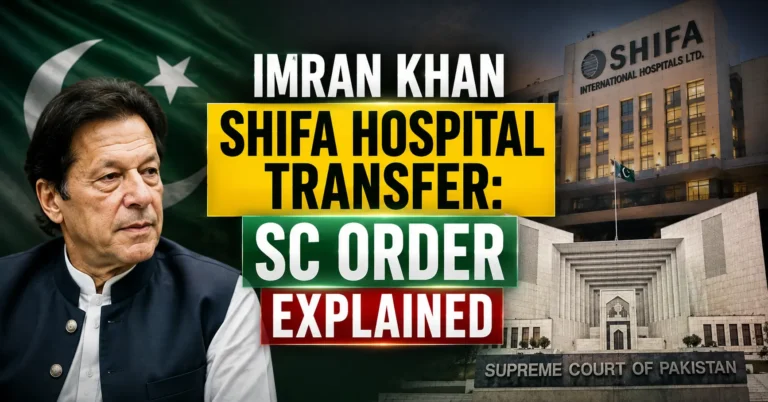

The Imran Khan Shifa Hospital transfer order landed on Tuesday, ending months of legal wrangling over the jailed former prime minister’s deteriorating health. A three-judge Supreme Court bench directed authorities to move him from Adiala Jail within 48 hours.
Justice Shahid Waheed headed the bench, joined by Justices Naeem Akhtar Afghan and Ishtiaq Ibrahim. The court ordered Imran Khan be shifted to Shifa International Hospital in Islamabad and remain there until doctors are satisfied with his condition.
Why the Court Intervened: Health Concerns Behind the Order

Health concerns had been mounting for weeks before the bench acted. A jail-submitted medical report flagged fluctuating blood pressure, restlessness, rapid heartbeat, and severe mental stress affecting the 73-year-old politician.
The numbers told their own story. Imran Khan blood pressure measured 140/100 mmHg on August 1, up sharply from 120/80 mmHg recorded back in February — a jump doctors couldn’t ignore.
Key figures from the medical report:
- Blood pressure: 140/100 mmHg (August 1) vs 120/80 mmHg (February)
- Right eye vision reportedly at 15% capacity, per an earlier February report
- Doctors recommended reduced stress, longer family meetings, and reading access
- A CT coronary angiography was suggested for further cardiac assessment
Inside the Medical Board’s Findings
The court-ordered medical board’s assessment became central to Tuesday’s ruling. Its recommendations pushed for more frequent family visits specifically to help manage Imran Khan anxiety and blood pressure levels.
READ MORE: PM Shehbaz’s Talks Invitation to PTI Still Stands: Crucial Update
Jail authorities, however, offered a contrasting account. They claimed his eye condition had improved following treatment at Pakistan Institute of Medical Sciences, describing his vision as “almost normal” — a claim PTI has disputed repeatedly.
| Metric | Jail Report | PTI/Family Claim |
|---|---|---|
| Right eye vision | “Almost normal” post-PIMS treatment | Severely impaired, delayed care alleged |
| Blood pressure | Elevated, requires monitoring | Critical, demands hospital-level care |
| Access to personal doctors | Limited, supervised | Insufficient, demanded expansion |
Legal Background: Years Behind Bars and Pending Cases

Imran Khan has been in custody since August 2023, initially over a corruption case involving roughly £190 million. That single case reshaped Pakistan’s political landscape almost overnight.
More recently, on December 20, 2025, Imran Khan and his wife Bushra Bibi received 17-year sentences in the Toshakhana-II case, tied to allegations of unlawfully retaining a Bulgari jewellery set. Anti-Terrorism Act cases linked to May 2023 protests remain pending too.
PTI’s Reaction to the Court’s Decision
Party spokespeople welcomed the ruling but didn’t hide their frustration over the delay. PTI’s Zulfikar Bukhari called it a welcome step, though he suggested it should have come far earlier to prevent further deterioration.
PTI Chairman Barrister Gohar Ali Imran Khan had pressed the same point days earlier, framing hospital access as both a medical necessity and a matter every citizen would expect for a former head of government.
- PTI had formally petitioned for the transfer after the jail’s own BP report surfaced
- The party demanded personal physicians be included in future medical assessments
- Weekly family meetings were also part of PTI’s core demands to the court
What Happens Next: The September 16 Hearing

Tuesday’s order isn’t a final resolution — it’s an interim measure. The Supreme Court adjourned proceedings until September 16, when Imran Khan broader appeal and medical situation will resume before the bench.
Until then, Imran Khan is expected to remain under hospital care at Shifa International, with security arrangements designed not to disrupt the surrounding area’s law and order. Treatment costs, notably, will be borne by Imran Khan himself, per the court’s directive.
Implications for Pakistan’s Political and Judicial Landscape
Beyond the immediate medical question, this order carries political weight. The court explicitly framed medical treatment as a fundamental right, a principle that could shape how future high-profile detention cases are handled.
For PTI, the ruling offers a symbolic and practical win after years of contested access battles. For the judiciary, it signals a willingness to intervene on humanitarian grounds even amid an ongoing, politically charged legal saga.