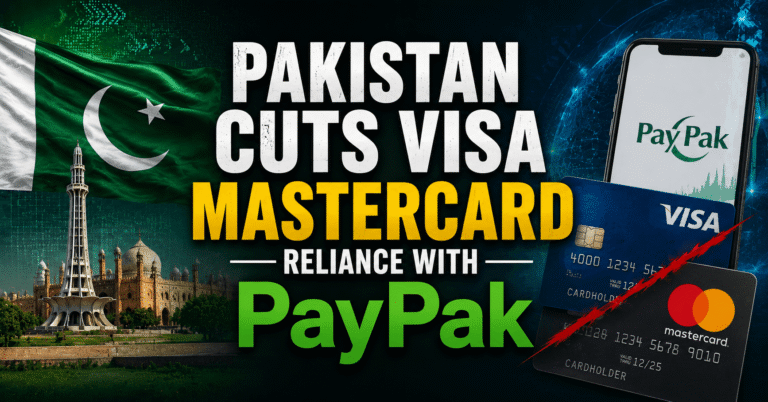

Pakistan Visa Mastercard reliance is shrinking fast, and the numbers explain why. Every swipe of a foreign-branded card sends money out of the country — and Islamabad has decided it can no longer afford that.
Pakistan’s Push to Cut Visa and Mastercard Reliance

For decades, Pakistan Visa Mastercard reliance shaped how ordinary people paid for anything online or abroad. Almost every debit and credit card issued by local banks ran on foreign rails by default.
That is now changing at pace. Government committees, the central bank, and private-sector players are all pulling in the same direction — toward a payments system built and settled inside Pakistan.
Why the State Bank Wants Less Dependence on Foreign Networks
The core issue is foreign exchange. Every transaction processed through an international card scheme carries settlement costs that ultimately flow out in US dollars, adding quiet pressure on reserves already under strain.
The State Bank of Pakistan has told the Senate Standing Committee on Finance and Revenue that promoting cost-efficient local alternatives is now a strategic priority, not a side project.
Key figures behind the shift:
- Roughly 90 million Visa and Mastercard cards are currently in circulation across Pakistan
- PayPak cards, by contrast, have not yet crossed 5 million
- Raast has processed 1.9 billion transactions worth PKR 44 trillion since launch
- Digital points of sale grew from 500,000 to 1.3 million terminals nationwide
PayPak and Raast: Building the Domestic Alternative

PayPak and Raast form the backbone of Pakistan’s answer to Visa and Mastercard. PayPak, run by 1LINK, now accounts for over 25% of debit cards issued, while Raast handles instant, low-cost domestic transfers.
Daily Raast P2M transactions jumped from nearly 60,000 in June 2025 to about 1.1 million by June 2026. The federal government backed this growth with a Rs3.5 billion QR-code subsidy programme in FY2025-26.
The $250 Million Question
Every year, an estimated $250 million leaves Pakistan through fees tied to Visa and Mastercard-linked transactions. That figure has become the rallying number behind the entire domestic-payments push.
READ MORE: Pakistan Wildlife Protection Awards 2026: Rangers and Communities Honoured in Islamabad
Analysts estimate PayPak could eventually retain up to 40% of that value inside the local economy — worth roughly $100 million annually — if adoption scales the way officials are hoping it will.
Government Salaries Could Shift to PayPak Next
1LINK has submitted a formal proposal to the SBP recommending that all government salary accounts be linked to PayPak cards. It is one of the boldest steps yet in the campaign to reduce dependence on foreign networks.
Senator Saleem Mandviwalla raised the card-count disparity directly in committee, while Bilal Azhar Kayani confirmed a dedicated prime ministerial committee is now driving documentation and digital-payment adoption across ministries.
The proposal also seeks to:
- Mandate PayPak cards for recipients of government subsidies and welfare payments
- Integrate public transport fare systems with PayPak
- Introduce tax incentives on PoS and e-commerce transactions made through PayPak
Pakistan’s First Homegrown Credit Card
Pakistan Visa Mastercard reliance faces its biggest test yet with the launch of the country’s first domestically developed credit card, built entirely on the PayPak network rather than a foreign scheme.
READ MORE: Bank of Khyber Partners with Wateen Telecom to Overhaul Digital Infrastructure
1LINK CEO Najeeb Agrawalla confirmed the card is being developed with member banks and the SBP, and will be accepted nationwide once it rolls out later this year — a milestone that makes Pakistan the region’s newest entrant with a full domestic card ecosystem.
Visa vs Mastercard vs PayPak: How They Compare

The practical differences between these networks still matter for everyday users, especially anyone who shops internationally or travels.
| Feature | Visa / Mastercard | PayPak |
|---|---|---|
| International acceptance | Global | Domestic only |
| Works for Netflix, Amazon, Steam | Yes | No |
| Typical transaction cost | Higher (FX-linked) | Lower (local rails) |
| Cards in circulation | ~90 million | Under 5 million |
| Overseas ATM use | Yes | No |
That gap in international usability is exactly why full replacement of Visa and Mastercard remains unlikely in the short term.
Lessons From Saudi Arabia and Russia
Pakistan is not writing this playbook alone. Saudi Arabia’s Mada network has become the default domestic card there, while Russia’s MIR kept payments functioning even through heavy sanctions pressure.
Industry commentary, including analysis from payments professionals in the region, has pointed to merchant incentives and mandatory acceptance rules as the factors that made those networks stick — lessons PayPak’s backers appear to be studying closely.
Challenges Standing in PayPak’s Way
Scaling from under 5 million cards to genuine mass adoption is not simply a matter of issuing more plastic. PayPak has to earn trust the way any newer network does.
That means proving reliability at the point of sale, tightening security standards, and matching the digital-integration experience that Visa and Mastercard have refined over decades. None of that happens overnight.
What It Means for Consumers and Businesses
For most Pakistanis, the shift toward PayPak will mean lower fees on everyday domestic transactions, especially as banks and welfare programmes move salary and subsidy payments onto the network.
Anyone who pays for foreign subscriptions, shops on international platforms, or travels abroad will likely still need a Visa or Mastercard for the foreseeable future — the two systems look set to run in parallel rather than one replacing the other.