
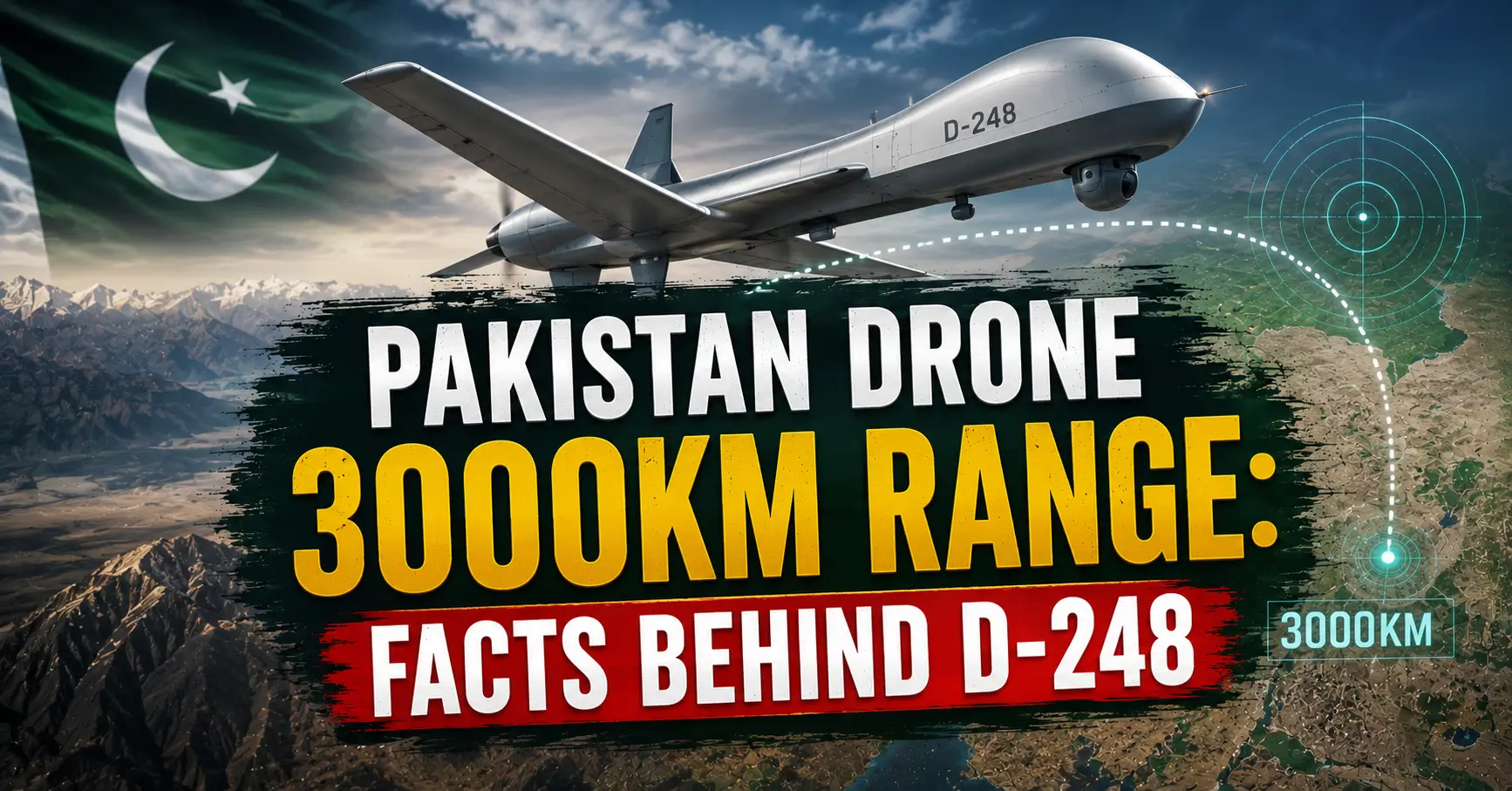

Pakistan Drone programme just crossed a line that few regional militaries have publicly claimed to reach. A domestically built loitering munition, unveiled this month, is now being described as capable of striking targets up to 3,000 kilometers away — a figure that, if verified, would put it in the same range class as Pakistan’s Shaheen-III ballistic missile.
The announcement came from Heavy Industries Taxila (HIT), a state-owned defence manufacturer, at the 2026 Indus Robotics and Autonomous Systems (RAS) Expo. Two systems were shown off together, and both numbers are big enough to demand a closer look before anyone takes them at face value.
Pakistan Unveils D-248 and S-369: A New Long-Range Benchmark

The Pakistan drone 3000km range claim centers on a single platform: the D-248, a tailless delta-wing loitering munition built by HIT. It was displayed publicly for the first time at the Indus RAS Expo held in Taxila this August.
Alongside it sat the S-369, an arrow-delta configuration with a shorter but still substantial reach of 1,500 to 2,000 kilometers. Together, HIT says, the pair now represents Pakistan’s largest and longest-range unmanned strike systems to date.
What a “3,000km Drone Range” Actually Means
Range numbers get thrown around loosely in defence reporting, so it’s worth pausing on what this one covers. HIT states the D-248 can engage targets between 2,200 and 3,000 kilometers from its launch point — not a fixed figure, but a band depending on payload and flight profile.
That distinguishes a loitering munition from a missile. A Pakistan Drone like the D-248 flies slower, cruises at roughly 185 km/h, and can loiter over a target area before striking — trading speed for endurance, precision, and a lower unit cost per mission.
Key specifications HIT has released for the D-248:
- Range: 2,200–3,000 km
- Maximum take-off weight: 240 kg
- Payload: 30–50 kg
- Wingspan: 3.3 meters
- Maximum speed: 225 km/h; cruise speed: 185 km/h
- Endurance: 12–14 hours
- Flight ceiling: up to 4,500 meters
D-248 vs S-369 vs Shaheen-III: Specifications Compared

Placing the two new drones next to Pakistan’s existing long-range missile gives readers a clearer sense of scale — and shows why comparisons to Shaheen-III have become unavoidable in coverage of this launch.
| System | Type | Range | Payload | Speed |
|---|---|---|---|---|
| D-248 | Loitering munition | 2,200–3,000 km | 30–50 kg | 225 km/h max |
| S-369 | Loitering munition | 1,500–2,000 km | 30–50 kg | 220 km/h max |
| Shaheen-III | Ballistic missile | ~2,750 km | 1,000–1,200 kg | Supersonic |
The table makes the trade-off obvious. Shaheen-III carries roughly twenty times the payload but travels at ballistic speed and costs far more per unit. The D-248, by contrast, is built for volume and persistence rather than raw destructive mass.
Why Taxila’s Announcement Matters Strategically
Pakistan has spent the last two years accelerating indigenous drone production, partly to reduce reliance on imported systems that carry sanctions risk. The D-248’s design — a tailless delta layout — closely mirrors Iran’s Shahed-136, a lineage Pakistani outlets have openly acknowledged.
Regional defence analysts have linked this expansion to broader posture shifts in the Arabian Sea and along Pakistan’s western and eastern borders. Indonesian defence outlet Indomiliter, tracking the launch, noted the drone’s range would place Israeli defence positions within theoretical reach — a claim that underscores how far the reported figures extend, even if it says little about actual deployment intent.
- Reduces dependence on imported strike drones
- Signals a shift toward mass-producible, lower-cost strike assets
- Expands Pakistan’s stated strike envelope beyond its immediate region
- Adds to a growing family of HIT and GIDS-built loitering munitions, including the Sarkash and Mudamir-LR
The Verification Gap: Claims vs. Confirmed Data

Every figure in this story so far traces back to one source: HIT’s own presentation at a domestic trade expo. That matters. No independent flight-test data, third-party radar tracking, or foreign defence-ministry assessment has yet confirmed the 3,000km figure.
This is where fact-checking discipline matters most. Manufacturer-stated ranges for loitering munitions are routinely optimistic, calculated under ideal conditions rarely replicated in combat. Readers should treat the 2,200–3,000 km band as HIT’s claim — plausible, technically consistent with the drone’s stated fuel and weight figures, but not yet externally validated.
Pakistan’s Shaheen-III range, by comparison, has been publicly reported and cross-referenced for years, giving it a firmer evidentiary basis than a drone unveiled weeks ago.
What Happens Next
HIT has not announced a formal induction date for either system into Pakistan Army service, nor confirmed export plans. The Shahpar-III MALE combat drone, a separate indigenous programme, is still awaiting its first flight test before the end of 2026 — suggesting Pakistan’s broader unmanned systems pipeline remains a work in progress rather than a finished arsenal.
- No confirmed operational deployment date yet
- Export potential unconfirmed
- Independent range verification still pending
- Broader drone programme (Shahpar-III, Sarkash, Mudamir-LR) still in testing phases
What’s clear is the direction: Pakistan’s defence-industrial base is prioritizing long-range, low-cost, mass-producible unmanned systems over expensive one-off platforms.
The D-248 actually delivers a 3,000-kilometer strike envelope in practice — rather than on a trade-show data sheet — is a question only future testing, and independent scrutiny, can answer.