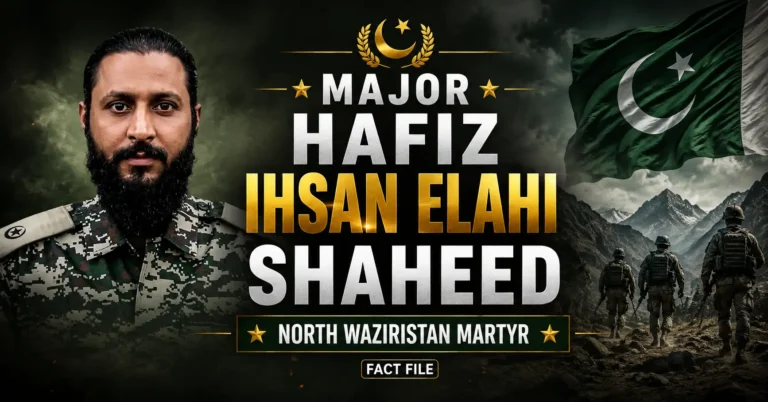

Major Hafiz Ehsan Elahi Shaheed, 34, a resident of District Mianwali, gave his life fighting Indian-proxy militants during an intelligence-based operation in North Waziristan. His unit’s courage under fire has become the defining story of Pakistan’s bloodiest month of 2026.
Who Was Major Hafiz Ehsan Elahi Shaheed?

Major Hafiz Ehsan Elahi Shaheed hailed from Mianwali district in Punjab. At 34, he was already known within his unit as an officer who preferred the front line over the rear.
He was described as a brave officer who led his troops from the front and fought gallantly before making the ultimate sacrifice. That description now defines his legacy for a grieving district.
Inside the Razmak Operation in North Waziristan
The operation unfolded in the Razmak area of North Waziristan on August 1, 2026. Security forces launched an intelligence-based operation after reports of terrorist presence in the area, and during the exchange, five militants linked to Fitna al Khawarij were also killed.
READ MORE: No 8 Squadron Haiders PAF: 66 Years of Air Power
Fighting intensified as troops closed in on the position. It was in this exchange, commanding from the front, that the major sustained fatal wounds and embraced shahadat alongside his men.
What the ISPR Statement Confirms
The Inter-Services Public Relations issued a formal statement confirming the operation’s outcome. It said troops effectively engaged the militants, killing five Indian-sponsored khawarij during the encounter.
- Weapons and ammunition were recovered from the site
- The slain militants were allegedly involved in prior attacks on security forces and civilians
- Sanitisation operations continued afterward to clear remaining threats in the area
Understanding Fitna al Khawarij
Fitna al Khawarij is the term Pakistani authorities use for militants affiliated with the banned Tehreek-i-Taliban Pakistan. It is a designation applied to a group that Pakistan’s own intelligence apparatus once cultivated before it turned against the state.
Islamabad routinely describes such networks as backed by India, a claim New Delhi denies. The framing shapes how Pakistani officials present these operations to the public and to allied states.
Mianwali District Mourns Its Fallen Son

News of the martyrdom reached Mianwali within hours, and the district has since been in mourning. Local residents describe the major as a son of the soil who chose service over safety.
Funeral prayers and tributes are expected to draw military officials alongside civilians. Such losses ripple through smaller Punjab districts, where each martyred officer is known personally within the community.
National Tributes for Major Hafiz Ehsan Elahi Shaheed
Pakistan’s leadership responded swiftly to the news. President Asif Ali Zardari paid tribute to the officer, saying the nation would always remember the sacrifices of its brave sons and that he had set an example of duty and leadership.
Military spokespeople reiterated that such sacrifices strengthen resolve rather than weaken it. Officers across ranks have echoed similar sentiments, framing the loss as part of a continuing national effort.
July 2026: Pakistan’s Deadliest Month in Over a Decade

The major’s death arrived amid a brutal month for Pakistan’s security forces. Violence linked to terrorist attacks and counter-terrorism operations intensified sharply in July, making it the deadliest month of 2026, with 112 security personnel among 205 people killed nationwide.
- 401 terrorists were eliminated — the highest monthly tally in more than ten years
- Security personnel deaths jumped 195% compared to June
- Eight suicide attacks were recorded, the worst monthly count in a decade
Casualty Data at a Glance
The scale of July’s violence becomes clearer when set against the year’s broader trend, based on figures from the Pakistan Institute for Conflict and Security Studies.
| Metric | June 2026 | July 2026 | Change |
|---|---|---|---|
| Security personnel killed | 38 | 112 | +195% |
| Terrorists killed | 192 | 401 | +109% |
| Civilians killed | 61 | 74 | +21% |
| Suicide attacks | — | 8 | Highest in a decade |
Across the first seven months of 2026, Pakistan recorded 2,786 deaths linked to militant violence and counter-militancy operations, including 434 security personnel and 463 civilians.
The Parallel Nushki Operation in Balochistan
Razmak was not the only front active that weekend. In a separate statement, ISPR said security forces killed seven Indian-sponsored terrorists during an intelligence-based operation in Balochistan’s Nushki district on the night of July 30/31.
Among those killed was a would-be suicide bomber. The near-simultaneous operations underline how thinly stretched security forces remain across two very different terrains.
Vision Azm-i-Istehkam and the Road Ahead
Military officials tied both operations to an ongoing national campaign. ISPR said the counterterrorism campaign under the vision of Azm-e-Istehkam, approved by the Federal Apex Committee on the National Action Plan, will continue with full determination against foreign-sponsored terrorism.
- The strategy centers on intelligence-based, targeted operations
- It emphasizes coordination between the army and civilian law enforcement
- Officials describe it as a long-term rather than short-term response
What This Means for Pakistan’s Security
The sacrifice of Major Hafiz Ehsan Elahi Shaheed lands at a pivotal moment. With militant and security-force casualties both climbing sharply, analysts warn the coming months will test whether current strategy can reverse the trend.
For families in districts like Mianwali, each such loss carries weight far beyond the statistics. The question now is whether escalating operational tempo translates into lasting security gains.