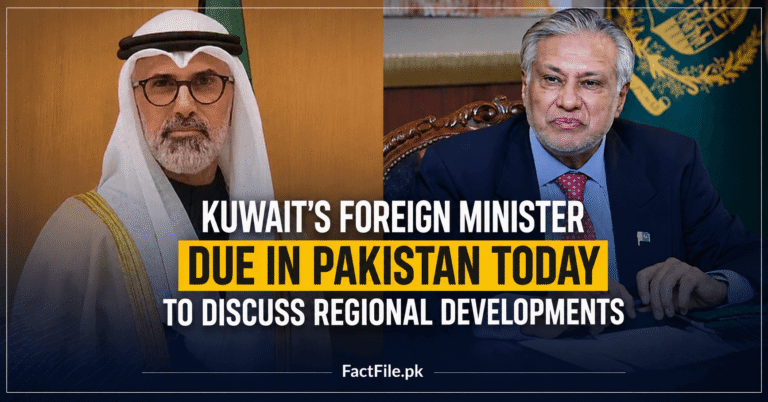

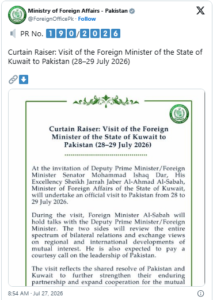
Kuwait foreign minister Pakistan visit dates are now confirmed. Sheikh Jarrah Jaber Al-Ahmad Al-Sabah arrives in Islamabad on July 28 for a two-day official trip, at the invitation of Deputy Prime Minister and Foreign Minister Ishaq Dar.
The Foreign Office announced the schedule on Monday, calling it a step to “further strengthen” ties between the two countries. Officials say the minister will hold delegation-level talks and also pay courtesy calls on senior Pakistani leadership during his stay.
Who Is Sheikh Jarrah Jaber Al-Ahmad Al-Sabah?
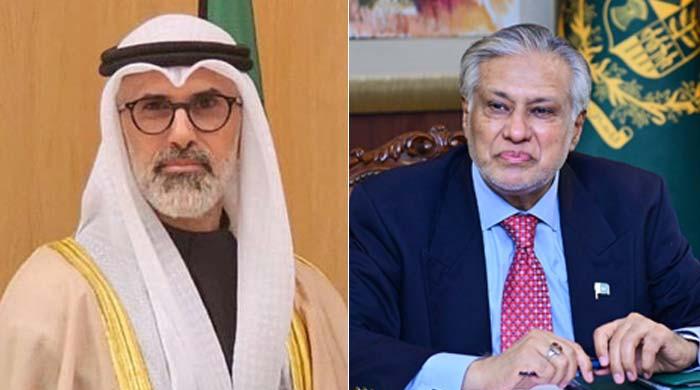
Sheikh Jarrah Jaber Al-Ahmad Al-Sabah currently serves as Kuwait’s foreign minister and is a senior member of the ruling Al-Sabah family. His visit follows a pattern of regular high-level contact between Islamabad and Kuwait City over the past two years.
He last spoke with Dar by phone in early May, when the two discussed regional developments. That call, and this in-person follow-up, point to an unusually active diplomatic channel between the two capitals this year.
Agenda: Bilateral Relations and Regional Security on the Table
According to the Foreign Office statement, both sides will:
- Review the “entire spectrum” of Pakistan-Kuwait bilateral relations
- Exchange views on regional and international developments of mutual interest
- Discuss expanding cooperation “for the mutual benefit of both countries”
- Hold a courtesy meeting with Pakistan’s top leadership
Notably, the statement stops short of naming specific deliverables — no signed agreements or joint statements have been previewed publicly ahead of the visit.
The Bigger Picture — Pakistan-Kuwait Defence and Energy Talks

This visit doesn’t happen in isolation. Just over a week earlier, Reuters reported that Pakistan and Kuwait were negotiating an expanded defence pact tied to energy cooperation, citing five sources familiar with the discussions.
Kuwait already has a limited defence arrangement with Pakistan dating to 2023, covering training and joint exercises. The new talks reportedly go further, exploring Kuwaiti investment in bonded fuel storage inside Pakistan, building on an existing government-to-government diesel supply deal.
A Pakistani security official told Reuters that Kuwait’s “wish list includes everything,” but added a clear caveat: Islamabad is “not and cannot consider a deployment of combat troops at this stage.” That single line does a lot of work — it signals appetite for partnership, but also a hard boundary on military commitment.
Why Now? Iran-Gulf Tensions Add Urgency
The timing matters. Kuwait came under direct attack earlier this year during an escalation involving Iran and Gulf Cooperation Council states. Iran’s Islamic Revolutionary Guard Corps claimed strikes on a US support facility at Camp Arifjan and a radar site at Ali Al Salem Air Base, while Kuwait Petroleum Corporation reported damage to an oil facility.
READ MORE: General Syed Aamer Raza calls on Field Marshal after assuming charge of CNSC
Pakistan, meanwhile, has its own balancing act to manage. Islamabad already signed a mutual defence pact with Saudi Arabia last year, and Reuters has reported growing concern in Pakistani policy circles that the agreement could pull the country into a wider US-Iran confrontation.
After Houthi forces struck Saudi Arabia, Pakistan warned Iran that any attack on the kingdom would be treated as an attack on Pakistan itself.
A Kuwait-Pakistan defence understanding, if it materializes, would extend that same logic to another Gulf state that has already come under fire this year.
What Analysts Are Saying
Regional watchers caution against reading too much, too fast, into this visit. One source close to the Kuwait-Pakistan talks told Reuters it remains “not clear this will amount to a defence pact per se,” describing the discussions as still exploratory.
Other Gulf states are watching too. Turkiye, Pakistan and Saudi Arabia are separately drafting their own mutual defence arrangement, Bahrain has expressed interest in something similar, and Jordan is reportedly weighing a weapons-and-training deal with Islamabad.
Pakistan’s position — a nuclear-armed state with a large standing military and domestic fighter-jet production — has made it an increasingly attractive security partner across the wider region.
What This Means for Pakistan’s Gulf Strategy
For Islamabad, deals like this serve a dual purpose: they reinforce Pakistan’s standing as a security guarantor in the Gulf, and they open the door to investment and energy support that the country badly needs.
Kuwait’s diesel supply arrangement with Pakistan is already in place expanding it into bonded storage would be a tangible, near-term economic win regardless of how the defence talks progress.
But there’s a risk side too. Deeper defence commitments across multiple Gulf states raise the odds that Pakistan gets drawn into a conflict not of its own making, particularly while Iran-US tensions remain unresolved. The July 28–29 visit likely won’t settle that tension either way — but it will show whether Islamabad and Kuwait City are ready to move from talks to something more concrete.