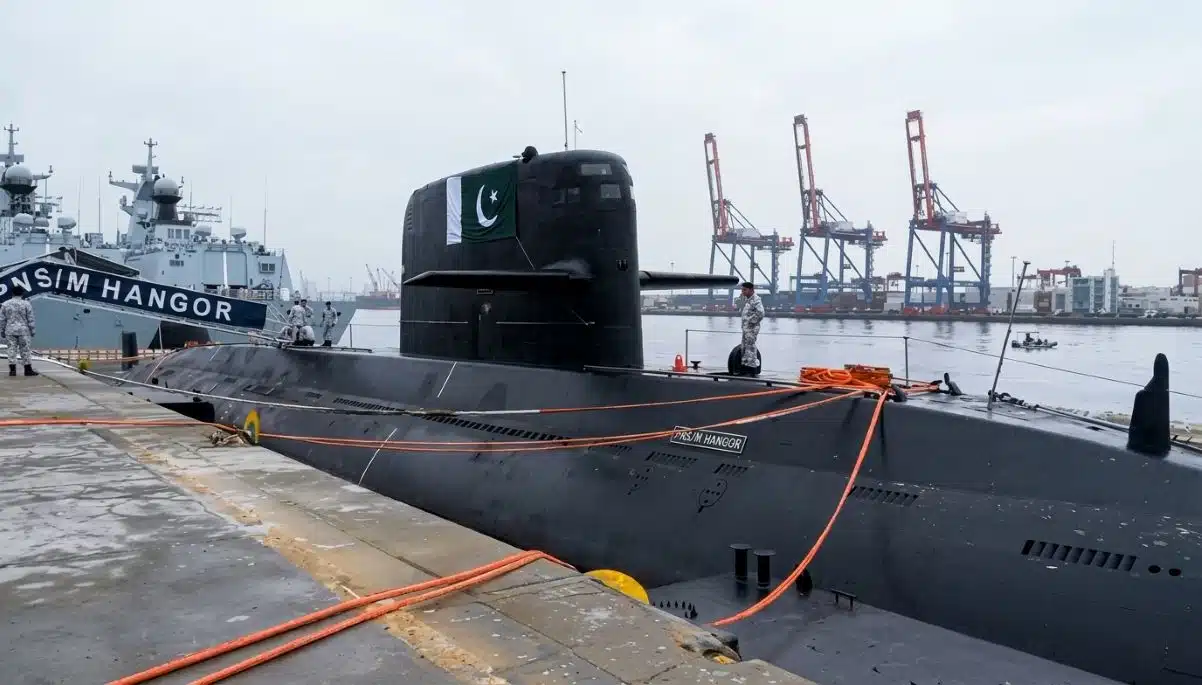

On Sunday, the Pakistan’s naval newly inducted PNS/M Hangor successfully carried out its maiden live weapon firing in the Arabian Sea. For a submarine that only arrived home in June, this test marks the moment it truly proved itself combat ready.
ISPR confirmed the news directly, calling it nothing less than a “major demonstration of operational readiness” for Pakistan’s growing submarine fleet.
What Happened During the Test
According to ISPR, the submarine accurately engaged a “designated long range target with an anti ship cruise missile” during the exercise. That is a fairly technical way of saying the Hangor located a distant target at sea and struck it precisely, exactly what a modern attack submarine is built to do.
Chief of the Naval Staff Admiral Naveed Ashraf personally witnessed the firing. He praised the submarine’s combat power afterward, stressing what he called the “strategic importance of enhancing subsurface capabilities for credible maritime deterrence.” That phrase subsurface capabilities, essentially points to Pakistan’s underwater defence, the part of its military strength that stays hidden until it is needed most.
ISPR’s own statement summed up the broader significance rather plainly too. “The milestone underscores the Pakistan Navy’s commitment to maintaining a modern, combat ready force to safeguard national maritime frontiers and regional peace,” the military’s media wing said.
How Government Leaders Reacted
Prime Minister Shehbaz Sharif congratulated the Navy directly, according to a statement from his office. He did not hold back on praise, “The submarine successfully struck a long range target with an anti ship cruise missile, demonstrating the operational readiness, professional expertise and combat capability of Pakistan Navy’s submarine force,” the Prime Minister said.
President Asif Ali Zardari added his own tribute too, describing the achievement as reflecting genuine “operational readiness and enhancement” of the country’s naval defence capabilities. The President’s office quoted him further. “Equipped with modern combat capabilities, the Pakistan Navy is playing a vital role in safeguarding national maritime boundaries and ensuring regional peace and security,” he said.
Why the Name Hangor Carries Real Weight
For anyone unfamiliar with Pakistan’s naval history, the name Hangor is not chosen lightly. It traces back to the 1971 Pakistan-India war, when the original PNS Hangor achieved something genuinely rare in naval warfare.
It became the first submarine since World War II to actually sink an enemy warship, striking down the Indian frigate INS Khukri in a moment that has remained a proud reference point in Pakistan’s naval history ever since.
Reviving that name for this new class of submarines was not just sentimental branding. It signals a deliberate connection between past naval achievements and the Navy’s current modernization push, built around genuinely advanced technology this time around.
The new Hangor-class boats come equipped with modern combat systems, advanced sensors, and something called Air Independent Propulsion, or AIP technology.
In simple terms, that system lets a submarine stay submerged for considerably longer stretches without needing to surface for air, making it far harder for adversaries to detect. Combined with enhanced stealth features, these submarines represent a way forward compared to older vessels in Pakistan’s existing fleet.
What Comes Next for Pakistan’s Submarine Fleet
The Pakistan Navy is set to bring a total of eight Hangor-class submarines into active service, built through deepening defence cooperation with China. The first of these submarines was actually launched in China back in April 2024, with three more following through 2025, launched in March, August, and December respectively.
This test also does not stand alone within Pakistan’s recent naval activity. Just months earlier in April, the Navy successfully tested an indigenously developed anti-ship weapon system named Taimoor, and separately fired a locally developed anti-ship ballistic missile capable of engaging targets at extended range.
Taken together, these tests tell a picture of a navy actively expanding both its imported submarine capabilities and its homegrown missile technology at the same time.
For a country navigating an increasingly tense regional security environment this kind of steady and visible progress in naval capability carries meaning well beyond a single successful missile strike.