
A juvenile driving permit can now be issued the same day to teenagers aged 16 to 18, Chakwal City Traffic Police said on September 19, 2026, provided applicants pass a traffic sign test.
The announcement covers motorcycles and scooters only. It arrives amid conflicting public information about fees, launch timelines and testing, so this report separates what police have confirmed from what remains genuinely unclear.
What Chakwal City Traffic Police Announced

The force outlined the procedure for 16- to 18-year-olds who already know how to ride a motorcycle or scooter. Eligible applicants can approach their nearest licensing centre and receive legal permission to ride.
Police said applicants need not wait the usual 42 days. The permit is granted on the same day once the applicant clears the traffic sign test, a notable shortcut for families.
Who Qualifies for the Juvenile Driving Permit
Only teenagers between 16 and 18 qualify, and they must already know how to ride a motorcycle or scooter. The permit is a separate category created for young riders, not a standard driving licence.
Punjab officials have framed the scheme as a way to bring teenage riders into a regulated legal framework with parental supervision, rather than relying on fines alone, according to traffic authorities quoted in June reports.
Age Bracket and Eligible Vehicles

The Chakwal announcement names motorcycles and scooters. Reports quoting Multan traffic police put the engine ceiling at 125cc, which excludes larger motorcycles. Cars and other vehicle types fall outside the permit.
Age is checked through the applicant’s B-Form or Child Registration Certificate in Chakwal, while other districts also accept a Smart Card. Applicants below 16 have no legal route to the juvenile driving permit.
Riding Limits: 125cc Cap and 60 km/h Ceiling
Lahore’s Chief Traffic Officer said permit holders may not exceed 60 kilometres per hour. Officials described the cap as a safety measure meant to reduce the risk of accidents involving young riders.
READ MORE: Pakistan abstains from UNSC vote on Iran sanctions panel
The Chakwal report did not mention the speed cap, so it is unclear whether local enforcement follows the same limit. Parents should confirm it with their licensing centre before handing over keys.
Documents Teenagers and Parents Must Bring
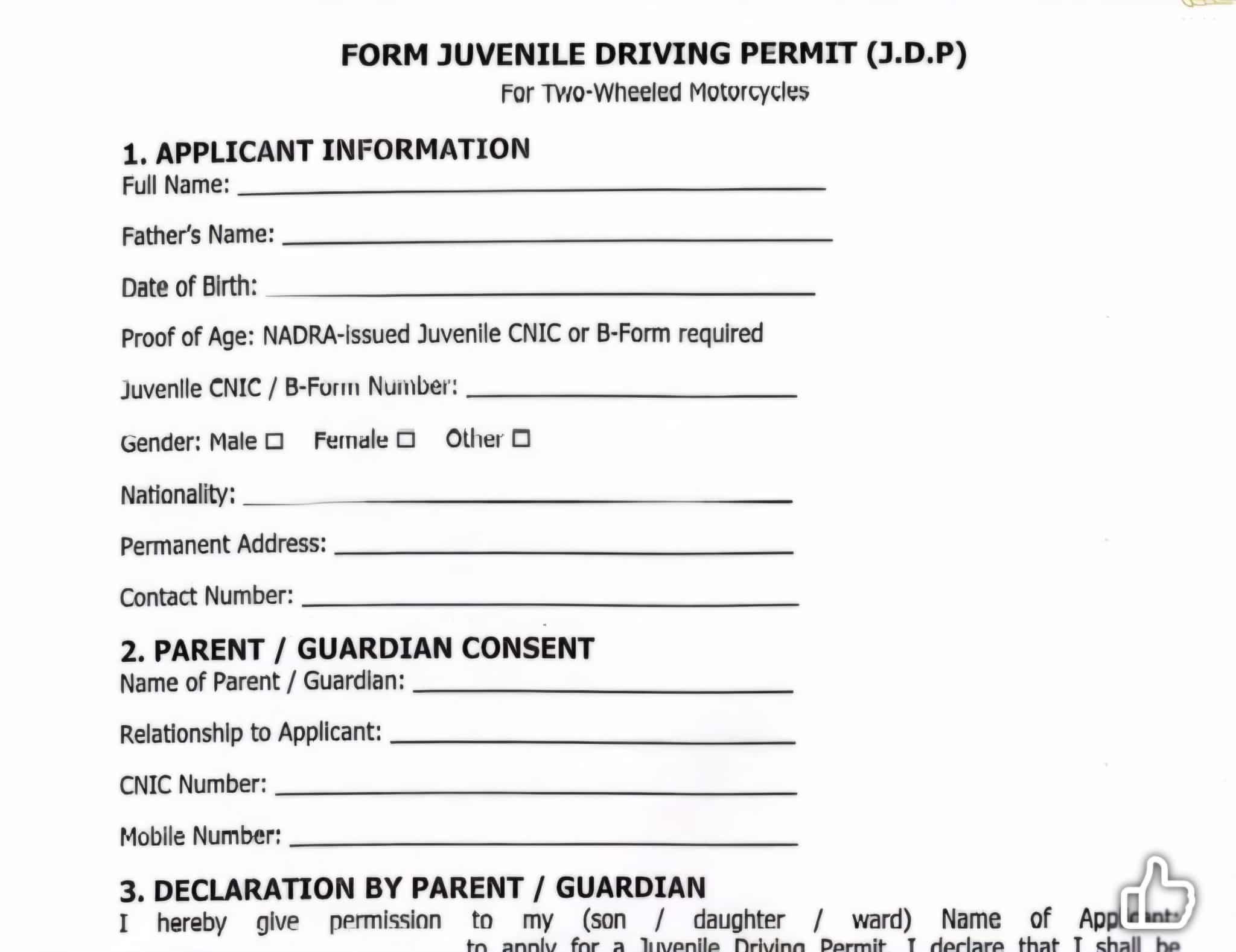
For a juvenile driving permit, Chakwal police require the applicant’s B-Form or Child Registration Certificate. A parent or guardian must accompany the teenager and present their original Computerized National Identity Card at the licensing centre.
- B-Form or Child Registration Certificate (Chakwal); Smart Card also accepted elsewhere
- Parent or guardian’s original CNIC (Chakwal)
- Written parental consent affidavit (Multan)
- Copy of the guardian’s CNIC and one passport-size photograph (Lahore reports)
Reports from Multan and Lahore add a written parental consent affidavit, a copy of the guardian’s CNIC and one passport-sized photograph. Chakwal police did not list these, so carry them anyway.
Age-Based Fee Structure
The juvenile driving permit fee depends on age. Chakwal police said a 16-year-old pays Rs 1,000, while a 17-year-old pays Rs 500. Reports quoting Lahore and Multan traffic officials carry the same age-based schedule.
| Applicant age | Permit fee |
|---|---|
| 16 years | Rs 1,000 |
| 17 years | Rs 500 |
Reports use slightly different wording for the brackets, describing them as 16 to 17 and 17 to 18. Chakwal police simply tied the fee to the applicant’s age, so families should confirm the exact cut-off at the counter.
Same-Day Permit: Sign Test Replaces the 42-Day Wait
The statement did not explain the 42-day period it refers to, but it makes the effect plain: applicants who pass the traffic sign test walk out with the permit the same day.
City Traffic Police spokesman Muhammad Adnan in Multan likewise named the sign test as the requirement. Some earlier reports mentioned a road test as well, but recent police-sourced statements do not confirm one.
Step-by-Step Application Process
The procedure for a juvenile driving permit is short. Teenagers visit a licensing centre with a parent, submit documents, take the sign test and pay the age-based fee. The permit is then issued the same day.
- Visit the nearest licensing centre with a parent or guardian.
- Present the B-Form or CRC and the guardian’s original CNIC.
- Clear the traffic sign test.
- Pay Rs 1,000 (age 16) or Rs 500 (age 17).
- Collect the permit the same day.
Keep every document in original and copy form. Reports from different districts list slightly different paperwork, so a short call to the licensing centre beforehand can save a wasted trip and a lost school day.
Where to Apply: Licensing Centres and e-Khidmat Markaz
Chakwal police pointed applicants to the nearest licensing centre. A report dated August 1 said the Punjab Information Technology Board has introduced the facility at e-Khidmat Markaz centres across Punjab.
That claim rests on a single report and has not been echoed in Chakwal’s announcement. Families in the district should treat the licensing centre as the confirmed route and check e-Khidmat availability locally.
Conflicting Reports: Flat Rs 500 Fee and Launch Date
Some February reports announced a flat Rs 500 fee and a March 1 start. Reports in mid-June then described an official launch, with age-based fees. None of the available reports explains the gap between those dates.
Validity is also unsettled. One June report gave one year, while earlier reports said the permit lapses when the holder turns 18. Chakwal police did not address validity, so families should ask before applying.
Why Punjab Created the Permit
Punjab’s cabinet standing committee on legislative business approved a juvenile driving permit category, according to a January report on the meeting. The Punjab Traffic Police then announced a rollout from March 1.
Several guides describe underage riding as widespread, with teenagers exposed to fines and vehicle seizures because no legal route existed. The permit is presented as a regulated alternative to that gap.
Road Safety Angle and What Parents Should Do
The safety case currently rests on official statements rather than independent expert commentary. Traffic authorities frame the 60 km/h cap, the 125cc limit and mandatory parental consent as core safeguards built into the scheme.
For parents, a juvenile driving permit is legal permission, not a training programme. Teach helmet use and speed discipline first, confirm the permit’s validity with the licensing centre, and carry the paperwork.