
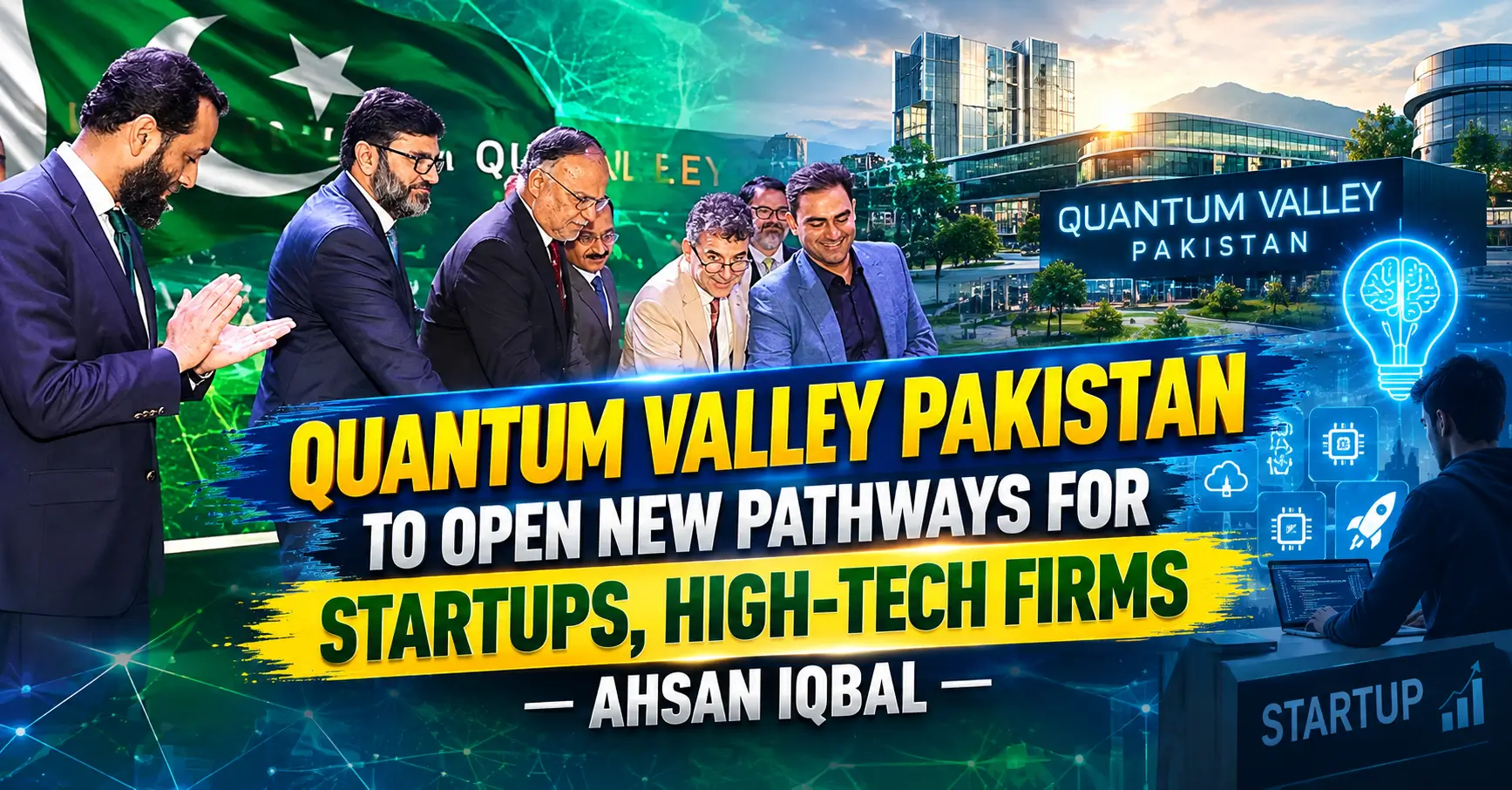

Pakistan just took its biggest swing yet at fixing a problem that has quietly held back its tech sector for years: talent and money never quite found each other. Quantum Valley Pakistan launched in Islamabad on September 16, 2026, and the government is betting it can change that.
Federal Minister for Planning, Development and Special Initiatives Ahsan Iqbal was the chief guest at the launch. “Today is not merely the inauguration of a project,” he told the audience. “It marks the beginning of a new direction for Pakistan’s future.”
What Is Quantum Valley Pakistan?

Quantum Valley Pakistan is a government-backed platform meant to connect universities, startups, researchers, and investors under one roof. Officials are already calling it Pakistan’s answer to Silicon Valley.
The scope is deliberately broad. QVP targets AI, quantum computing, fintech, agritech, biotechnology, medtech, and autonomous technologies — sectors where:
- Research rarely reaches the market
- Startups struggle to find international mentors
- Overseas Pakistani experts have no clear route back in
Inside the Launch: Partners, Agreements and Key Names
Two agreements were signed at the ceremony, both aimed at pulling international expertise directly into Pakistan’s tech ecosystem. The first was with the Cambridge Innovation Center (CIC), the second with Plug and Play.
Tim Rowe, CIC’s CEO, and Dougan Sherwood, a CIC partner, attended in person, alongside Seena Amidi, Managing Partner at Plug and Play. Their physical presence in Islamabad — not a video message — is being read as a signal that these are working partnerships rather than ceremonial paperwork.
| Partner | Role in Quantum Valley Pakistan |
|---|---|
| Cambridge Innovation Center | Signed collaboration agreement; contributed to framework design |
| Plug and Play | Building hubs in Islamabad and Karachi; backing 300 university startups |
| St John’s Innovation Centre, Cambridge | Co-designed QVP’s strategic framework |
| National Technology Fund (Ignite) | Government execution partner |
The Global Venture Acceleration Programme

The most tangible outcome for founders was the launch of the Global Venture Acceleration Programme. It offers 15 weeks of mentorship followed by a two-week immersion trip to Silicon Valley or Boston.
Plug and Play isn’t stopping at one programme, either. The firm plans to open innovation hubs in both Islamabad and Karachi, with acceleration support reaching 300 startups drawn from leading Pakistani universities — a scale few local incubators have managed before.
Who Built the QVP Framework
Cambridge involvement runs deeper than the launch-day signatures suggest. The entire strategic framework was co-developed with St John’s Innovation Centre, University of Cambridge — the same institution behind several tech clusters across Europe and Asia.
ALSO READ: Ahsan Iqbal proposes SCO digital governance and AI capacity-building network
On the Pakistani side, execution falls to a joint effort: the Ministry of Planning, Ministry of IT, Ministry of Science and Technology, Ministry of Defense, and Ignite. QVP’s physical base sits at the Evacuee Trust Complex on Agha Khan Road, Islamabad.
The Economic Target Behind the Project

Iqbal framed the launch inside a much bigger number. He said Pakistan must build a $1 trillion economy by 2035 under the Uraan Pakistan programme, scaling to $3 trillion by 2047 — the country’s centenary.
His reasoning leaned on demographics rather than sentiment. Nearly 60 percent of Pakistan’s population is young, he noted, and in his words, “the centre of power in the 21st century is no longer physical strength but intellectual and creative capability.”
From Vision 2010 to Quantum Valley — The Longer Timeline
QVP isn’t emerging from nothing. Iqbal traced its roots back to Vision 2010, followed by 10,000 PhD scholarships meant to build a critical mass of scientists and researchers.
That was followed by national centres for AI, robotics, big data, and cybersecurity — investments that, by the government’s own framing, have been waiting years for a platform like Quantum Valley Pakistan to convert them into commercial output.
What It Means for Founders and Researchers
For a startup founder in Lahore or Peshawar, the pitch is simple: fewer cold emails, more structured access. The Global Venture Acceleration Programme gives founders a defined runway toward global investors instead of relying on personal networks.
Researchers stand to gain too. Many university labs in Pakistan produce work that never reaches a product. QVP is positioned as the missing bridge — an intermediary meant to move research from paper to prototype to company.
Ambition vs Execution — The Real Test
Analysts tracking Pakistan’s tech policy have seen ambitious platforms before. What separates success from another shelved initiative is usually mundane: tax incentives, research grants, and intellectual property protections that actually reach founders.
Quantum Valley Pakistan has the partnerships on paper and international names in the room. That converts into funded startups and filed patents not just press coverage is the question that will define this project over the next two years.