
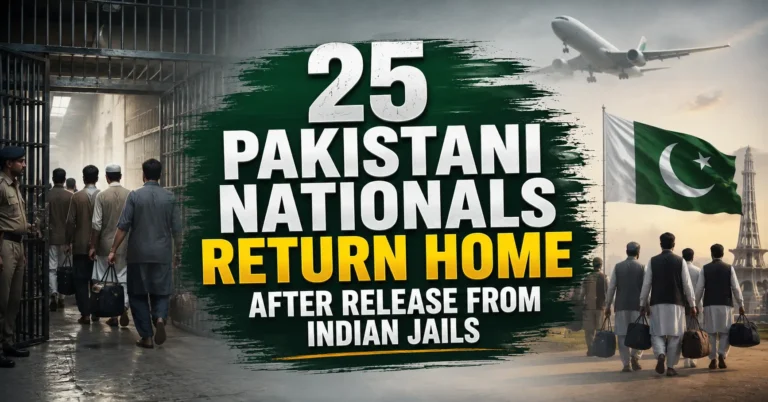

Twenty-five Pakistani nationals released from Indian jails crossed back into Pakistan on Saturday, walking through the Wagah-Attari border after Indian authorities formally handed them over. It was a quiet, procedural moment — but one loaded with years of waiting for the families on the other side.
Indian officials brought the group to the joint check post, where Pakistani authorities completed immigration formalities before the men were released to head home. No fanfare. No press conference. Just paperwork, and freedom.
Who Was Released and How

All 25 individuals in this batch were fishermen, according to the Fishermen’s Cooperative Society (FCS), which said the men hailed from Karachi and the coastal town of Thatta. They had completed their sentences and cleared nationality-verification checks before repatriation.
- 25 Pakistani fishermen released, all with completed sentences
- Handed over to Pakistan Rangers Punjab at Wagah-Attari
- Repatriated after routine immigration and legal formalities
- Families in Karachi and Thatta now awaiting reunion
Reaction From Officials and Fishermen’s Bodies
The Pakistan High Commission in New Delhi said its office would keep pressing for further releases. “The Government of Pakistan will continue its efforts for the release and repatriation of all Pakistani citizens detained in Indian jails,” the mission said in a statement.
READ MORE: PIMS Tragedy: A Wider Warning for Public Hospitals
FCS spokesperson Ghulam Rasool Sheikh welcomed the development, noting the men had waited long past their release eligibility. Rights groups, including the Pakistan-India Peoples’ Forum for Peace and Democracy, had pushed for exactly this kind of action earlier in the month.
Why Fishermen Dominate These Prisoner Lists

Fishermen consistently make up the bulk of prisoners held on both sides — not because of criminal intent, but because the maritime boundary in the Arabian Sea, near the Sir Creek estuary, has never been formally settled between the two countries.
Boats drift. Engines fail. GPS signals falter in rough weather. A wrong turn during a storm can mean months, sometimes years, in a foreign jail before diplomatic channels catch up with the paperwork.
The Consular Access Agreement: How These Releases Actually Happen
These repatriations don’t happen randomly. Under the 2008 Agreement on Consular Access, Pakistan and India exchange updated prisoner lists twice a year — on January 1 and July 1 — identifying nationals held in each other’s custody.
On July 1 this year, Pakistan formally asked India to release 97 prisoners, including 33 fishermen, who had already completed their sentences and had confirmed nationality. Saturday’s release chips away at that outstanding request, though most of it remains unresolved.
A Pattern of Intermittent Releases Amid Frozen Diplomacy

This is not an isolated gesture. In May 2026, four Pakistani prisoners were repatriated through the same crossing. In September 2025, India freed 67 Pakistani prisoners — 53 fishermen and 14 civilians — in what was then the largest single release since the two countries’ four-day military conflict in May 2025.
High-level diplomatic engagement between Islamabad and New Delhi has remained largely suspended since that conflict. Yet prisoner repatriations, tied to the older consular framework, have continued in fits and starts — proof that some bureaucratic channels keep functioning even when politics freezes over.
How Many Pakistanis Are Still Held in India?
The numbers move with each biannual exchange, but recent lists give a sense of scale:
| Exchange Date | Pakistani Nationals in Indian Custody | Fishermen Included |
|---|---|---|
| January 1, 2026 | 424 | 33 |
| July 1, 2026 | 439 | 53 |
| Before Saturday’s release | — | 53 |
Officials say Pakistan has released nearly 600 Indian prisoners over the past five years, while India has freed only around 200 Pakistanis since 2021 — a gap that Islamabad has repeatedly flagged in diplomatic correspondence.
What Comes Next
Saturday’s release brings some relief to 25 families, but it barely dents the backlog. Hundreds of Pakistani nationals most of them fishermen picked up for straying into disputed waters — remain in Indian custody, many well past their release dates.
The next scheduled prisoner-list exchange falls on January 1, 2027. Until then, repatriations will likely keep happening the way this one did: quietly, occasionally, and entirely outside the broader diplomatic freeze between the two nuclear-armed neighbours.