
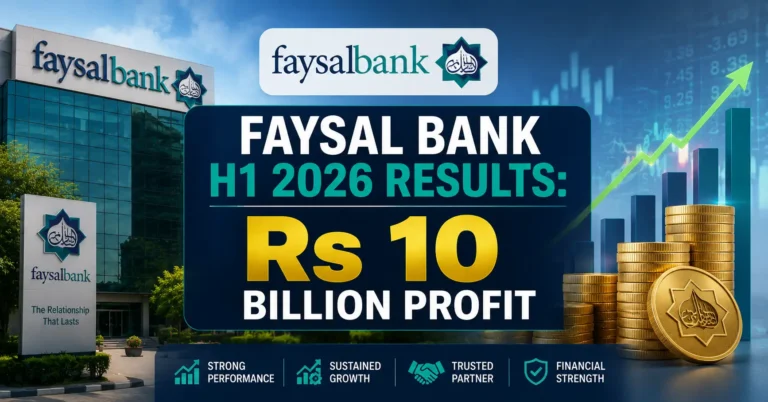

Faysal Bank H1 2026 results have landed, and the numbers tell a story of a lender growing steadily even as the interest-rate environment turns against it.
The bank reported a profit before tax of Rs 20.5 billion and a net profit of Rs 10 billion for the first half of 2026, translating into earnings per share of Rs 6.60.
For a bank operating in a falling-rate cycle, that’s not a small feat.
Faysal Bank H1 2026 Results at a Glance
The headline figure is simple: Rs 10 billion in net profit over six months. But the detail underneath is where the real story sits. Total assets crossed Rs 1.8 trillion, a scale few private banks in Pakistan can match.
What stands out is the timing. Despite lower market interest rates squeezing margins across the sector, FBL held onto profitability through deliberate balance sheet growth rather than rate-driven income. That’s a distinction analysts tend to watch closely.
- Profit before tax: Rs 20.5 billion
- Net profit: Rs 10 billion
- Earnings per share: Rs 6.60
- Total assets: over Rs 1.8 trillion
Profit and Earnings Per Share Breakdown
Faysal Bank’s H1 2026 results build directly on a strong opening quarter. In Q1 2026 alone, the bank posted profit before tax of Rs 10.8 billion and net profit of Rs 5.2 billion, with EPS of Rs 3.40.
That means Q2 alone added roughly Rs 4.8 billion in net profit, nearly matching the first quarter’s output. Momentum, not a one-off spike, is driving the half-year number — a detail smaller outlets skipped entirely.
Deposit Growth and Current Account Mix

Deposits are where the bank’s underlying strategy shows most clearly. Total deposits grew 9.5 percent to Rs 1.56 trillion, while current accounts jumped 21 percent to Rs 646 billion. That’s a meaningful shift toward low-cost funding.
The current account mix improved to 41.4 percent from 37.5 percent in December 2025, and the CASA ratio strengthened to 86.8 percent from 81.9 percent. Fewer expensive term deposits, more free-float cash — that combination protects margins when rates fall.
H1 2026 vs Year-End 2025
| Metric | Dec 2025 | H1 2026 |
|---|---|---|
| Current Account Mix | 37.5% | 41.4% |
| CASA Ratio | 81.9% | 86.8% |
| Advance-to-Deposit Ratio | 61.1% | 51.7% |
| Infection Ratio | — | 2.3% |
Asset Quality, Capital Strength and the Tier II Sukuk
The advance-to-deposit ratio declined to 51.7 percent from 61.1 percent, while the infection ratio stood at 2.3 percent. A lower ADR alongside contained bad loans signals caution rather than aggressive lending in an uncertain rate environment.
READ MORE: 1LINK Board of Directors: A New Payments Era Begins
Capital-raising also featured this half. FBL completed the issuance of a Rs 7 billion Tier II Sukuk — a Shariah-compliant instrument that bolsters the bank’s capital adequacy without diluting shareholders.
- ADR fell nearly 10 percentage points year-on-year
- Infection ratio held at 2.3 percent, within comfortable industry range
- Rs 7 billion Tier II Sukuk strengthens the capital buffer
Islamic Banking Strategy Behind the Numbers

FBL attributed the results to its Islamic banking operations, business fundamentals, risk management practices and growth strategy, backed by digital, technology-based, women-focused and customer-focused initiatives.
That framing matters, since Faysal Bank completed its full conversion to Islamic banking years ago.
Pakistan Credit Rating Agency (PACRA) upgraded the bank’s long-term rating to AA+ in March 2026, while VIS Credit Rating assigned the same AA+ long-term grade.
Rating upgrades of this kind rarely happen without sustained balance-sheet discipline behind them.
Leadership Perspective on the Results
Chairman Mian Muhammad Younis has repeatedly tied the bank’s momentum to its network expansion and deposit strategy.
Reflecting on the bank’s Q1 2026 performance, he credited the “growing maturity and depth” of Faysal Bank’s Islamic banking journey to the board’s long-term strategic direction.
President and CEO Yousaf Hussain, recently reappointed for a fresh three-year term starting August 15, 2026, has echoed that outlook.
The board approved his reappointment on May 12, 2026, extending a tenure that began in 2017 — continuity that investors typically read as a vote of confidence in current strategy.
How Faysal Bank Compares With Pakistan’s Banking Sector
Faysal Bank isn’t alone in posting solid H1 2026 numbers. Sector peer Meezan Bank posted a considerably larger Rs 48 billion H1 2026 profit, reflecting its scale advantage in low-cost deposits.
Faysal Bank’s growth path looks different — smaller base, faster current-account expansion.
- Faysal Bank: Rs 10 billion H1 net profit, 21% current account growth
- Sector trend: falling interest rates pressuring margins industry-wide
- Islamic banks broadly outperforming on deposit mix improvement this cycle
What This Means for Investors and Depositors
The bank declared a second-quarter cash dividend of Rs 1.5 per share, consistent with its Q1 payout. For shareholders, that’s two consecutive quarters of steady returns despite a softer rate environment.
For depositors, the shift toward current accounts and away from costly term deposits suggests the bank is positioning for sustainable margins rather than short-term yield chasing a pattern worth watching as Pakistan’s rate cycle bcontinues to evolve.