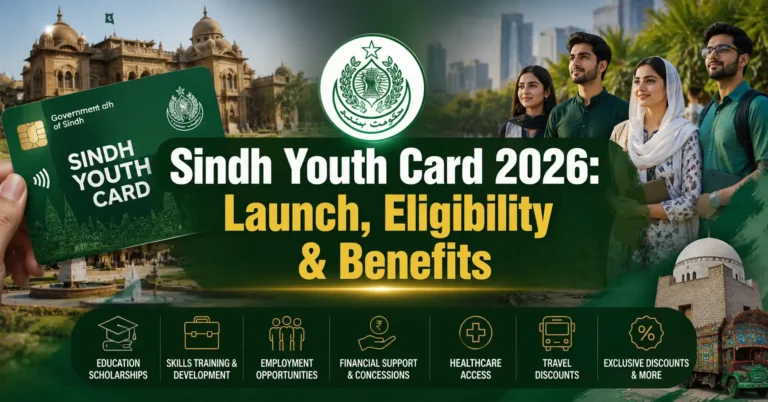

The Sindh Youth Card is finally moving from paperwork to reality. After months of internal planning, the Sindh government has confirmed it will roll out the card this month, with PPP Chairman Bilawal Bhutto Zardari set to inaugurate the programme in the last week of August 2026.
Sindh Youth Card: What Is It and Why Now

The Sindh Youth Card is a province-wide initiative meant to hand young people direct access to education funding, interest-free credit and skills training through one card. Officials describe it as a single-window fix for a fragmented system where students and job seekers previously had to chase separate departments for each benefit.
Timing matters here. Sindh’s youth unemployment challenge has pushed the provincial government to frame the card as part of a broader strategy to address joblessness and promote economic self-reliance. Officials have linked the scheme directly to the ruling party’s youth-outreach agenda ahead of the formal launch.
Key Facts: Who Gets the Sindh Youth Card First
Numbers matter more than promises, and here the government has been specific. In the first phase, the card will be issued to 100,000 people between the ages of 15 and 29 across all 30 districts of the province.
- Target group: 100,000 youth, ages 15–29
- Coverage: All 30 districts of Sindh
- Launch window: Last week of August 2026
- Inaugurating official: Bilawal Bhutto Zardari, PPP Chairman
- Distribution partner: Cards will be issued through Jazz Bank, though full registration details are still to be announced
That last point is worth flagging. Several government schemes in Pakistan have slipped past announced deadlines before, so the August window should be treated as the current official target rather than a guarantee.
Benefits Under the Sindh Youth Card

The benefits package is the card’s real selling point, and it stretches well beyond a one-time cash handout. Students will receive scholarships for higher education, opportunities for advanced studies both abroad and within Pakistan, interest-free loans, financial assistance, skills training, and concessions on local transport and train travel.
| Category | What’s Offered |
|---|---|
| Education | University scholarships, support for advanced studies abroad and in Pakistan |
| Finance | Interest-free loans, direct financial assistance |
| Skills | Professional and vocational skills training |
| Transport | Discounts on local transport and rail travel |
| Access | Preferential access to select public and private services |
Put together, this reads less like a stipend scheme and more like an attempt at a youth-development ecosystem. Whether the funding and administrative capacity match the ambition is the question worth watching over the coming weeks.
Eligibility Criteria and the Domicile Requirement
Not every young Pakistani in Sindh will automatically qualify. The Sindh Youth Card will only be issued to applicants who hold a valid Sindh domicile certificate, according to the provincial youth affairs minister.
READ MORE: SUPARCO Internship Program 2026: Rs 50,000 Monthly Stipend
That single condition carries real friction. Sindh’s domicile process is not centralized — unlike Punjab, Sindh does not run one unified domicile portal, and each of its districts maintains its own separate application process. Applicants without an existing domicile certificate may need to secure one before they can even attempt registration, which could slow uptake in rural districts.
- Age bracket: 15 to 29 years
- Residency proof: Valid Sindh domicile certificate required
- Open to both male and female applicants
- Documentation likely needed: CNIC or B-Form, educational records
How to Register for the Sindh Youth Card

Registration will be conducted entirely online and has been designed to be simple and accessible, according to the Sindh Minister for Sports and Youth Affairs. No dedicated portal or app has been publicly launched yet, so applicants currently have nothing to sign up for.
This gap between announcement and operational rollout is exactly where misinformation tends to spread. Unofficial websites and social media pages have already started publishing “registration guides” for a portal that doesn’t exist. Prospective applicants should treat only official Government of Sindh channels as reliable until a verified link is published.
From Committee Meeting to Provincial Rollout: A Timeline
This scheme has a longer paper trail than the recent headlines suggest. The idea first moved forward in a Thursday meeting at the Sindh Secretariat chaired by Sports and Youth Affairs Minister Sardar Muhammad Bakhsh Mahar back in February 2026, where officials were told to build a full implementation plan.
- February 2026: Planning meeting held; Sports Department told to draft implementation framework
- June 2026 (initial target): Early reports suggested a launch before mid-year
- July 2026: Government formally announces scholarships, loans and skills-training benefits
- August 2026: Registration and issuance preparations finalized; inauguration set for month’s end
The slippage from a mid-year target to an August launch is normal for a programme of this scale, but it’s a detail readers should keep in mind before assuming the new date is final.
Official Statements and What They Signal
Provincial officials have been consistent in linking the card to top PPP leadership rather than presenting it as a routine department initiative. Minister Sardar Muhammad Bakhsh Khan Mehar said the initiative “reflects our commitment to fostering a generation of empowered, educated, and financially independent young leaders.”
That framing matters politically as much as administratively. Tying a welfare card directly to Bilawal Bhutto Zardari’s personal brand raises the programme’s visibility — and also raises the stakes if implementation stumbles once cards actually reach applicants’ hands.
What the Sindh Youth Card Means for the Province
If executed as described, the Sindh Youth Card could become one of the largest youth-focused welfare rollouts in the province’s recent history. Combining scholarships, credit access and skills training under one card addresses a real coordination problem that has historically slowed youth programmes in Sindh.
The bigger test starts after the ribbon-cutting: whether the online registration system holds up under demand, whether districts with weaker domicile infrastructure get left behind, and whether the promised 100,000 cards actually reach verified applicants rather than getting absorbed by delays common to first-phase government rollouts.