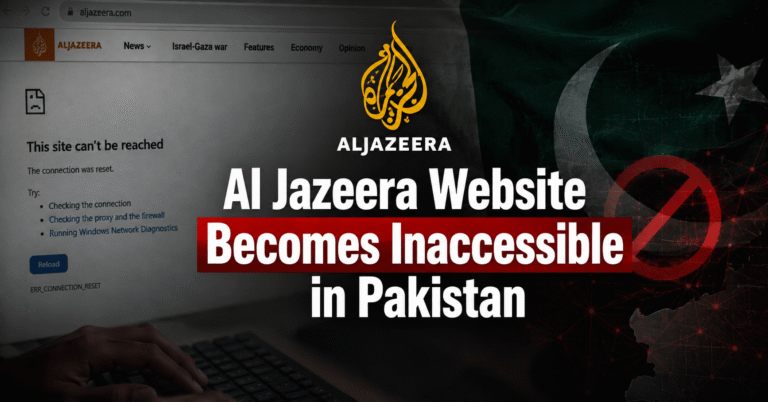

Al Jazeera blocked in Pakistan is the phrase trending across social media this week, after users nationwide reported being unable to open the broadcaster’s English website. The disruption surfaced on Monday, August 3, 2026, hitting both desktop and mobile connections.
No Pakistani authority has formally confirmed a ban. Not the Pakistan Telecommunication Authority, not the Ministry of Information and Broadcasting.
Al Jazeera itself has yet to issue an official statement on the cause. What’s verifiable is simpler: the site won’t load for large numbers of users inside Pakistan, and the timing lines up precisely with a government broadside against the network’s coverage.
- Access failures reported from multiple ISPs and mobile data networks
- No PTA order made public
- Ministry accusations came one day before the reported outage
- Al Jazeera has not issued a formal response as of this writing
Why Was Al Jazeera Restricted in Pakistan?

The Al Jazeera blocked in Pakistan story traces directly back to the network’s reporting on the Azad Jammu and Kashmir (AJK) elections.
On August 2, Pakistan’s Ministry of Information and Broadcasting publicly accused the broadcaster of “selective reporting” from a handful of polling stations in Muzaffarabad.
Officials went further, branding the coverage “yellow journalism” and suggesting outside influence was steering the narrative.
Notably, the ministry did not cite specific factual errors in Al Jazeera’s reports — it objected to which stations were shown, not to any claim being proven false. That distinction matters for anyone trying to separate fact from framing.
The Azad Jammu and Kashmir Unrest
Street protests in Pakistan-occupied Kashmir began on June 5, 2026, after authorities banned the Joint Awami Action Committee (JAAC) under the Anti-Terrorism Act 2014.
Since then, clashes between demonstrators and security forces have reportedly left more than 50 people dead and hundreds injured over four days, according to figures circulating from local rights groups.
READ MORE: SUPARCO Internship Program 2026: Rs 50,000 Monthly Stipend
Al Jazeera has covered the unrest consistently, including claims from residents about the scale of casualties in police crackdowns — claims Pakistani authorities have repeatedly disputed or downplayed.
Pakistan’s Defence Minister Khawaja Asif drew criticism in late July for describing PoK protesters as “enemies like India” while defending the security response.
The Dispute Over 12 Reserved Assembly Seats

At the center of the unrest sits a narrower, more technical fight: 12 of the 45 seats in the PoK Legislative Assembly are reserved for refugees originally from Indian-administered Jammu and Kashmir.
Local groups allege Islamabad uses those seats to install compliant governments, diluting the voice of PoK’s actual resident population.
- PoK’s “Supreme Court” ruled on June 7 that the seats are constitutionally protected
- Protesters wanted the seats abolished or restructured before elections
- Al Jazeera reported that residents in Muzaffarabad boycotted the vote over the issue
- The ministry’s “biased coverage” complaint centers specifically on this reporting
Pakistan’s Track Record With Al Jazeera
This isn’t the first time Al Jazeera has gone dark in Pakistan, and it likely won’t be the last. In 2011, the PTA ordered ISPs to block the network’s website after it published a report detailing Osama bin Laden’s years-long stay in Abbottabad before the US raid that killed him. Enforcement then was patchy — the site stayed reachable in parts of Islamabad even as others lost access.
More recently, rumours of a ban surfaced in February 2026 following Al Jazeera’s coverage of Afghan airstrikes in Nangarhar and Paktika provinces.
That claim turned out to be false the network remained accessible, and no policy change was ever documented. The pattern is consistent: restrictions — confirmed or rumoured — tend to follow coverage Islamabad finds embarrassing rather than any transparent regulatory process.
Al Jazeera’s Restrictions Elsewhere
Pakistan is far from alone. Al Jazeera has faced blocks, suspensions or office closures in several countries, often tied to politically sensitive coverage rather than clear legal violations.
Country | Action | Timing |
|---|---|---|
| Israel | Local operations shut; restriction extended 90 days | Since May 2024; renewed July 23, 2026 |
| DR Congo | Network banned, press credentials revoked | January 2025 |
| Egypt | Main website blocked | 2017 |
| Saudi Arabia, UAE, Bahrain, Jordan | Websites, broadcasts or offices restricted | 2017 diplomatic dispute |
| Pakistan | Website reportedly inaccessible unconfirmed | August 2026 |
The recurring theme: governments citing “bias” or “selective reporting” rather than pointing to specific factual inaccuracies.
Reaction From Rights Groups and Journalists

The Joint Kashmir Jammu Awami Action Committee (JKJAAC) was among the first to publicize the restriction, posting that blocking access “is an attack on press freedom and the public’s right to information,” and tagging the UN Human Rights Council and Amnesty International in its statement.
The US-based Human Rights Foundation has separately urged Pakistani authorities to halt the use of force against PoK protesters.
Pakistani journalist unions have a documented history of pushing back on press restrictions — the Pakistan Federal Union of Journalists has previously organized nationwide marches over Al Jazeera-related press freedom cases, and the International Federation of Journalists has flagged “undeclared censorship” concerns in Pakistan more broadly in recent months.
What Happens Next
For now, the situation sits in an unusual limbo widely reported, widely felt by users, but not officially acknowledged by the state.
That ambiguity is itself common in Pakistan’s internet governance — PTA has historically avoided public confirmation of politically sensitive blocks, leaving journalists and rights monitors to document outages independently.
- Watch for a formal PTA statement or gazette notification
- Watch for any Al Jazeera response or legal challenge
- Watch for whether the block, if real, is lifted once AJK election coverage cycles out of the news
- Watch how foreign media guidelines announced alongside the restriction get applied to other outlets