
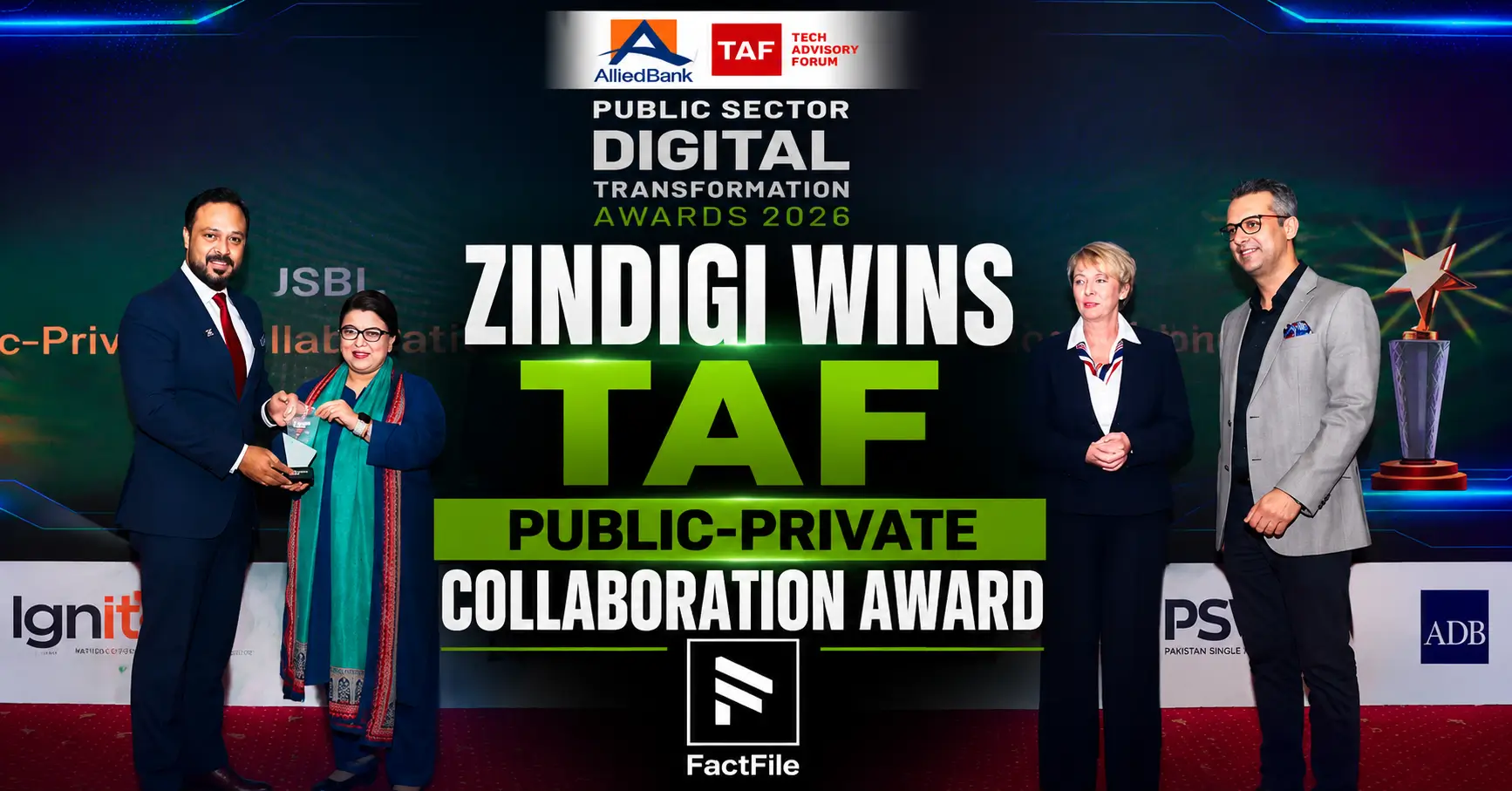

Zindigi, the digital banking platform powered by JS Bank, has picked up one of Pakistan’s most closely watched tech honours. The Zindigi TAF Public-Private Collaboration Award was announced this week by the Tech Advisory Forum (TAF) Pakistan, and it lands at a moment when the country’s public sector is under real pressure to prove its digital push is more than slogans.
The timing matters. This win comes in the same stretch that TAF, alongside Allied Bank Limited, Ignite, the National Technology Fund and Pakistan Single Window, hosted the inaugural TAF-ABL Public Sector Digital Transformation Awards 2026 — a signal that Islamabad’s digital governance agenda is being scrutinised, and rewarded, more publicly than before.
Zindigi Clinches TAF’s Public-Private Collaboration Award

Zindigi recognition specifically honours collaboration between a private fintech platform and multiple government institutions, rather than a single flashy product launch. That distinction is the whole point of the category, and it’s why the win carries weight beyond a routine corporate press release.
- Award: Public-Private Collaboration of the Year
- Presented by: Tech Advisory Forum (TAF) Pakistan
- Recipient: Zindigi, powered by JS Bank
- Announced: late July 2026
What the Public-Private Collaboration Award Actually Recognises
TAF doesn’t hand this category to whoever spends the most on marketing. Judges look at organisations that demonstrably modernise public services, foster innovation, and produce measurable citizen impact — not just internal efficiency gains that never reach ordinary users.
READ MORE: AutoSoft Dynamics Punjab Provincial Cooperative Bank Deal
That framing explains why Zindigi’s pitch leaned on government-facing projects rather than consumer app features. Digitising a parking payment or a Sunday bazaar transaction is unglamorous work, but it is exactly the kind of visible, everyday friction TAF’s award criteria are built to reward.
Zindigi’s Government Partnerships Behind the Win

The core of Zindigi’s case rested on three institutional partnerships that most ordinary account holders never see documented in one place. Each involved a different layer of government — federal regulatory, capital-territory administrative, and municipal.
- State Bank of Pakistan (SBP) — regulatory and payments-infrastructure collaboration
- Capital Development Authority (CDA) — Islamabad-based public service digitisation
- Metropolitan Corporation Islamabad (MCI) — municipal payment and revenue systems
Stitching together a central bank, a capital authority, and a city corporation under one fintech rail is unusual for Pakistan, where public agencies have historically run separate, incompatible payment systems.
From Smart Parking to Digital Cattle Markets
The Zindigi TAF Public-Private Collaboration Award citation pointed to a specific run of pilot-to-scale projects rather than a general innovation narrative. Each one targeted a cash-heavy, friction-prone corner of public life that had resisted digitisation for years.
Two things stand out here. First, the spread across sectors — travel, retail, agriculture, municipal services — suggests deliberate breadth rather than a single showcase project. Second, Raast QR acceptance sits underneath nearly all of it, tying Zindigi’s rollout to the central bank’s own instant-payment rail rather than a proprietary alternative.
Leadership Reaction From Zindigi
Mohsin Khan, Head of Merchant Channel & Retail Sales at Zindigi, framed the win around outcomes rather than technology for its own sake. His comment leaned on a familiar but pointed idea in Pakistan’s fintech sector: adoption only matters if it actually simplifies someone’s day.
“True digital transformation is measured by the lives we make simpler,” Khan said, adding that Zindigi designs initiatives to be seamless and inclusive. He described the recognition as motivation to keep building solutions that support a more connected Digital Pakistan.
A Bigger Moment: TAF’s 2026 Digital Transformation Push

This award didn’t happen in isolation. TAF and Allied Bank Limited ran the first-ever TAF-ABL Public Sector Digital Transformation Awards 2026 around the same period, bringing together government officials, technology firms, and development partners to assess how far Pakistan’s public-sector digitisation has actually progressed.
At that event, Federal Minister Shaza Fatima Khawaja was named Digital Visionary of the Year for her work on the Digital Nation Pakistan initiative and the national AI policy. She told attendees that digital transformation is no longer a purely technical agenda — it’s now treated as a development imperative tied to government efficiency and economic growth. That statement gives Zindigi’s win useful context: it’s arriving inside a broader, government-endorsed push, not a standalone corporate milestone.
What the Award Signals for Pakistan’s Digital Governance
For Factfile.pk’s international readership, the more interesting question isn’t the trophy itself — it’s whether these public-private projects survive past their pilot phase. Pakistan has seen digitisation initiatives launch with fanfare before, only to stall once the press cycle moves on.
A few implications are worth watching:
- Raast QR acceptance keeps expanding beyond flagship pilots into everyday small-vendor transactions
- Pakistani banks and fintechs replicate the multi-agency partnership model rather than building isolated systems
- Whether municipal bodies like CDA and MCI treat this as a template for other cities, or a one-off Islamabad showcase
None of that is guaranteed by an award. But the fact that TAF is now running dedicated public-sector transformation ceremonies, and that a fintech platform rather than a government department is the one being credited for citizen-facing results, says something about where the pressure to deliver currently sits.