


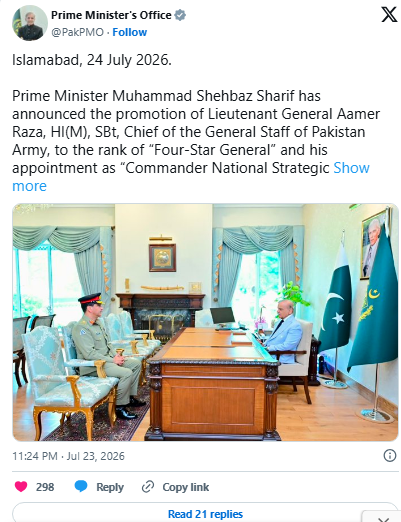
Commander National Strategic Command Gen Aamer Raza has officially taken charge, appointed by Prime Minister Shehbaz Sharif in a major reshuffle of Pakistan’s top military hierarchy. He was previously serving as Chief of the General Staff of the Pakistan Army.
The announcement came directly from the PM Office, confirming both a rank promotion and a brand-new command assignment in a single move.
PM Office Statement: What Was Announced

Commander National Strategic Command appointment was confirmed through an official PM Office statement, which said the premier promoted Gen Aamer Raza from Lieutenant General’s rank to the rank of “Four-Star General,” simultaneously appointing him to the post.
The statement added directly: “The prime minister congratulated Gen Aamer Raza, HI(M), SBt on his promotion and appointment wishing him the best for undertaking this important responsibility.”
Who Is Gen Aamer Raza?

Before this appointment, Gen Aamer Raza held the post of Chief of the General Staff of the Pakistan Army — one of the most senior staff positions at GHQ Rawalpindi, overseeing operational planning.
- Commissioned into the Pakistan Army’s 6th Lancers in 1988
- Commanded IV Corps in Lahore
- Chaired Heavy Industries Taxila
- Educated at Command and Staff College Quetta and NDU Islamabad
The Legal Basis: 2025 Amendment Bills
The new title was established after the Pakistan Army, Air Force, and Navy (Amendment) Bills 2025 were passed by parliament, restructuring how Pakistan’s top military posts function.
READ MORE: Pakistan Raises Kashmir Issue at UN Security Council
Under the same legislation, Field Marshal Asim Munir was also made the Chief of Defence Forces — placing both new top posts in place through one single piece of law.
What Is the National Strategic Command?
The National Strategic Command is a brand-new post created specifically to oversee Pakistan’s most sensitive defence assets. Gen Aamer Raza becomes its very first holder.
- Oversees strategic assets and nuclear-related coordination
- Reports within the new chain of command headed by the Chief of Defence Forces
- Replaces functions previously spread across separate service commands
- Created for a defined tenure rather than open-ended service
End of the CJCSC Post
The Commander of the National Strategic Command post was created after the abolishment of the Chairman Joint Chiefs of Staff Committee (CJCSC), a position that had coordinated all three services for decades.
General Shamshad Mirza was the last officer to hold the CJCSC position before it was formally discontinued under the new legal framework introduced this year.
How the Appointment Works
The law states that the prime minister may appoint the commander from among serving Pakistan Army generals for a three-year term, based on the recommendation of the Chief of the Army Staff–Chief of Defence Forces.
- Appointee must be a serving Pakistan Army general
- Term fixed at three years
- Recommendation required from the COAS–CDF
- Final appointment decision rests with the prime minister
Old System vs New System
Feature | CJCSC (Old) | CNSC (New) |
|---|---|---|
| Last/First holder | Gen Shamshad Mirza | Gen Aamer Raza |
| Legal basis | Earlier Army Act provisions | Army, Air Force, Navy (Amendment) Bills 2025 |
| Term length | Not fixed at three years | Fixed three-year term |
| Appointing authority | PM, per prior rules | PM, on COAS–CDF recommendation |
| Related post created | — | Chief of Defence Forces (Asim Munir) |
Why This Appointment Matters
Commander National Strategic Command now sits at the center of Pakistan’s most sensitive security decisions. Placing a career staff officer with corps command experience in this seat signals continuity, not disruption.
The broader restructuring — CDF, CNSC, mandatory VCOAS — reflects an institutional attempt to formalize command lines that were previously less clearly defined, particularly around strategic and nuclear coordination.