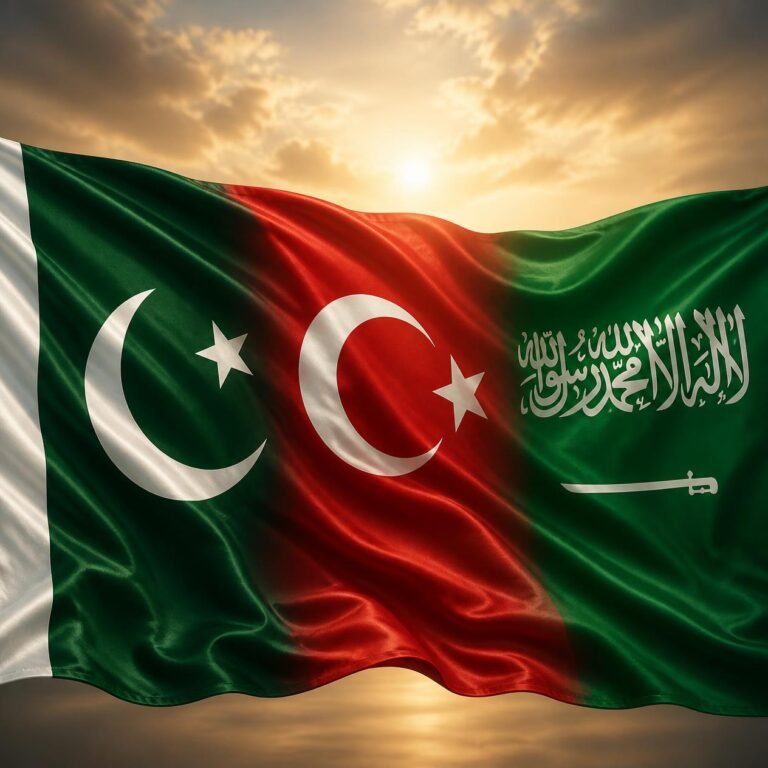

Saudi Pakistan Turkey Alliance looks to change the regional dynamics in the Middle East. On August 7th 2026, in the holy city of Mecca, Saudi Crown Prince Mohammed bin Salman, Turkish President Recep Tayyip Erdoğan, and Pakistani Prime Minister Shehbaz Sharif along with Field Marshal Asim Munir met to sign an agreement that quietly flipped the script on regional security. At first glance, the Mecca Joint Defense Agreement looks like a standard diplomatic handshake. But inside the document is a bold NATO style promise that states that an armed attack on any one of these three nations will be treated as an attack on them all.
This statement holds a lot of power to its self, it clearly warns the enemy to think a hundred times before starting a conflict, because the after effects could cause great trouble for the enemy as it would have to fight all three at once. All these three countries are the leading Muslim states and have a great alliance because each country has its own individual strengths and when all three nations combine together they create a self-sustaining defense umbrella that they can control entirely.
The Mecca Pact: When Three Neighbors Decided to Build Their Own Shield
By bringing together oil rich Saudi Arabia, nuclear armed Pakistan, and NATO member Turkey, these three nations made sure that if any aggressor ever wants to attack them, they pay a heavy price because each one of these would show the enemy a side they have never seen before with their collective efforts as a whole.
By linking the Saudi wealth, Turkish technology and Pakistani military power, the three nations created a self-sustaining security triangle. The Mecca Joint Defense Agreement is not about starting trouble or building an aggressive alliance but it is a clear signal to the rest of the world that they are not waiting for outside powers to protect them; they now have the tools, the money, and the manpower to handle it themselves. It is about self-reliance and independence.
What Led to the Need of the Mecca Pact?
The Mecca Pact has a very strong and clear motive which is to protect and support each other. It was made out of a simple realization that if you want a security umbrella you can actually trust, you have to build it yourself. For almost a century, keeping the peace in West and South Asia meant relying on different superpowers and advanced technology. The Middle Eastern states spent billions buying Western jets, hosting foreign bases, and depended on diplomatic guarantees from Washington or European capitals during crisis. But recent years made it very clear that how unpredictable those safety nets could be.
The West and especially the US always supported the gulf countries GCC including Qatar, Bahrain, Oman, Kuwait, UAE and Saudi Arabia and had made military bases in these countries. The Gulf countries are rich in resources like oil and the US has great technology, so these countries collaborated and worked together.
Despite gaining no technological advancement this reliance did little to build technological autonomy. Before the Islamic revolution of Islam Iran was a strategic ally of the America. But after the Islamic revolution of 1979 the American interest was shaken into pieces, so the Americans built new partners in the gulf countries and made them fear the Iranian revolution.
Iran never entered the GCC it was Israel and the US who suppress the neighboring Islamic countries of their rights. When the US and Iran conflict started, the Iranian government attacked the GCC countries but they did not target the civilians they targeted the US bases. When the whole world saw the behavior of the US assists and militants the way they left, hid and scattered in the towns with the civilians, the US state was later questioned that who was there to protect them at that point? The Iran war tore off the falsely made blanket of the US led security dilemma. So in current Saudi Arabia, Turkey and Pakistan made this alliance not against any country but against this aggression.
The Power Triangle: How the Saudi-Pakistan-Turkey Alliance Strengthens Regional Security
“An attack on any of these three nations will be treated as an attack on them all,” this statement holds great power and it shows the depth of the Mecca Agreement pact that how deep and connected the nations are. The biggest rule of their agreement is collective defense which clearly is a signal for the enemy to think before attacking because now it has to fight against all three at once. The power triangle just serves as a triangle; each side is equal and important. What makes this pact so interesting is not just the promise to help each other out it is how perfectly their individual strengths patch up each other’s weak spots. Acting alone each country might have a blind spot. Working together, those gaps practically disappear. Let us dive into the strengths of each country:
Saudi Arabia: The Financial Engine
Saudi Arabia spends tens of billions of dollars on defense every single year and sits on incredible energy wealth. Despite buying some of the most sophisticated military hardware on the market, it discovered that all the money in the world won’t protect your oil fields if foreign suppliers decide to stall interceptor deliveries during a crisis because it lacks willfully strong security confidence. So with the help of Turkey’s technology and Pakistan’s strong military Saudi Arabia can overcome this issue. Saudi Arabia would be the financial engine having a lot of wealth it would help fund the industrial plants and manufacturing infrastructure in building advanced technology.
Turkey: The Tech Producer
Over the last fifteen years, Turkey built one of the most impressively independent defense industries in the world. From the famous Bayraktar combat drones and stealth frigates to home grown air defense networks. Turkish engineers know how to build modern warfare tools from scratch they can provide the engineering blueprints, software, and advanced sensors. What Turkey’s defense factories constantly need is reliable long term capital to scale up production and fund their next generation of research and with the help of Saudi Arabia Turkey can continue such projects.
Pakistan: The Battle-Hardened Shield
Despite the fact that Pakistan faces a lot of economic challenges but having a nuclear program and being the first and only Muslim Nuclear state has always got key importance. Pakistan brings raw, tested military power to the table. With over 600,000 active troops, world class fighter pilots, and decades of experience fighting in harsh mountain terrains and counter operations it is a challenge in the battlefield. On top of that, as the only nuclear-armed nation in the Muslim world, Pakistan gives the alliance a level of strategic weight that makes any major adversary pause. Pakistan already has an experience of facing its enemy in the battlefield and then winning incredibly. It can handle heavy assembly, field testing, and real-world tactical feedback.
How Would This Actually Change Things on the Ground
There are certain changes which we will see once we get into the implementation of this historical alliance. Some of them will include:
Creates a Clear Do Not Attack Deterrent
The headline feature of the agreement is collective protection. In the past, a hostile group or neighboring rival might have thought about launching a strike against a Saudi oil facility or a Pakistani border outpost, assuming the fight would stay isolated. Now, things have got changed completely, hitting a target in one country means risking a response from all three. An aggressor now has to worry about Turkish drone fleets, Pakistani combat units, and Saudi financial backing showing up at the same time. That collective risk would make the world think before doing any mistake.
Building Weapons at Home
When tensions flare up, relying on outside powers for spare parts or permission to use your own weapons is not an easy task. The Mecca treaty addresses this by setting up joint manufacturing hubs across all three member countries. Instead of ordering finished hardware from abroad this treaty assigned each country its duty just like Turkey would provide the engineering blueprints, software, and advanced sensors, while Saudi Arabia would fund the industrial plants and manufacturing infrastructure and Pakistan would handle heavy assembly, field testing, and real world tactical feedback. By doing so, these nations can manufacture their own precision ammunition, drone parts, and armored vehicles locally. This would ensure that their supply lines stay open no matter what happens on the global political stage.
Keeping the Waterways Safe
A huge part of global trade and crude oil moves through the sea lanes right in these countries specifically the Red Sea, the Bab al-Mandab Strait, and the northern Arabian Sea. When these waters get chaotic, global shipping costs skyrocket and energy markets panic. By coordinating naval patrols, sharing radar data, and running joint air defense operations across these sea corridors, the alliance helps keep international trade moving smoothly. This way all the three countries could easily do trade without any interference.
Sharing Secrets in Real Time
Modern defense is about information speed. A permanent coordination secretariat based in Riyadh now connects military intelligence networks from all three capitals. If Turkish satellites or Pakistani radar stations detect an incoming threat early on, that data flows straight to Saudi air defense batteries in real time. They are also pooling their cyber defense experts to guard critical public systems like power grids, water desalination plants, and refineries from state sponsored hacking. This is a really important benefit as it would strengthen the relations of all three more deeply.
Strategic Implications
If we look at this treaty strategically it would benefit all of the three nations one way or another. Saudi Arabia would gain immediate operational depth and extra protection against state and non-state threats, lowering operational reliance on single external powers. Pakistan would solidify its geopolitical standing as a strong security anchor in the Islamic world, securing critical diplomatic and financial backing. Turkey would expand its strategic footprint into the Gulf and West Asia getting reliable markets for its defense export sector.