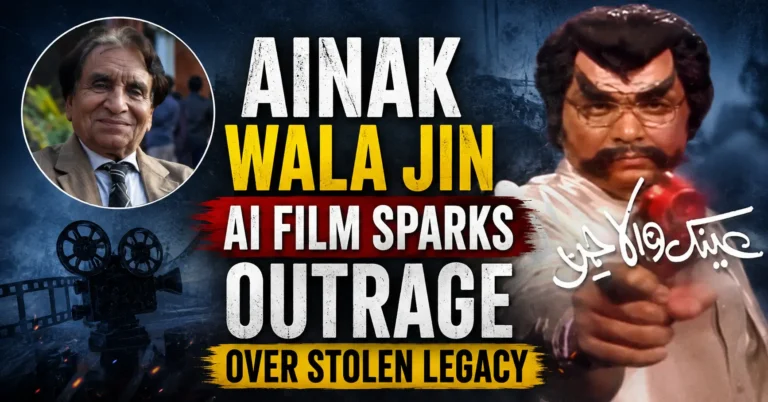

The Ainak Wala Jin AI film was supposed to be a nostalgic comeback. Instead, it has turned into one of Pakistan’s sharpest debates yet over who owns a creative legacy once artificial intelligence gets involved.
What Sparked the Ainak Wala Jin AI Film Controversy
Billed on IMDB as Asia’s first fully AI-generated feature film, the movie opened in cinemas nationwide on Friday, July 24, 2026, and quickly ignited a debate that had little to do with genies and everything to do with authorship. The backlash arrived within days of release.
Fans first flagged the trailer, noticing visuals that looked rushed and unfinished, with some viewers even claiming they had spotted a Google Gemini watermark in one scene. That early skepticism set the stage for a much bigger fallout once the original creator spoke publicly.
Hafeez Tahir’s Reaction to the Unauthorized AI Adaptation

Veteran writer-director Hafeez Tahir, the man behind the original 1993 series, posted a video calling the project “daylight robbery,” insisting the concept, title, and story were entirely his own creative property. He said neither the film’s director nor PTV consulted him.
Tahir did not hold back on the execution either. He said his lead character “looks like a dacoit” in the new version, and claimed the studio handed the project to a novice and made a mess of his iconic idea. Key concerns he raised:
- Character redesigns he says distort the original visual identity
- AI-generated voice work replacing the show’s original cast tone
- AI-composed music he called below acceptable quality
- No consultation or credit extended to him before release
He closed his statement by publicly asking followers whether he should “just wail about it and remain silent or take the legal route,” leaving the door open to a lawsuit.
Inside the Making of Pakistan’s First AI-Generated Feature Film

The Ainak Wala Jin AI film comes from filmmaker Farhan Khan, a Punjab University alumnus working as a filmmaker, journalist and writer, produced by Faisal Saleem in collaboration with the PTV Network. Khan has defended his authorship in interviews.
READ MORE: Nazish Jahangir Goes Viral for Witty Reply About Babar Azam
According to reporting on the production, Khan has said in several morning show interviews that he wrote the story himself, though critics reviewing the trailer footage argue the narrative bones feel borrowed from elsewhere despite original dialogue. The plot follows a strict household, an old jinn neighbor, and a portal into a magical realm.
Original Series vs AI Film: A Side-by-Side Comparison
Understanding the outrage requires knowing what exactly is being compared. The table below lays out the core differences between Tahir’s original production and the new AI adaptation drawing criticism online.
| Detail | Original Series (1993) | AI Film (2026) |
|---|---|---|
| Creator/Director | Hafeez Tahir, written by Abdul Hameed | Farhan Khan |
| Network | PTV One, broadcast 1993–2008 | Cinemas, via PTV Network |
| Format | Two seasons, 152 and 90 episodes | 85-minute feature film |
| Lead character | Nastoor Jin, played by Shahzad Qaiser | AI-generated visual redesign |
| Consent for reuse | Original creator, not consulted | No agreement reported |
Beyond specs, the emotional weight is what fuels this story. Tahir noted the original still “makes millions” for PTV on YouTube decades later, arguing that a profitable legacy was reused without compensating its architect.
Copyright and Intellectual Property Concerns in Pakistan’s Film Industry
The Ainak Wala Jin AI film dispute has reignited a broader conversation about how weakly creator rights are enforced across Pakistan’s television and film sector. Industry peers have publicly urged Tahir toward formal channels rather than social media alone.
Actor Omair Rana advised Tahir to take legal action and bring the case before the Actors Collective of Trust. Artist and critic Maryam Zahid went further, arguing on Instagram that generative AI work inherently borrows from existing creators, writing that “AI is and will always be plagiarism” and questioning the environmental cost of the technology behind it.
What This Means for Pakistani Creators and the Future of AI in Entertainment

This case is unlikely to be the last of its kind. As studios and independent filmmakers experiment with generative tools to revive old intellectual property cheaply, disputes over consent, credit, and compensation are expected to multiply across South Asian media markets.
For now, the practical questions remain unresolved. Key issues still hanging over the industry include:
- Pakistan’s copyright framework adequately covers AI-remixed derivative works
- Who holds enforceable rights when a state broadcaster co-produces a private AI project
- How audiences should weigh nostalgia against consent when classics get revived
- PTV will issue a formal response to Tahir’s public allegations
Tahir’s supporters argue his case could become a reference point for future disputes, especially as more Pakistani studios turn to AI tools to cut production costs. It ends in a lawsuit, a settlement, or silence, the Ainak Wala Jin AI film row has already forced an industry-wide reckoning that was arguably overdue.