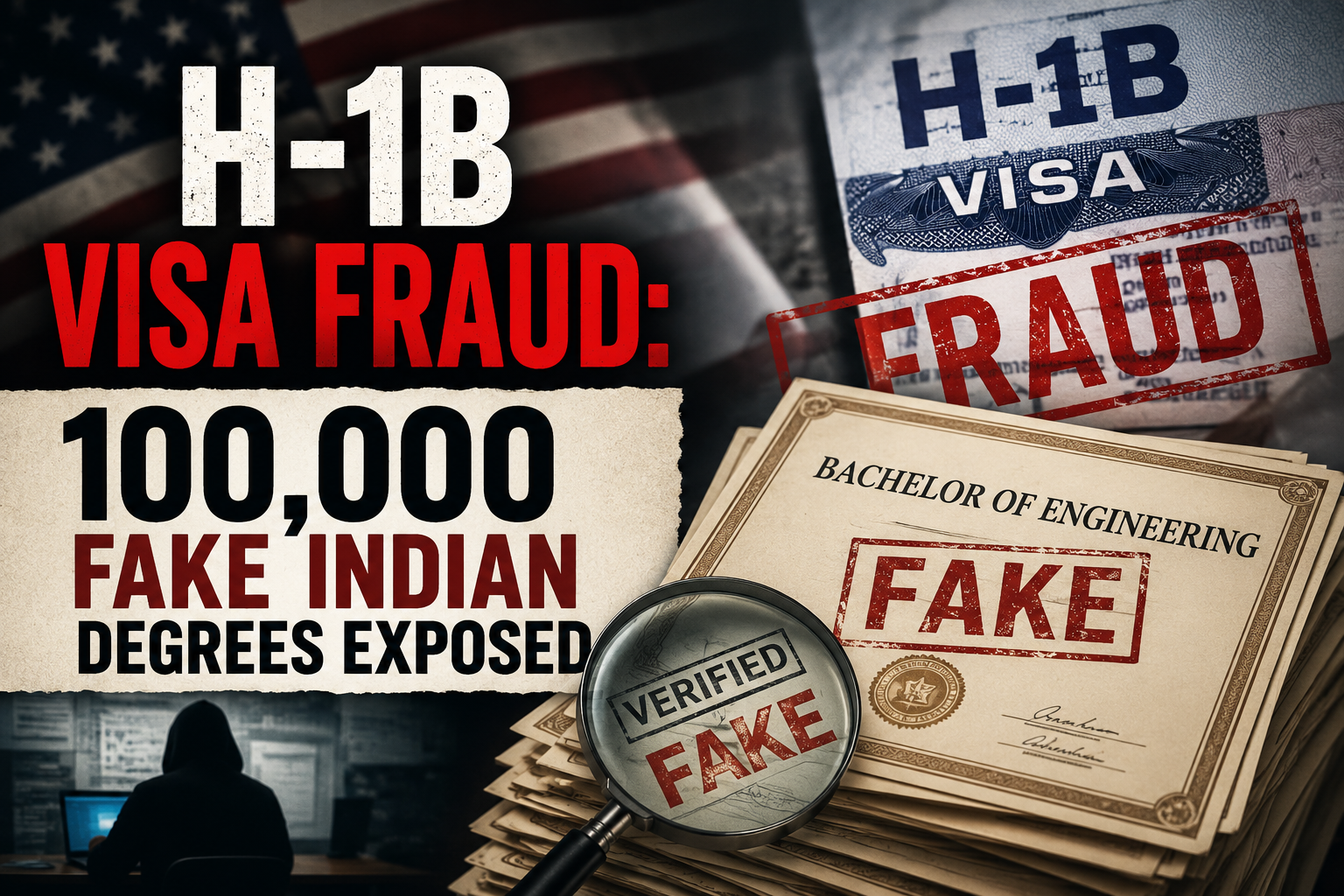
H-1B Visa Fraud: How 100,000 Fake Indian Degrees Gamed the US System
A sweeping law enforcement operation in India has blown open one of the most alarming credential fraud schemes ever linked to America’s H-1B skilled worker visa programme — and the scale of the damage is still being counted.
Kerala Police dismantled a large-scale, pan-India racket involved in manufacturing and distributing forged university degree certificates, including fake foreign qualifications, in what investigators are calling one of the most extensive education fraud networks uncovered in recent years. The investigation has since sparked urgent questions in Washington about how thoroughly the US immigration system actually vets the credentials it relies on.
A Criminal Enterprise Hiding in Plain Sight
During the investigation, officials seized more than one lakh — roughly 100,000 — counterfeit certificates linked to 22 universities. Investigators believe the syndicate may have circulated over ten lakh fake degrees over the years.
The Ponnani police in Malappuram district began investigating last October after receiving intelligence that a resident named Irshad was producing fake university certificates for people planning to go abroad. What started as a tip about one man’s operation unravelled into a national network spanning multiple states, industries, and international borders.
The operation was centred in Malappuram district and involved clandestine printing presses in Pollachi, Tamil Nadu, utilising skilled workers from Sivakasi to replicate holograms, seals, and signatures, before routing certificates through Bengaluru for distribution via agents in multiple states including Kerala, Tamil Nadu, Karnataka, Andhra Pradesh, Maharashtra, Goa, Delhi, and West Bengal.
This wasn’t a backroom photocopier job. It was organised crime with a supply chain.
The Price of a Stolen Career
The racket specialised in forging medical, nursing, engineering, and postgraduate degrees. These fake certificates were allegedly sold for amounts ranging from ₹75,000 to ₹1.5 lakh. At current exchange rates, that puts the cost of a counterfeit degree at roughly £700 to £1,400 — a modest sum compared to the six-figure salaries an H-1B placement in the United States can unlock.
A fraudulent degree costs as little as $1,400 — a fraction of the salary premium an H-1B job commands. The maths made the fraud almost inevitable. For anyone determined to deceive, the financial upside far outweighed the risk.
Police said the certificates were designed to closely resemble genuine documents, complete with authentic-looking logos, holograms, and forged signatures. Employers and consular officers were, in many cases, simply not equipped to spot the difference.
How the Fraud Fed Into H-1B Applications
The H-1B visa is the primary route through which US companies hire foreign nationals for speciality roles in technology, medicine, and engineering. Under US immigration law, an H-1B “specialty occupation” requires a US bachelor’s degree or its foreign equivalent. A counterfeit degree doesn’t just pad a résumé — it fabricates the legal basis of the visa itself, invalidating the petition USCIS approved and the Labour Condition Application the employer certified.
Authorities suspect that many buyers used the forged qualifications to secure jobs, gain admission into educational institutions, and obtain visas for foreign countries, including the United States, the United Kingdom, several European nations, and the UAE. The US connection was not incidental. It was, for many buyers, the entire point.
One University, 36,000 Fake Degrees
Beyond the Kerala-centred operation, investigators also spotlighted a separate but related case involving Manav Bharti University in Himachal Pradesh. A 2021 report said investigators found the university sold about 36,000 bogus degrees for as little as $1,362 each. That single institution — out of the 28 universities now implicated across various investigations — produced enough fraudulent credentials to fill a mid-sized town’s entire educated workforce.
Indian police have identified a network spanning at least 28 universities, with fake certificates and seals recovered across the medical, nursing, and engineering fields. The breadth of involvement across institutions suggests this was not an isolated rogue operation — it was a market with buyers, sellers, and repeat customers.
Former US Diplomat: “The Fraud Was Systematic”
The Indian police raids did not happen in a vacuum. Alarm bells had already been ringing inside the US diplomatic system for years.
Mahvash Siddiqui, who worked as a consular officer at the US Consulate in Chennai from 2005 to 2007, alleged that between 80 and 90 per cent of H-1B visa applications from India involved fraudulent documentation or unqualified applicants.
Siddiqui described widespread use of forged documents, including degrees, property papers, marriage certificates, fake transcripts, and fake bank statements. She said that certain districts, notably around Hyderabad, were hubs for visa consultancy shops that allegedly sold fraudulent credentials and trained applicants to pass the visa issuance process.
Her account goes further. She claims consular officers who tried to raise alarms and deny suspicious applications were pressured by political interventions and orders from above, rendering many anti-fraud efforts ineffective. “The fraud unit was considered a rogue operation because we were caring for America’s first interests,” Siddiqui said.
These are serious allegations — ones that, if accurate, suggest the H-1B credential fraud problem was known, flagged, and quietly buried.
Washington Responds: Investigations, Bills, and Project Firewall
The latest India raids have given renewed momentum to US enforcement efforts that were already quietly gathering pace.
- Texas Attorney General Ken Paxton launched a separate probe into 30 “ghost office” companies in January 2026 — companies that faked business addresses to sponsor foreign workers.
- The US Department of Labour opened 175 H-1B investigations in September 2025 through “Project Firewall.”
- USCIS also expanded probes targeting lottery gaming and fake employers.
- Texas Representative Chip Roy introduced the American White-Collar Worker Jobs Act of 2026, a bill aimed at overhauling the H-1B visa programme.
Taken together, these moves signal that Washington is no longer treating H-1B fraud as a peripheral compliance issue. It is being treated as a systemic threat.
The Real-World Stakes: Safety, Not Just Jobs
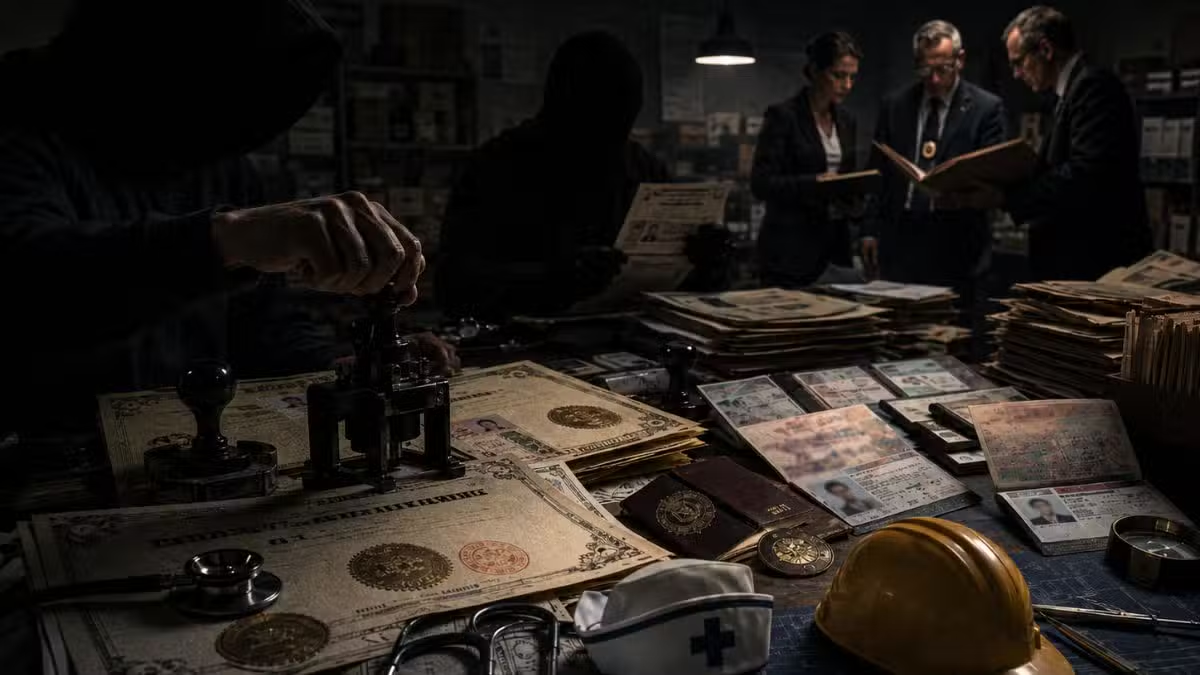
Critics of the H-1B programme often frame the debate around job displacement — qualified American workers losing opportunities to cheaper foreign labour. That concern is legitimate. But the fake degree scandal raises a separate, arguably more urgent question: what happens when an unqualified person holds a medical or engineering licence they didn’t earn?
This creates safety risks, especially in medical and engineering fields. Employers hire people who lack actual skills. A forged nursing certificate or a counterfeit engineering degree doesn’t just cheat a hiring manager. It puts patients, colleagues, and the public at risk.
The consequences of credential fraud are not abstract. They are structural — and in high-stakes professions, potentially fatal.
Key Facts
| Detail | Figure |
|---|---|
| Fake certificates seized | 100,000+ |
| Universities implicated | 22–28 |
| Estimated total in circulation | Over 1 million |
| Cost per fake degree | £700–£1,400 (~$1,400) |
| Fields targeted | Medicine, nursing, engineering |
| Suspects arrested (Kerala operation) | 11 |
| H-1B investigations opened (2025) | 175 (Project Firewall) |
Key Takeaways
- Indian police dismantled a multi-state fake degree network that supplied forged credentials used in H-1B visa applications
- Over 100,000 counterfeit certificates from 22 universities were seized; investigators believe over one million may have been distributed
- Degrees in medicine, nursing, and engineering were most commonly forged — the exact fields that qualify workers for the US skilled visa system
- A former US diplomat has separately alleged that up to 90% of H-1B applications from India contained fraudulent information
- US authorities have launched multiple parallel investigations, including Project Firewall and the Texas ghost-office probe
- Legislation to overhaul the H-1B programme is now moving in Congress
People Also Ask
How many fake degrees were seized in the India H-1B fraud bust?
Indian law enforcement seized over 100,000 counterfeit certificates across multiple raids. Investigators estimate the network may have distributed more than one million fake degrees in total.
How much did a fake degree cost in the H-1B fraud scheme?
Fraudulent university certificates were reportedly sold for between ₹75,000 and ₹1.5 lakh — roughly $900 to $1,400 — a fraction of the earning potential an H-1B job placement unlocks.
Which fields were most affected by H-1B visa fraud fake degrees?
Forged credentials concentrated heavily in medicine, nursing, and engineering — precisely the speciality occupations that qualify for H-1B status under US immigration law.
What is the US government doing about H-1B credential fraud?
The US Department of Labour launched 175 investigations under “Project Firewall” in 2025. USCIS expanded probes into fake employers and lottery gaming. Texas separately investigated 30 ghost-office companies, and new legislation to reform the H-1B system has been introduced in Congress.
Is using a fake degree for a US visa illegal? Yes. Submitting forged credentials to obtain an H-1B visa constitutes visa fraud under US law, carrying penalties of up to ten years imprisonment, deportation, and permanent bars on re-entry.
What Comes Next
US officials will likely increase visa scrutiny in the wake of these revelations — and pressure on USCIS to implement mandatory third-party credential verification is mounting from both political parties. The Indian government, meanwhile, faces difficult questions about why institutions within its higher education system became factories for fraudulent qualifications.
The H-1B programme was designed to bring genuine expertise to American companies that couldn’t source it domestically. Whether it has been delivering that — or quietly importing a credentialling crisis — is now an open question before both governments.